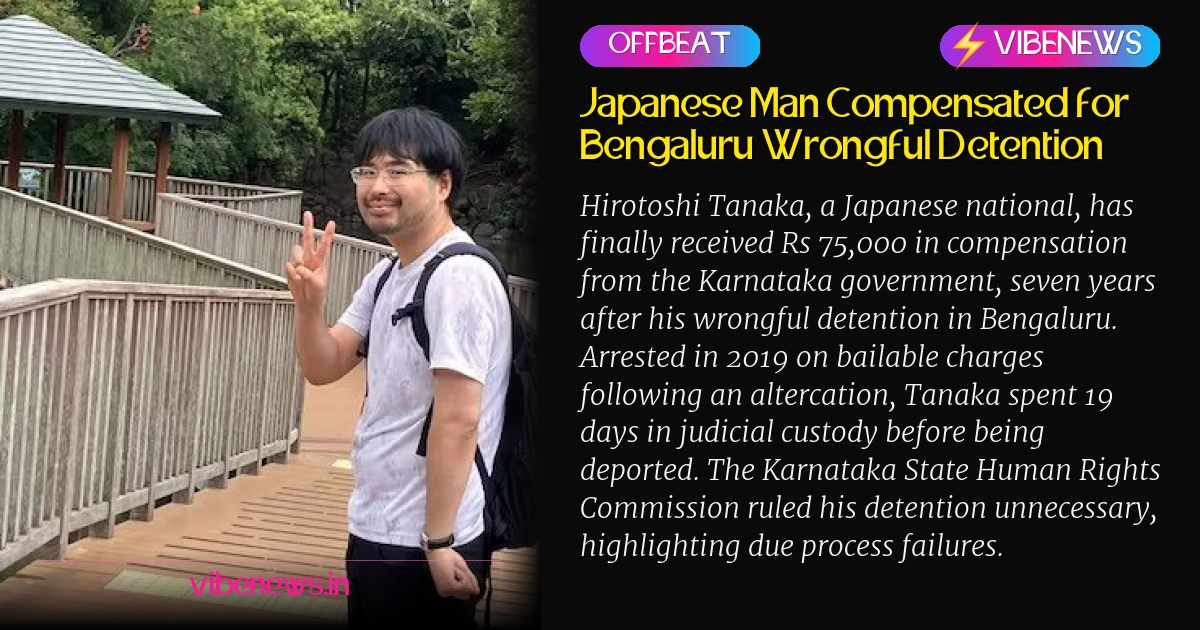
A Long-Awaited Redressal for Unjust Detention
Hirotoshi Tanaka, a Japanese national, has finally received Rs 75,000 in compensation from the Karnataka government, seven years after an ordeal involving wrongful detention in Bengaluru. The payment, confirmed by Tanaka through his legal counsel, marks the culmination of a protracted legal battle that underscored critical lapses in due process by local law enforcement.
The compensation order was issued by the Karnataka State Human Rights Commission (KSHRC) earlier this year. It came after a thorough review of Tanaka’s case, which began with his arrest in 2019 under circumstances the commission later deemed unjust.
The Unforeseen Ordeal in Bengaluru
Tanaka’s journey to Bengaluru in 2019 was driven by a desire to improve his English language skills at a private academy. However, his academic pursuit took an unexpected turn following a dispute with the institute’s director over irregular classes and alleged mismanagement.
This disagreement escalated into a physical altercation, leading to Tanaka’s arrest by Bengaluru police. He was charged under sections pertaining to bailable offenses, including criminal intimidation and voluntarily causing hurt, which typically do not warrant immediate judicial custody.
Despite the bailable nature of the charges, Tanaka was sent to Bengaluru Central Prison, where he spent 19 days. Following his release from judicial custody, he was subsequently transferred to a detention centre and eventually deported to Japan in 2021, effectively ending his stay in India under distressing circumstances.
A Seven-Year Pursuit of Justice
From Japan, Hirotoshi Tanaka initiated and diligently pursued his case with the Karnataka State Human Rights Commission. His remote legal battle highlighted the challenges faced by foreign nationals navigating unfamiliar legal systems and seeking redress for perceived injustices.
The KSHRC, after reviewing the evidence and circumstances surrounding Tanaka’s arrest and detention, concluded that his judicial custody was unnecessary. The commission’s ruling emphasized that individuals charged with bailable offenses should not be subjected to prolonged incarceration, especially when legal alternatives are available.
In its directive, the KSHRC not only ordered the Karnataka government to provide monetary compensation to Tanaka but also called for disciplinary action against the police personnel responsible for his unwarranted detention. This dual directive underscores the commission’s commitment to both victim redressal and accountability within the state’s law enforcement agencies.
The Karnataka State Human Rights Commission’s Mandate
The Karnataka State Human Rights Commission plays a crucial role in safeguarding human rights within the state. Established under the Protection of Human Rights Act, 1993, its mandate includes investigating complaints of human rights violations, recommending compensation, and advocating for reforms in laws and practices.
The commission’s intervention in Tanaka’s case exemplifies its function as an independent oversight body. Its ruling serves as a vital reminder to law enforcement agencies about the strict adherence to legal procedures, particularly concerning arrest and detention protocols for bailable offenses, which are designed to protect individual liberty.
Implications for Due Process and Police Accountability
This case brings into sharp focus the critical importance of due process and police accountability in India. The detention of an individual, especially a foreign national, on bailable charges for an extended period raises serious questions about the discretion exercised by police officers and the oversight mechanisms in place.
Such incidents can erode public trust in the justice system and potentially impact India’s image on the international stage. The KSHRC’s firm stance sends a clear message that arbitrary detention will not be condoned and that state authorities are expected to uphold the fundamental rights of all individuals, regardless of their nationality.
Editorial Context: A Precedent for Justice
The resolution of Hirotoshi Tanaka’s case is more than just a personal victory; it sets an important precedent for human rights and police accountability in Karnataka and potentially across India. It reinforces the idea that human rights commissions are not merely advisory bodies but possess the power to enforce justice and demand accountability from state actors.
This development underscores the long-term significance of robust oversight mechanisms in a democratic society. It serves as a powerful reminder that the pursuit of justice, even when remote and prolonged, can ultimately lead to redressal and contribute to strengthening the rule of law. For Vibe News, this story highlights the continuous struggle for individual liberties against potential state overreach and the enduring importance of independent judicial and quasi-judicial bodies.
TL;DR
- Hirotoshi Tanaka, a Japanese national, received Rs 75,000 compensation for wrongful detention in Bengaluru.
- He was arrested in 2019 on bailable charges after an altercation at an English academy.
- Tanaka spent 19 days in Bengaluru Central Prison despite the bailable nature of his alleged offenses.
- The Karnataka State Human Rights Commission (KSHRC) ruled his judicial custody unnecessary.
- KSHRC directed the Karnataka government to pay compensation and initiate disciplinary action against responsible police personnel.
- The compensation was routed through his Indian wife’s bank account due to transaction limitations.