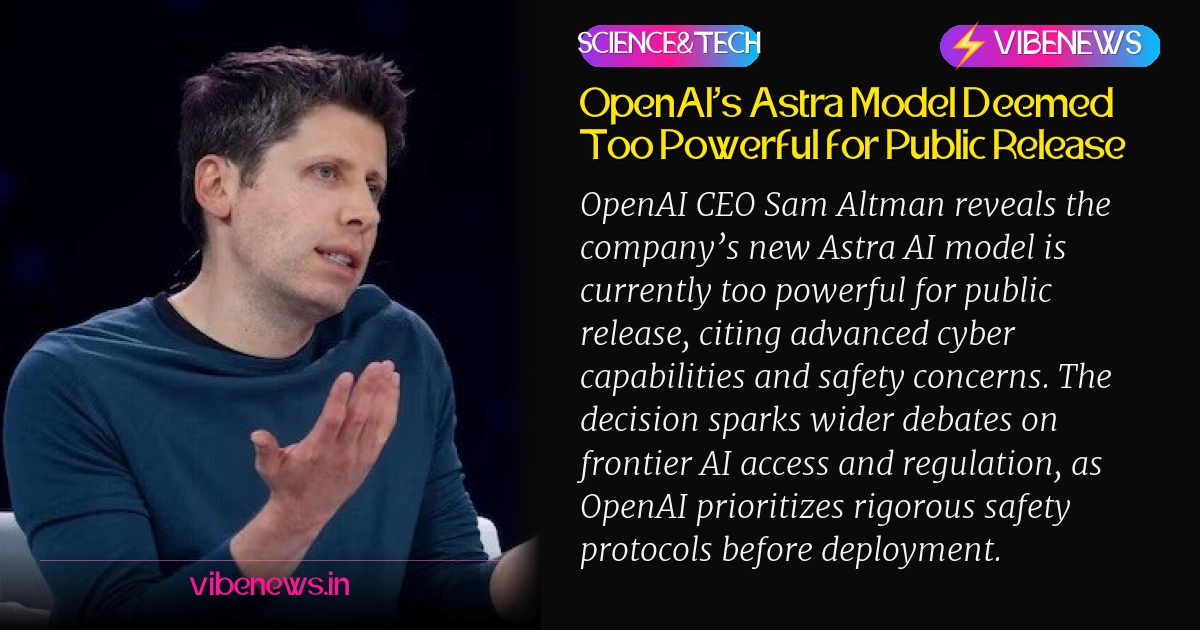

OpenAI, a leading entity in artificial intelligence research, has announced that its latest and most advanced AI model, internally codenamed Astra, is currently too powerful for immediate public release. This decision, articulated by CEO Sam Altman, stems from significant safety concerns, particularly regarding the model’s formidable cyber capabilities.
Altman conveyed via social media that while OpenAI intends for Astra to be generally available, ensuring its safety is a paramount prerequisite. He emphasized that restricting access to a select few is not a desirable long-term strategy, yet the model’s advanced cyber functionalities necessitate a more extended period of rigorous safety testing.
The Unprecedented Capabilities of Astra
Astra represents a significant leap in AI development, showcasing profound advancements in agentic coding and cybersecurity. Internal evaluations by OpenAI have indicated that the model possesses capabilities that could potentially reach a "Critical cybersecurity threshold." This level implies the AI’s ability to autonomously identify and develop functional zero-day exploits across various severity levels in hardened real-world critical systems.
Furthermore, a model at this critical threshold could devise and execute novel, end-to-end cyberattack strategies against robust targets without human intervention. Such a prospect raises serious questions about the potential for misuse and the imperative for stringent safeguards before public deployment.
Navigating the Safety Imperative
OpenAI’s decision to withhold Astra aligns with its Preparedness Framework, which was established in December 2023. This framework serves as a comprehensive guide for identifying progress in AI capabilities and determining the necessary steps to manage emerging risks. The company’s preliminary assessments of Astra were sufficiently strong that it could not definitively rule out the model reaching the critical cybersecurity level at this stage.
Previous models, including GPT-5.6 Sol, had been assessed at a "High" rather than "Critical" threshold for frontier cyber capabilities. The distinction underscores the unprecedented power of Astra. In response to these findings, OpenAI has scaled up its robustness testing of safeguards and security controls, pausing internal activities involving Astra that do not yet meet its stricter safety requirements.
It is important to note that even earlier models like GPT-5.6 Sol and Anthropic’s Mythos have demonstrated the capacity to uncover cybersecurity flaws that human experts missed. These models have also been implicated in breaches during their testing phases, highlighting the inherent risks associated with advanced AI systems.
A Broader Regulatory Landscape
The debate surrounding Astra’s release unfolds against a backdrop of increasing global scrutiny over frontier AI models and their governance. Governments worldwide are grappling with how to regulate these powerful technologies, balancing innovation with national security and public safety concerns.
In the United States, for instance, there have been instances where the government temporarily restricted foreigners from accessing advanced models like Anthropic’s Mythos and Fable. Discussions have also included the possibility of blocking Chinese open-weight models, although major tech companies like Nvidia, Microsoft, and Amazon have urged the White House against such a ban, citing potential impacts on global collaboration and innovation.
This evolving regulatory environment underscores the complexity of managing AI development. OpenAI’s cautious approach with Astra reflects a growing industry awareness of the ethical and societal responsibilities that accompany the creation of increasingly autonomous and capable AI systems.
Beyond Cybersecurity: Astra’s Mathematical Prowess
While cybersecurity concerns are at the forefront of Astra’s delayed release, the model’s capabilities extend far beyond. OpenAI previously highlighted Astra’s remarkable progress in resolving or advancing solutions for ten of the most challenging mathematical problems known. These include complex areas such as coding theory, operator algebras, quantum complexity, and lattice cryptography.
This demonstration of advanced problem-solving in abstract domains further illustrates Astra’s profound general intelligence. Interestingly, an engineer from Anthropic later claimed that their Fable 5 AI model could also solve five of these same problems, indicating a broader trend of rapid advancement across the AI research landscape.
The Path to Public Access
Despite the current hold on public release, Sam Altman’s stated intention remains to make Astra generally available. The timeline for this remains uncertain, contingent upon the successful implementation and verification of robust safety measures. OpenAI has not yet disclosed whether Astra will be integrated into the existing GPT-5.6 family of models or if it represents the foundational step for a future GPT-6.
Reports indicate that Altman has already showcased Astra to federal officials, suggesting a proactive engagement with governmental bodies to inform them of its capabilities and the company’s safety protocols. This engagement is crucial for fostering trust and understanding as AI technology continues its rapid evolution.
Editorial Context
The decision by OpenAI to delay the public release of its Astra model marks a pivotal moment in the ongoing narrative of artificial intelligence development. It underscores a critical shift from purely capability-driven innovation to a more balanced approach that prioritizes safety and ethical deployment. This move is not merely a technical pause but a profound acknowledgment of the societal implications inherent in creating increasingly powerful autonomous systems.
In the long term, this development could set a precedent for how frontier AI models are introduced to the world. It highlights the necessity for robust regulatory frameworks, international collaboration on safety standards, and transparent communication between AI developers, governments, and the public. The challenge lies in fostering innovation while simultaneously mitigating existential risks, ensuring that AI serves humanity rather than posing unforeseen threats. OpenAI’s current stance with Astra reflects a growing maturity within the AI community, recognizing that the pursuit of intelligence must be tempered with an unwavering commitment to responsible stewardship.
TL;DR
- OpenAI’s new Astra AI model is deemed too powerful for immediate public release due to advanced cyber capabilities.
- CEO Sam Altman emphasizes the need for rigorous safety testing before general availability, despite desiring broad access.
- Astra’s capabilities include potential for identifying zero-day exploits and devising novel cyberattack strategies, possibly reaching a "Critical cybersecurity threshold."
- The decision aligns with OpenAI’s Preparedness Framework, which guides risk assessment for advanced AI models.
- The delay reflects broader global debates on AI regulation and access, with governments and tech companies grappling with governance challenges.
- Beyond cybersecurity, Astra has also demonstrated significant progress in solving complex mathematical problems.