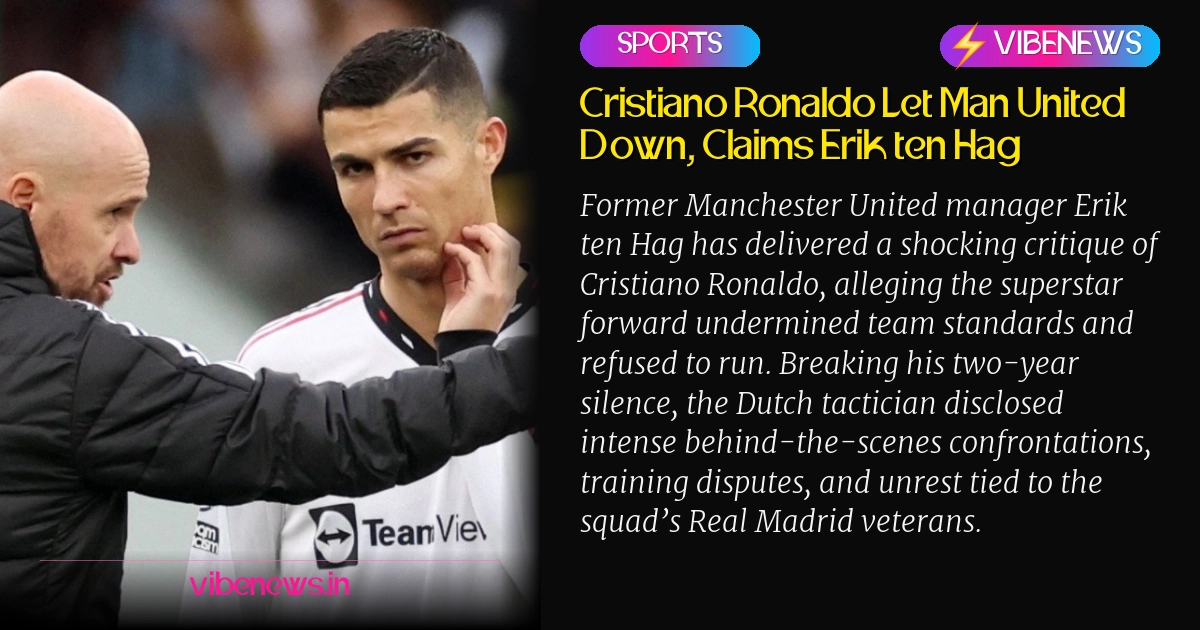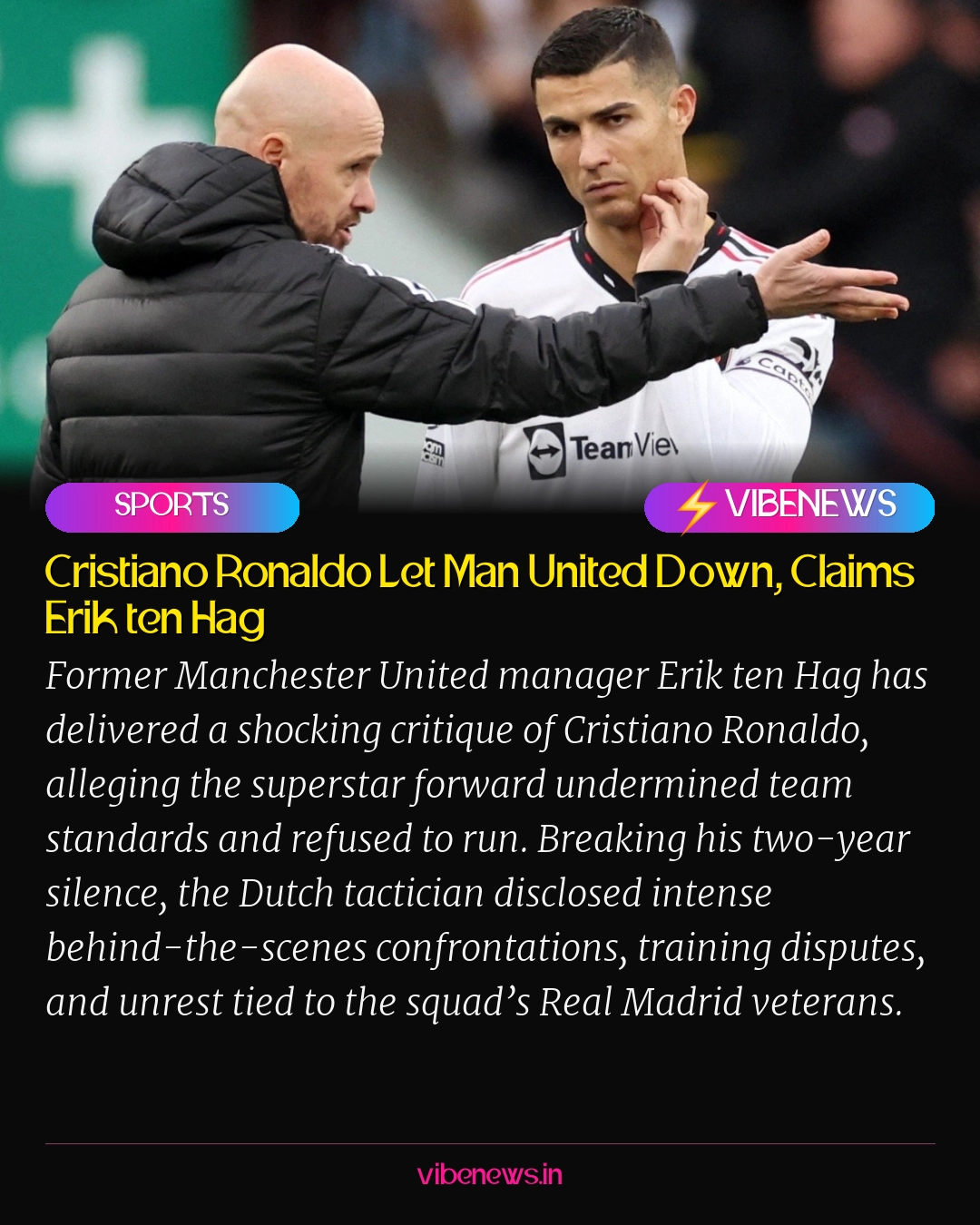

Former Manchester United manager Erik ten Hag has publicly accused Cristiano Ronaldo of letting him and the squad down, breaking a two-year silence in an interview with The Athletic published on October 20, 2026. The explosive remarks expose the intense internal warfare and power struggles that destroyed the relationship between the Dutch tactician and one of modern football’s greatest icons.
The Collision Between Managerial Authority and Player Power
The bitter deterioration of the partnership inside Old Trafford stemmed from irreconcilable differences over physical preparation, discipline, and tactical execution. Ten Hag disclosed that prior to assuming official managerial duties in Manchester, he travelled directly to Portugal to personally outline his strategic vision to Ronaldo. The Dutch manager intended to structure his attacking scheme around the veteran goalscorer, only to watch those operational plans rapidly collapse during the 2022-23 season as standard fitness protocols went unmet.
Addressing the rift head-on, Ten Hag outlined the blunt conversations that took place behind closed training doors when the forward could not fulfill basic positional demands.
“He let the team down, and he let me down, because we planned with him... He ran neither in possession nor out of possession. The reason was because he didn’t prepare himself.”
Ten Hag disputed long-standing public perceptions that his system had overburdened an aging forward with unreasonable defensive pressing. Instead, the manager revealed that Ronaldo’s underlying physical readiness prevented him from even arriving inside the penalty area to convert chances created by his teammates.
A Drastic Collapse in Output and Squad Cohesion
The sudden breakdown shocked observers because Ronaldo had dominated United’s offensive output just one season prior. Throughout the 2021-22 campaign, the Portuguese striker finished as the club’s leading scorer with 24 goals across all competitions, including 18 goals in the Premier League and six in the Champions League. Despite United’s wider collective instability at the time, his elite finishing ability had remained undisputable.
The arrival of Ten Hag radically altered that status. During the 2022-23 campaign, Ronaldo managed just three goals across 16 competitive appearances and was handed only four Premier League starts. Frustrations reached a boiling point when the forward refused to enter the pitch as a substitute against Tottenham Hotspur and departed the stadium prior to the final whistle. The simmering disciplinary crisis culminated in an explosive television interview with Piers Morgan, precipitating the abrupt termination of Ronaldo’s contract in November 2022.
Dismantling the Influence of the Madrid Hierarchy
Beyond his clashes with Ronaldo, Ten Hag pointed to a wider cultural obstacle within the dressing room, which he labelled the influence of the "Madrid connection." The manager argued that established winners recruited from Real Madrid—specifically Cristiano Ronaldo, midfield anchor Casemiro, and defender Raphael Varane—exercised a level of individual influence that conflicted directly with the club’s rebuilding mandate.
According to Ten Hag, club executives wanted to establish a dynamic, attacking philosophy built on intense collective movement, whereas the former Madrid stars possessed the authority and appetite to dictate how they operated on the pitch. The tactical friction proved impossible to bridge, with the manager asserting that backing Ronaldo’s individual preferences would have fundamentally derailed the long-term direction of Manchester United.
TL;DR
- Former manager Erik ten Hag claims Cristiano Ronaldo let Manchester United down by failing to meet basic physical preparation standards.
- Ten Hag travelled to Portugal prior to taking charge to build tactical plans around Ronaldo, which subsequently collapsed.
- Ronaldo scored only three goals in 16 appearances under Ten Hag following a 24-goal campaign the previous season.
- The Dutch manager criticised the squad’s ex-Real Madrid contingent for exerting disruptive player power over team tactics.