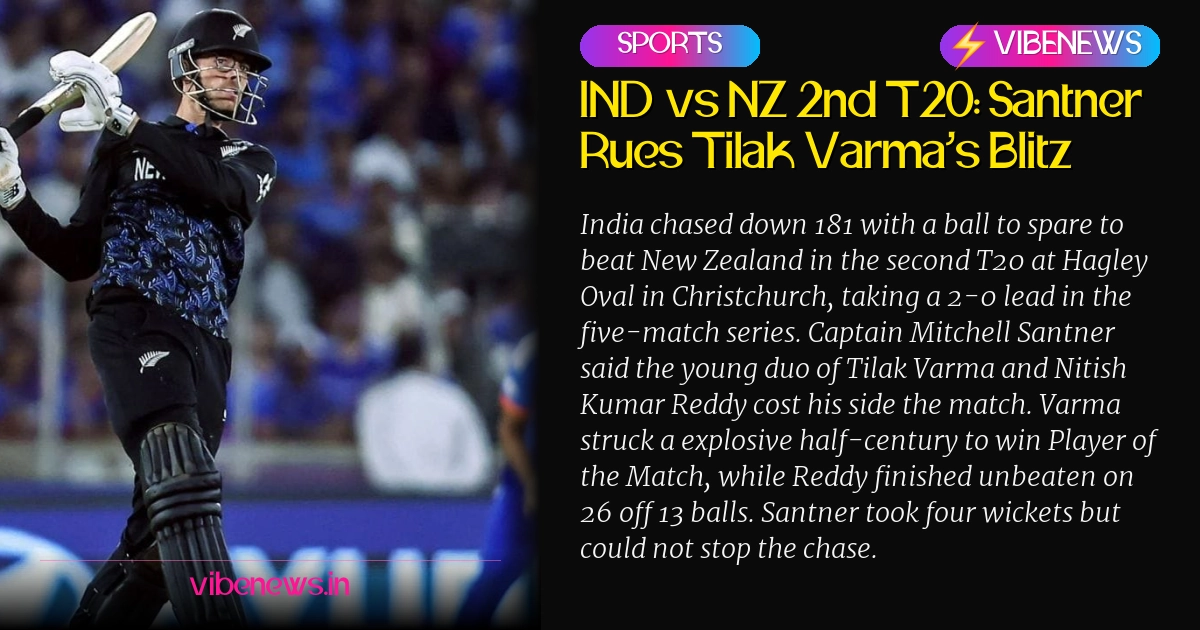

India chased down 181 with a ball to spare to beat New Zealand in the second T20 at Hagley Oval in Christchurch, moving into a 2-0 lead in the five-match series. Six wickets fell for the win, and the result leaves the hosts searching for answers after their second straight defeat in the series.
New Zealand captain Mitchell Santner did not hide his frustration. He pointed the finger at two young Indian batters, Tilak Varma and Nitish Kumar Reddy, whose performances, he said, decided the game.
How the chase slipped away
New Zealand won the toss and batted first, posting 180 for 5 in their 20 overs. India started the chase poorly and were under pressure in the early overs. Then the middle and lower order turned the contest around.
Varma’s explosive half-century earned him the Player of the Match award. Reddy was even more eye-catching in the closing stages, scoring an unbeaten 26 off just 13 balls at a strike rate of 200. Between them, they took the game away from a New Zealand side that had looked in control for long periods.
We came so close to winning and then lost it. Watching the game slip away right at the end was very disappointing.
Santner admitted that losing a tight contest hurt, but he also framed it as a natural part of playing a strong team. He praised both Varma and Reddy for batting with composure until the finish. He said that if New Zealand had taken just one wicket from the pair, the match would have ended there. Instead, both batters stayed in and carried India home.
A strategy that backfired
Santner’s comments reveal how New Zealand had prepared for this fixture. Hagley Oval is a larger ground than most venues in New Zealand, and the home side had reportedly planned around that. Playing two matches at the same venue, the thinking went, would give them a built-in advantage. Their plan to beat India twice on the same big ground did not work.
Santner said the approach ended up helping India. The visitors adjusted to the conditions quickly, and New Zealand lost both matches at the same venue. The captain’s admission carries weight because it shows his team had banked on the ground to tilt the series in their favour, and that bet failed.
He also accepted that India’s batters punished mistakes by New Zealand’s bowlers in the final overs. The late errors gave the Indian lineup room to finish the chase, and the visitors did not waste the opening they were given.
Santner’s own numbers
Santner was New Zealand’s most successful bowler on the night, taking four wickets. It was a personal performance that should have been enough to keep the match close, and it was. Yet it could not produce a win for his side. For a captain who had spent the evening trying to hold the innings together, the result was a bitter one.
Santner said New Zealand played much better in the second T20 than in the first. Improvement was there in the performance, but the scoreboard told a different story. India now lead the series and will look to close it out in the next match.
What comes next for New Zealand
The defeat is the second bitter experience in a row for New Zealand in this series. They have shown flashes of competitiveness, and Santner’s tactical reasoning about the venue was clear. The problem is that the margins have gone against them at the decisive moments, and their bowlers have been punished late in both games.
For Indian fans, the performance of Varma and Reddy is the headline. For New Zealand, the question is how to stop two young batters from closing out matches when the pressure is highest. With India ahead 2-0, the hosts have to find an answer quickly if they want to keep the series alive.
TL;DR
- India chased down 181 with a ball to spare to beat New Zealand in the second T20 at Hagley Oval, Christchurch.
- India lead the five-match series 2-0 after back-to-back wins.
- Tilak Varma’s explosive half-century earned him Player of the Match honours.
- Nitish Kumar Reddy finished unbeaten on 26 off 13 balls, striking at 200.
- Captain Mitchell Santner took four wickets but said the young Indian duo cost New Zealand the game.
- New Zealand had planned to use the big Hagley Oval to their advantage, but the strategy backfired.