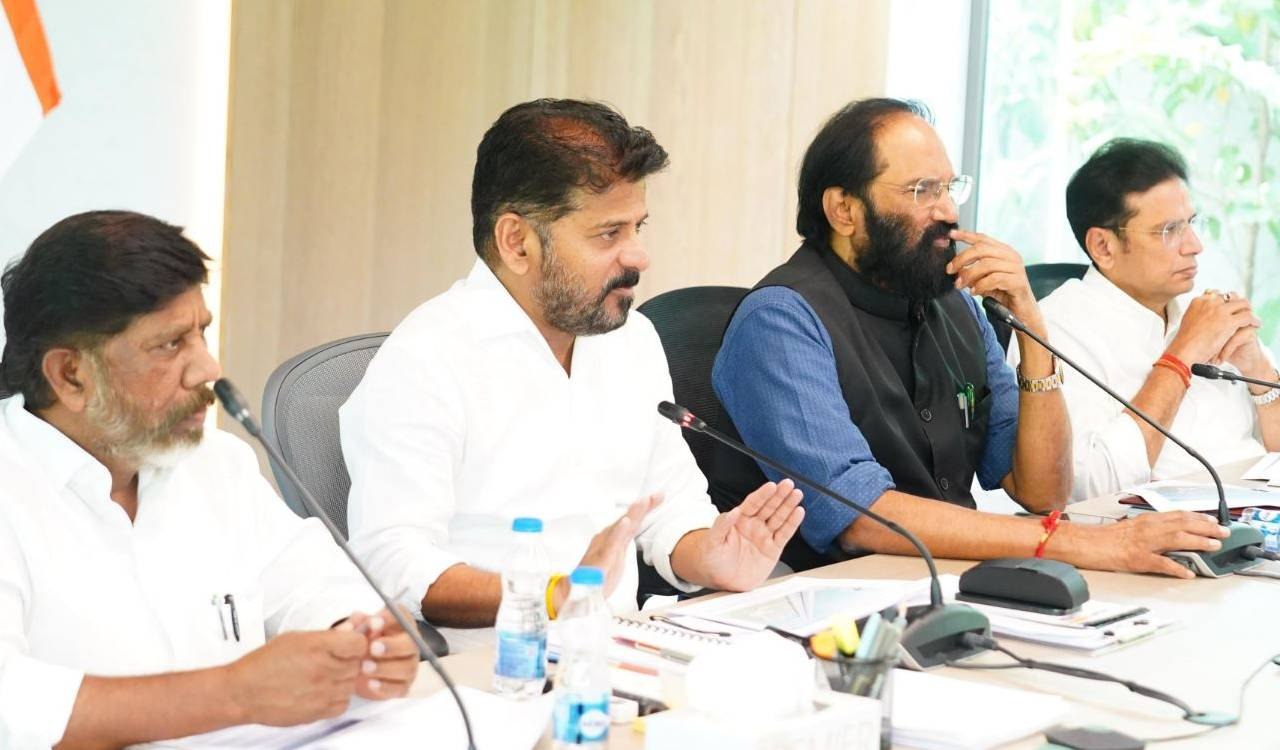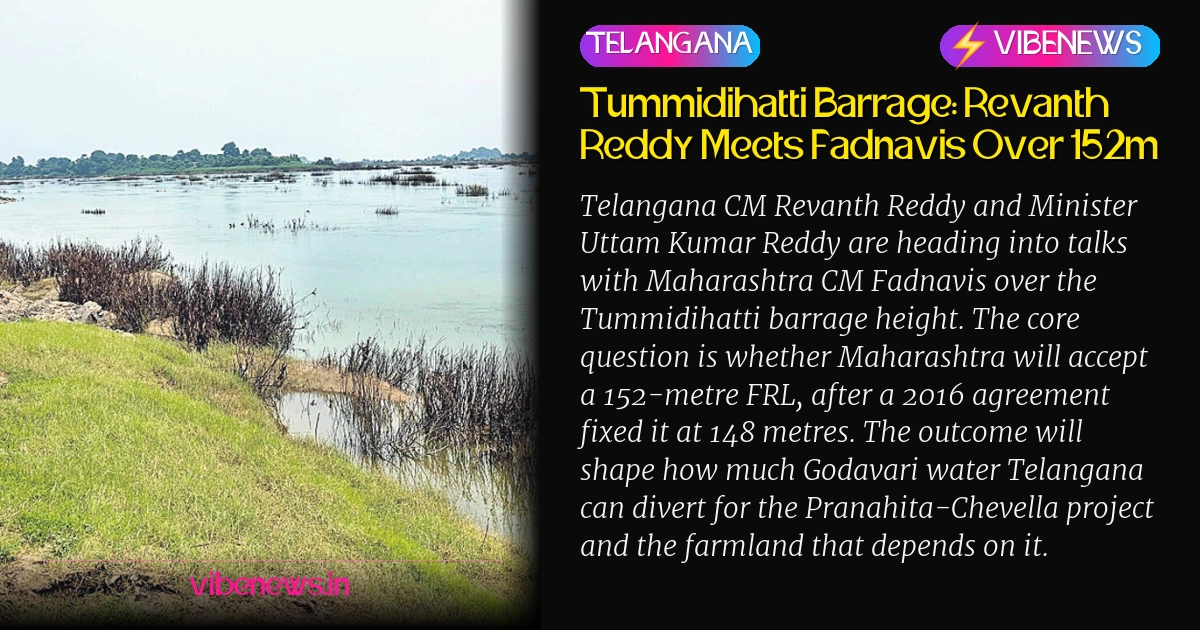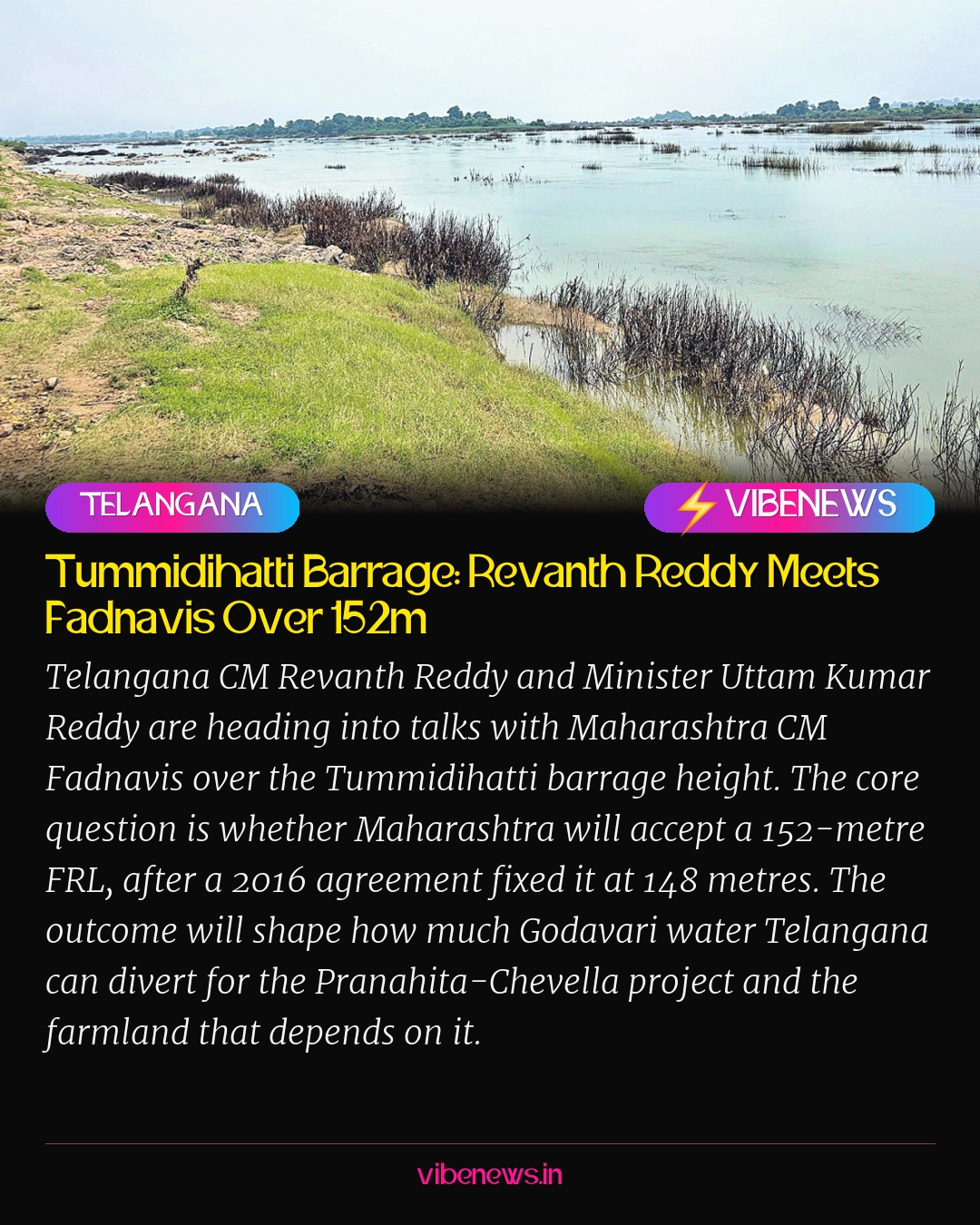
Telangana Chief Minister Revanth Reddy is set to meet Maharashtra Chief Minister Fadnavis to push for a higher barrage at Tummidihatti, a move that could reopen a 2016 water agreement between the two states. Minister Uttam Kumar Reddy is travelling with him. The central question is simple and loaded: will Maharashtra agree to a 152-metre full reservoir level (FRL) for the barrage, or will the 148-metre deal stand?
The stakes are concrete. The Tummidihatti barrage is part of the Pranahita-Chevella project, which was designed to divert around 160 TMC of water from the Godavari. At 152 metres, the project can do the job. At 148 metres, it cannot, and that gap is the reason the issue keeps coming back to the negotiating table.
Why the 148-metre deal became the problem
The 2016 agreement fixed the barrage’s FRL at 148 metres, and the consequences have been severe. Telangana had already finalised a 152-metre FRL design, set the head regulator sill level at 145.25 metres, and dug canals on that basis. Dropping to 148 metres reduces the water head by 2.55 metres.
According to the report, even if Telangana diverted water for 150 days, it could use no more than 44 TMC under the lower height. The Pranahita-Chevella Shrinking Sustainable Scheme (PCSS) command area alone faces a shortfall of 100 TMC.
Fadnavis has said he will not accept a 152-metre barrage, but he has offered to cooperate if Telangana builds the project at 148 metres.
That position has not changed much since the Fadnavis government first took office. He has opposed the 152-metre barrage in the past, citing submergence concerns, and the report notes that this stance now sits uneasily with any shift he might make.
A dispute that has run since Telangana’s formation
The fight is older than the current government. Within 45 days of Telangana’s formation in 2014, the KCR government opened talks with Maharashtra on the barrage. It met then-irrigation minister Hasan Mushrif and laid out the project’s need. The response was firm. Maharashtra’s side pointed to a letter that then-Maharashtra CM Prithviraj Chavan had written to then-united Andhra Pradesh CM Kiran Kumar Reddy, and rejected any agreement at 152 metres.
Officials from both states met in Hyderabad on August 16, 2014, and again on February 4, 2015. Water expert R Vidyasagar Rao took part in the discussions. After Maharashtra’s elections brought a BJP government to power, Harish Rao met Maharashtra irrigation minister Girish Mahajan in Mumbai. Mahajan suggested that the matter be settled at the chief minister level, which led to the February 17 meeting with Fadnavis. That meeting produced no breakthrough beyond the offer on 148 metres.
The Central Water Commission’s objections
The Central Water Commission (CWC) raised its own concerns. It noted that 165 TMC of water is available, but around 63 TMC of that is not being used by upper riparian states. The CWC also said that if upstream states build projects and use that water in the future, the net available to Telangana would fall to 102 TMC.
In response, the KCR government redesigned the project. It split the Pranahita-Chevella scheme into two parts and took up the Pranahita and Kaleshwaram projects to serve undivided Adilabad.
The Congress government’s record under scrutiny
The current Congress government’s record is now part of the argument. The report says that after three years in power, the government had not dug a single basket of earth on the Yellampalli diversion route it had promised. It handed the detailed project report to an agency and, the report argues, moved on. Plans were also drawn up to divert water from Tummidihatti to Sundilla instead of Yellampalli, with officials negotiating 152, 150 or 149 metres without formal talks with Maharashtra.
Those claims come from a report that is openly critical of the current government, and they should be read as one side of the debate. The record of the earlier period also draws scrutiny. The report notes that the Congress was in power at the Centre, in Maharashtra and in united Andhra Pradesh between 2007 and 2014, and that no central clearance for a Tummidihatti project was secured during that stretch.
The first Centre-led talks and what comes next
The latest development came when the Central Water Commission hosted its first meeting with Maharashtra officials in Delhi. Telangana’s side was asked to accept a 152-metre FRL, while the central body offered to bear the costs of submergence and rehabilitation. Maharashtra, according to the report, asked for fresh studies on water availability before agreeing to anything.
That request is why Revanth Reddy is now going directly to Fadnavis. The meeting will test whether the chief ministers can move past the technical standoff that has defined the issue for more than a decade.
For Telangana, the outcome is not abstract. Water flow decides how much land can be irrigated, how long farmers wait for canal supply and how much of the project’s promised capacity ever reaches the fields. A shift to 152 metres would reopen existing canal designs. Holding at 148 metres would keep the shortfall in place.
Watch for whether Fadnavis accepts the 152-metre proposal, agrees to fresh water studies or sticks to the 148-metre framework. Any of those answers will set the terms for the next phase of the Godavari water fight.
TL;DR
- Telangana CM Revanth Reddy meets Maharashtra CM Fadnavis to discuss raising the Tummidihatti barrage height.
- The 2016 agreement fixed the barrage at 148 metres, while Telangana’s design calls for 152 metres.
- At 148 metres, Telangana could use no more than 44 TMC even after 150 days of diversion, according to the report.
- The PCSS command area faces a projected 100 TMC shortfall under the lower barrage height.
- The Central Water Commission says 63 TMC of available water is unused by upper states and could fall to 102 TMC net.
- Fadnavis has previously said he will not accept 152 metres but offered support for a 148-metre barrage.