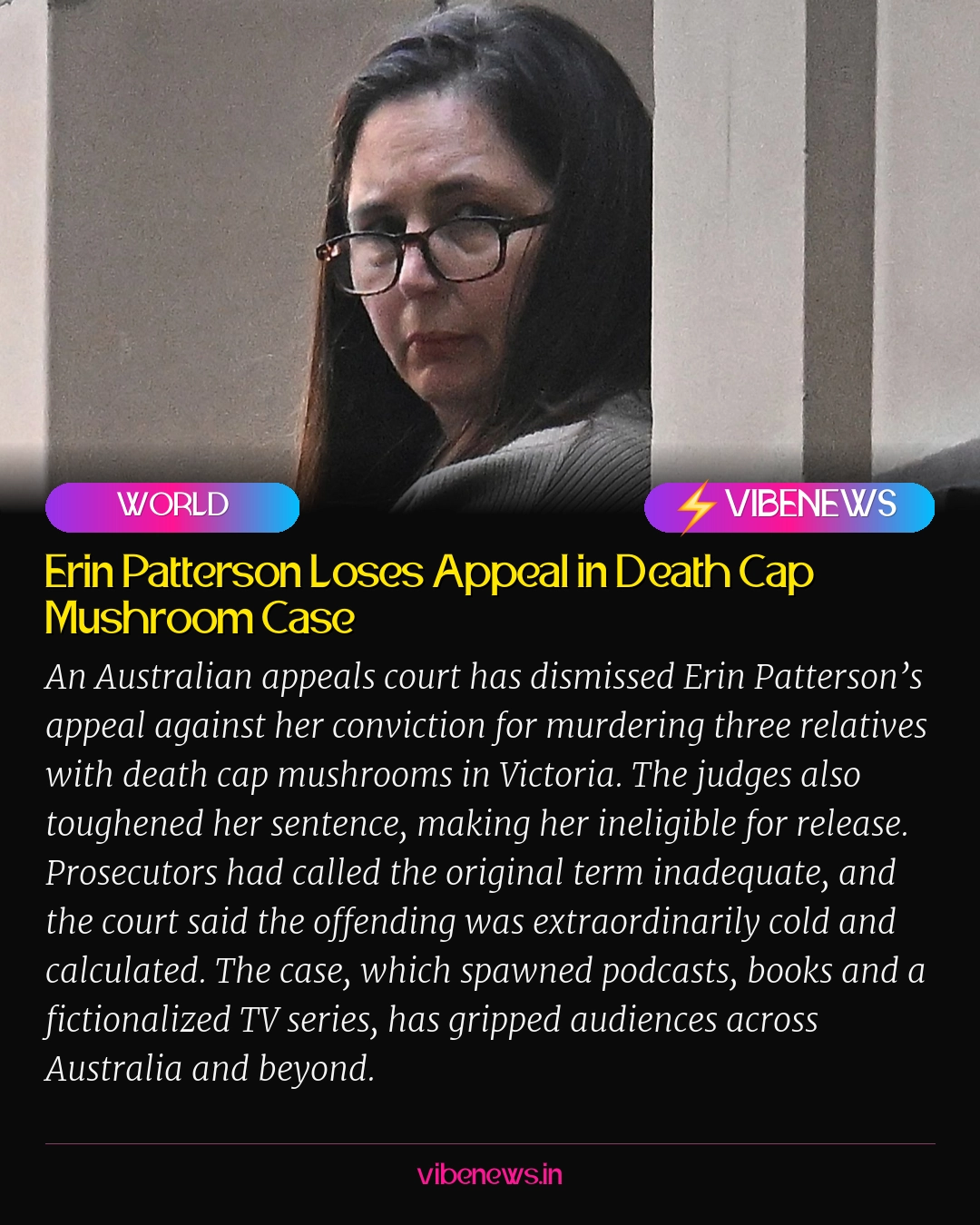

An Australian appellate court on Friday rejected the appeal of Erin Patterson, 52, who was convicted of murdering her in-laws and another relative with death cap mushrooms. In the same ruling, the judges made her ineligible for release.
Patterson was originally sentenced to life in prison, with the possibility of parole after 33 years. That term is now off the table. The court accepted prosecutors’ argument that the original sentence did not match the crimes.
The convictions that started it all
The case dates back to 2023, when Patterson served a lunch of beef Wellington in Leongatha, a rural town about two hours southeast of Melbourne in the state of Victoria. Three people who ate the meal died days later. They were Gail Patterson, Don Patterson and Gail’s sister, Heather Wilkinson.
Heather’s husband, Ian Wilkinson, was also poisoned. He spent time in intensive care, recovered, and later testified at the criminal trial. Patterson was convicted of attempting to murder him.
Patterson testified at her own trial. She has consistently maintained that the deaths were a tragic accident.
Defense arguments rejected
Patterson’s attorneys tried to overturn the conviction on three grounds. They argued that the jury was not sufficiently sequestered in a case that drew intense public attention. They said prejudicial evidence had been admitted. And they claimed the prosecution’s closing arguments had overreached.
The court was not persuaded. It said there had been no interaction between jurors and others connected to the case who were staying in the same hotel. It also found that the evidence the defense had objected to was appropriate, because it formed part of the circumstantial case prosecutors built against her.
The verdict stands, and the court’s reasoning leaves little room for a successful challenge on those points.
Prosecutors win the sentencing fight
The fight did not end with the conviction. Prosecutors filed their own appeal, arguing that Patterson’s sentence was manifestly inadequate. They described the crimes she was convicted of as truly dreadful.
The judges agreed. They ruled that the original sentence failed to reflect what they called calculated criminality. Their reasoning focused on how long and how deliberately the offending unfolded.
According to the judges, Patterson’s intent persisted for more than two weeks, from the moment she first extended the lunch invitation. They also said she allowed the victims to suffer for a week after the meal. During that time, she could have come forward and helped them.
Justice Stephen McLeish delivered the ruling from the bench. He did not soften the language.
"This offending was extraordinarily cold and calculated, and stands to be denounced in the strongest terms."
The invitation that was never accepted
Patterson had also invited her estranged husband, Simon Patterson, to the lunch. He canceled the night before. The couple had separated and had previously clashed over their children and finances.
Simon is the son of Gail and Don Patterson. His decision to stay away is one of the strangest threads in a case already full of them. He was not at the table, and he survived the weekend that killed his parents.
Why this case refuses to fade
The Patterson trial captivated Australia for months. It spawned several podcasts, books and a fictionalized television series. That kind of saturation can make a courtroom outcome feel like old news. Friday’s ruling proves otherwise.
Patterson’s fate now rests on a sentence that leaves no path to freedom. For a case built on circumstantial evidence and a defense of accident, that is the most consequential outcome the courts could have delivered. The judges made their view clear: they do not see the poisonings as a mistake that went terribly wrong.
The appeal ruling also reinforces a principle that matters beyond this case. Courts will examine whether a sentence fits the deliberate choices behind a crime, not just the harm that followed. In this instance, the judges concluded that the timeline of Patterson’s decisions demanded a harsher penalty.
For readers who followed the trial, the ruling closes the legal chapter. For the families of the three people who died, and for Ian Wilkinson, who survived, the decision confirms what the courtroom heard from the start: a lunch was served, people were left to suffer, and the person who prepared it did not come forward.
TL;DR
- An Australian appeals court rejected Erin Patterson’s appeal against her mushroom murder convictions on Friday.
- The court imposed a harsher sentence, making Patterson ineligible for release.
- Patterson had been sentenced to life with possible parole after 33 years.
- Three people died after eating a beef Wellington she served in Leongatha, Victoria, in 2023.
- Judges said her offending was extraordinarily cold and calculated, and her intent persisted for over two weeks.