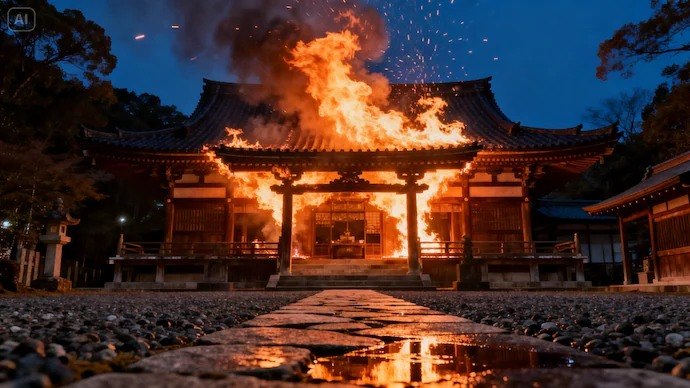
In a deeply heartbreaking string of tragedies, Japan is witnessing the irreparable loss of its ancient cultural and spiritual soul. A harrowing wave of fires has swept through sacred shrines and centuries-old temples across the country, turning irreplaceable historic wooden structures into piles of smoldering ash. Between January and May 2026 alone, at least nine major Japanese shrines and temple sites suffered severe damage or total destruction, leaving communities grieving over the sudden destruction of their revered heritage.
A Trail of Devastation Across Sacred Sites
The catastrophic sequence of events escalated painfully on August 31, when a massive fire tore through the Meirin shopping arcade in Ise city, Mie Prefecture. Located merely 700 meters from the outer shrine of Ise Jingu—one of Japan’s most vital Shinto spiritual centers—the raging blaze ripped through the densely packed district, destroying dozens of old wooden buildings. The very next morning, on September 1, horror struck again when an inferno broke out at Seianji Temple in Sanyo-Onoda City, Yamaguchi Prefecture. According to KRY Yamaguchi Broadcasting News, the ancient place of worship was completely incinerated.
These fresh tragedies follow months of sorrowful losses across the nation. In February, a horrific fire at Shorinji Temple in Shimonoseki, Yamaguchi Prefecture, tragically took the lives of two people. Other irreplaceable sites lost or damaged include Suga Shrine in Kitakyushu, temples in Ehime, Renshoji Temple in Toyama, Urufushine Shrine in Mie, Atago Shrine in Niigata, and Daihoji Temple in Toyama—a historic 573-year-old treasure. In May, a devastating blaze destroyed Reikado Hall at Daishoin Temple on Miyajima, a sacred site that housed a holy flame maintained continuously for nearly 1,200 years. While firefighters miraculously saved the sacred flame itself, the historic hall housing it was reduced to ruins.
Shocking Online Speculation and Misinformation
As photos of blackened timber and burnt ruins circulated on social media, the sheer volume of destruction sparked a wave of shock, fear, and wild conspiracy theories online. Accusations began spreading rapidly, with right-wing commentators claiming the fires were too frequent to be accidental. British far-right figure Tommy Robinson claimed on X that the fires were not coincidences, while prominent US-based accounts attempted to link the tragedies in Japan to church fires in America, asserting a global plot against places of worship.
More dangerously, baseless anti-immigrant and anti-Muslim rumors began targeting foreign residents in Japan. Unfounded claims alleged that migrants were deliberately burning down sacred Japanese sites. One frustrated social media user echoed the growing anxiety across internet forums:
"... Every time the same line comes back. Cause is under investigation. How many wooden halls have to go black before someone treats this as a pattern instead of bad luck?"
Official Data Contradicts Arson Conspiracy Narratives
Despite the shocking social media frenzy, official authorities and investigative reports stress that there is zero evidence linking these fires to migrants, arson conspiracies, or coordinated attacks. A detailed investigation by Japanese newspaper The Yomiuri Shimbun highlighted that police and firefighting agencies confirmed no foreign or arson involvement in eight out of ten major temple fires reviewed since January.
Furthermore, official statistics provided by Japan’s Fire and Disaster Management Agency reveal a surprising truth: fires at temples and shrines have actually experienced a long-term decline. Total incidents dropped from 83 in 2016 to under 60 annually in recent years, with suspected arson cases falling significantly over the same decade. The recent concentration of tragic fires represents a heartbreaking cluster of misfortunes rather than a rising trend of attacks.
Vulnerabilities of Centuries-Old Wooden Treasures
Fire investigators emphasize that Japan’s sacred architecture is uniquely vulnerable to catastrophic fire damage. Many traditional Shinto shrines and Buddhist temples are built almost entirely of aging timber, surrounded by tight residential quarters and narrow streets that obstruct fire trucks. In the Ise arcade fire, corrugated metal roofing trapped intense heat and blocked water streams, accelerating the destruction.
Experts such as fire investigator Hiroaki Suzuki pointed out that mundane hazards—such as dust building up in electrical outlets and creating short circuits—remain lethal threats to old wooden heritage. Although Japan’s Agency for Cultural Affairs launched a massive 13 billion Yen initiative to upgrade fire safety systems at 107 priority historical sites following the tragic 2019 Shuri Castle fire, protection upgrades at many sites remain unfinished. As investigations continue, grief lingers across Japan for the ancient sacred halls lost forever to flame.
TL;DR
- At least nine major Japanese shrines and temples were destroyed or severely damaged by fire in early 2026.
- Recent blazes in Ise city and Sanyo-Onoda City completely destroyed a historic shopping arcade and Seianji Temple.
- A February fire at Shorinji Temple in Yamaguchi Prefecture tragically claimed the lives of two people.
- Authorities confirm there is no evidence linking the destructive fires to arson or migrant groups.
- Official data reveals that fires at religious sites in Japan have actually declined over the past decade.