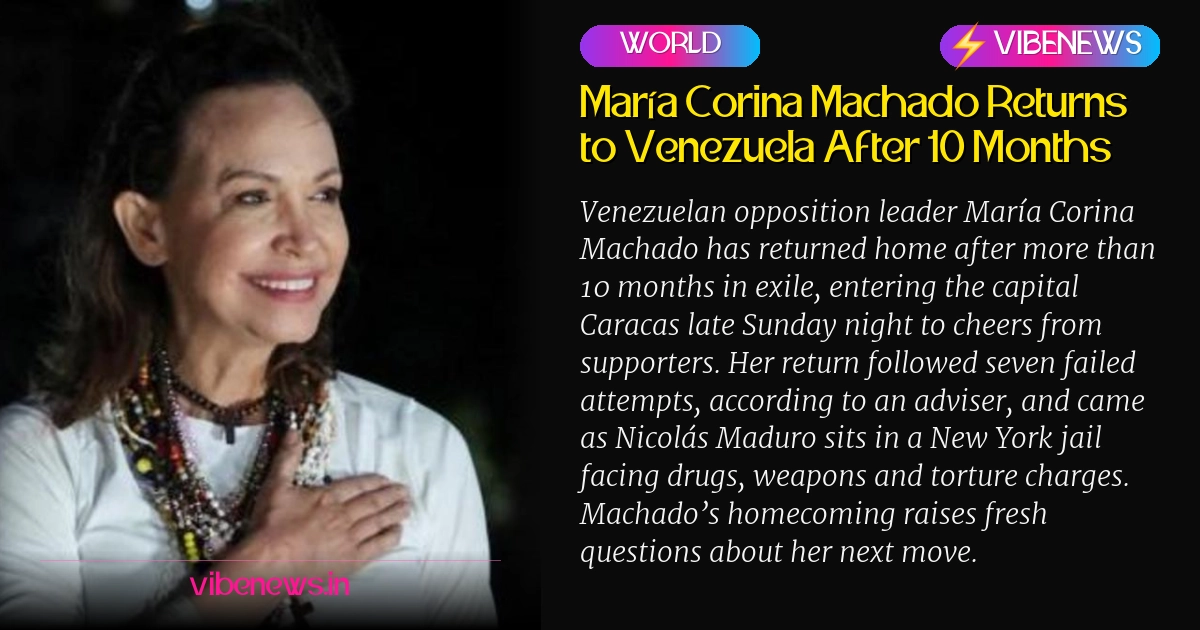
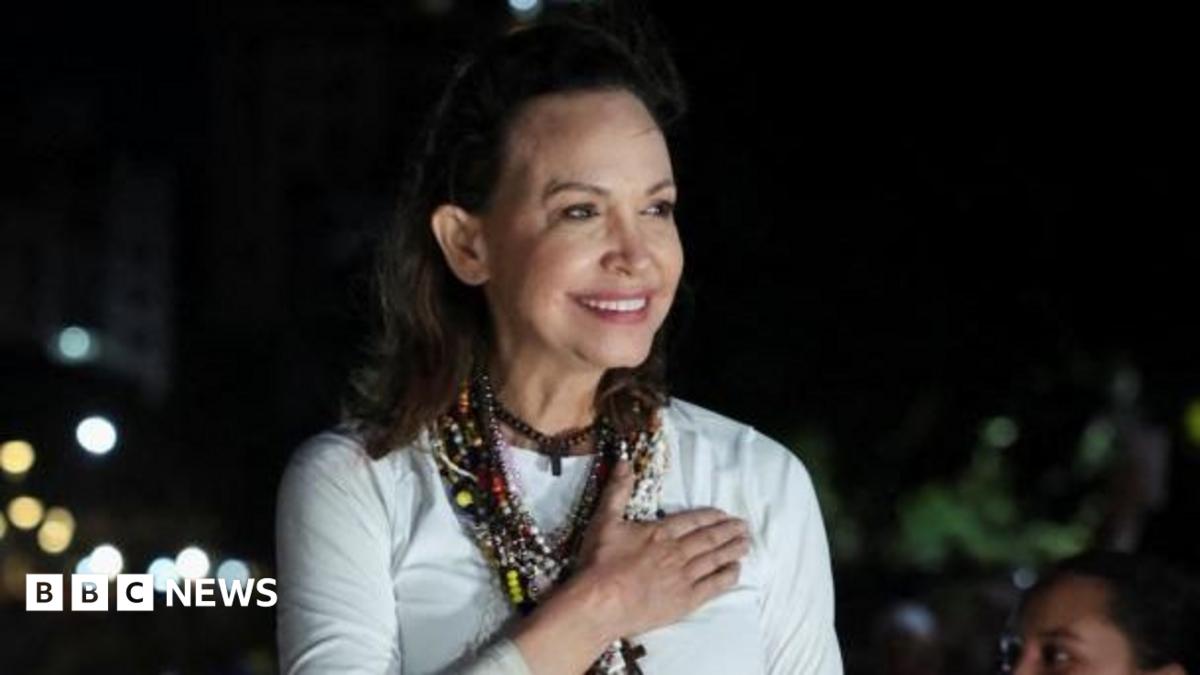
Venezuelan opposition leader María Corina Machado has returned home after more than 10 months in exile, reaching the capital Caracas late on Sunday night as supporters cheered along her route.
Machado announced her return on X with three words that her supporters will remember: "I am here. With you," she wrote on Sunday. Her arrival came only after repeated efforts to re-enter the country failed.
"I am here. With you," Machado wrote on X on Sunday.
Earlier in the day, Machado was photographed attending Mass at a church in the Venezuelan state of Lara. Supporters surrounded her, hugging her and clasping her hands. She then began travelling toward Caracas in a caravan of cheering supporters, and more people lined the road as she went. Late that night, she was photographed smiling as she leaned out of the sunroof of a car while entering the capital.
A return years in the making
Machado left Venezuela in December on a speedboat under cover of darkness to accept the Nobel Peace Prize in Norway. A month later, in January, the United States seized her opponent, President Nicolás Maduro. The Trump administration then backed his deputy, Delcy Rodríguez, as leader, and Rodríguez was sworn in as interim president. She later signed an oil deal that granted very favourable terms to the US.
An advisor to Machado said in September that over the previous few weeks, she had attempted seven times to return to Venezuela and was denied each time. Reports suggested the US was involved in delaying her return, a claim Washington has denied. Her ability to come home was always contingent on approval from the Trump administration, which now appears to have been granted.
The election that never ended
Machado is no stranger to confrontation with the government. She won an independent presidential primary election in 2023, held outside the Maduro government’s official election authority, and earned more than 90% of the vote. Maduro’s government barred her from running for office anyway, accusing her of fraud and tax violations. Machado denied the allegations, calling them politically motivated.
She spent her final days in the country hiding in safehouses before fleeing to Norway to accept the Nobel Prize. In the 2024 presidential election, her ally Edmundo González ran in her place against Maduro. The electoral authority, which is closely aligned with the government, declared Maduro the winner without making detailed voting tallies public. The opposition argued that González had won, and uploaded copies of the voting tallies as evidence.
Maduro in a New York cell
The man at the centre of that dispute is now far from Caracas. Maduro was removed from the country by US forces in January and is currently jailed in New York, where he faces drugs, weapons and torture charges. He has pleaded not guilty.
Machado’s return has been greeted by her supporters as a turning point. A spokesman for Machado, David Smolansky, called her return "a major step toward a democratic transition and free, fair, and verifiable presidential elections in the near future." He also thanked President Donald Trump, Secretary of State Marco Rubio, the US Government, Congress, and allied governments for their support.
Washington’s role under scrutiny
Trump, speaking to reporters on Sunday, said he "doesn’t know anything about" her return but hoped she was "safe." He added, "I think she’s a very nice woman. She gave me her Nobel Prize, so how can I say anything else?" In January, Machado had visited the White House and gifted her Nobel prize award to Trump. The committee that issues the prize had said it "cannot be revoked, shared, or transferred to others."
Rubio credited US-backed diplomacy for making the homecoming possible. "The conditions allowing for the safe return of Ms Machado to Venezuela is the direct result of the US supported reconciliation talks which has already seen hundreds of political prisoners freed and hundreds of political opposition figures return from exile," he wrote on X. He added that the talks "represent the best chance Venezuela has had in thirty years to peacefully achieve not just a free and fair election but an enduring democracy."
What comes next
It is unclear what Machado plans to do now that she is back. She has previously said she would run for president again if an election were held. Her ally Edmundo González confirmed her arrival in a statement, writing, "I am thrilled to announce to you that our leader, my dear María Corina, is on Venezuelan soil." He said he would soon join her in Venezuela to advance the country "toward freedom."
For a country that has spent years locked in a standoff over who actually won the vote, the next few weeks will test whether Machado’s return opens a path to a real election or simply shifts the power struggle onto new ground.
TL;DR
- María Corina Machado returned to Venezuela late Sunday after more than 10 months in exile.
- Her return came after seven failed attempts to re-enter the country, according to an adviser.
- Maduro was removed by US forces in January and is jailed in New York on drugs, weapons and torture charges.
- The Trump administration backed Delcy Rodríguez as interim president after Maduro’s removal.
- Machado’s supporters say her return is a major step toward free and verifiable presidential elections.
- It is unclear what Machado plans to do next, though she has said she would run for president again.