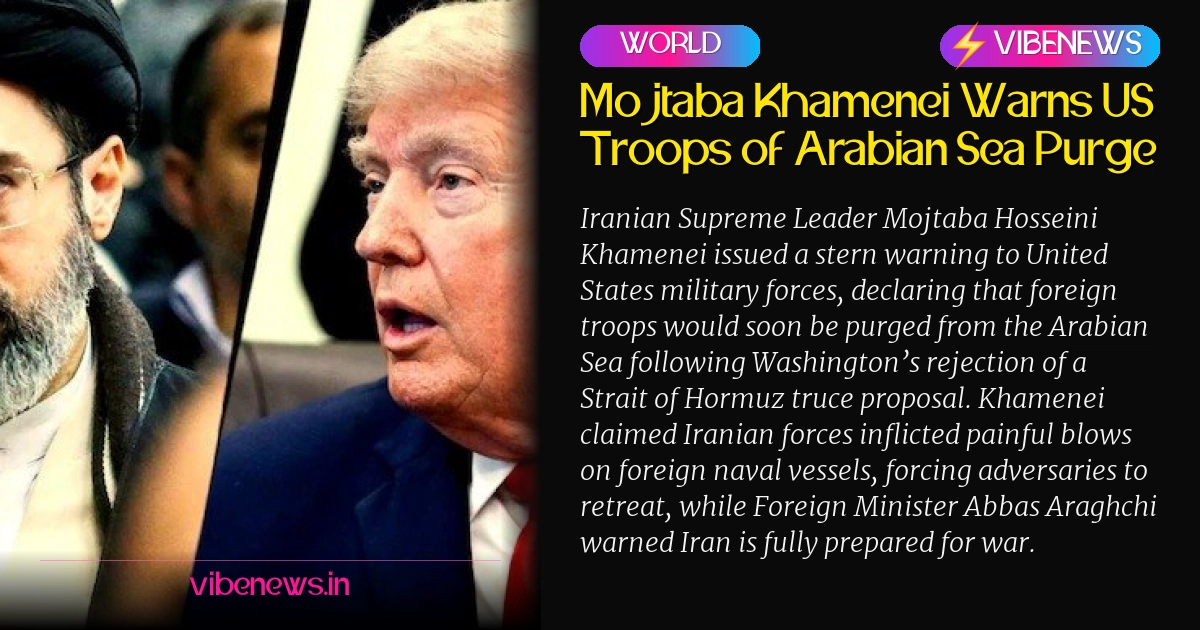
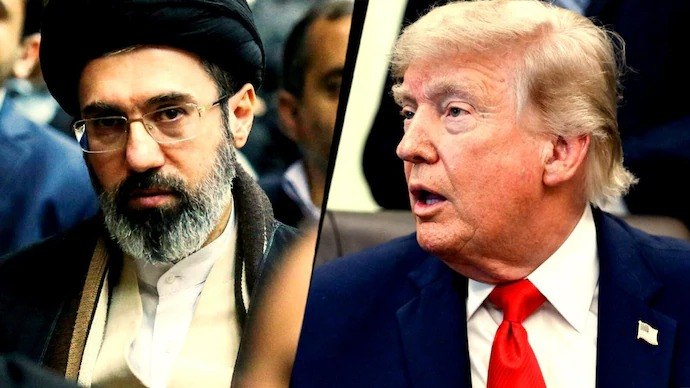
Iranian Supreme Leader Mojtaba Hosseini Khamenei issued a written statement on Monday warning that foreign military forces will soon be expelled from the Arabian Sea, following the United States’ rejection of a fresh Iranian proposal to reopen the strategic Strait of Hormuz.
Portraying the narrow waterway as a central pillar of national defense, Khamenei claimed that Iranian armed forces have already forced hostile foreign vessels to retreat from waters adjacent to Iran’s southern coastline. In his statement released by Iranian media, the Supreme Leader asserted that adversary forces no longer dare to venture beyond the Arabian Sea due to significant setbacks dealt by Iranian fighters in the region, signaling an escalating posture of confrontation against American military presence.
"Some see us as the fourth superpower in the world. Today, the enemy’s forces do not dare to venture beyond the Arabian Sea. Soon the day will come when the Arabian Sea will be purged of their presence. Our people fill the squares and streets across the country with their responsible presence," Khamenei said.
Strait of Hormuz Proposal Rejected by Washington
The fiery declaration follows a diplomatic impasse surrounding a seven-day plan put forward by Iranian Foreign Minister Abbas Araghchi through intermediaries during the 81st United Nations General Assembly in New York. Under the proposed framework, Tehran offered to reopen the crucial trade corridor in exchange for specific American actions, including a reduction in military pressure. However, the Trump administration swiftly turned down the offer. United States Ambassador to the UN Mike Waltz explained that President Donald Trump rejected the framework because Tehran insisted on receiving immediate sanctions relief and access to billions of dollars in frozen assets prior to entering substantive negotiations regarding its nuclear programme.
Disputing the American account, Foreign Minister Araghchi maintained that UN Ambassador Waltz had not reviewed the actual text of the Iranian submission. In an interview with NBC’s Meet the Press, Araghchi emphasized that while Iran remains open to diplomatic solutions, the Islamic Republic is thoroughly equipped to handle a full resumption of hostilities. He declared that Tehran prioritizes its core national interests over political developments in Washington, such as upcoming U.S. midterm elections, reiterating that the ultimate choice between warfare and negotiation rests entirely with President Trump.
Historical Parallels and Domestic Mobilization
Khamenei’s address was issued in conjunction with Iran’s Sacred Defence Week, an annual commemoration marking the 1980–1988 war with Iraq, as well as the anniversary of the death of Hezbollah leader Sayyid Hassan Nasrallah. Drawing explicit comparisons between modern geopolitical tensions and past military struggles, Khamenei accused Western nations of attempting to erode Iran’s sovereignty. He referenced the 1953 foreign-backed coup against Iran’s government, charging that external powers historically utilized psychological pressure and intimidation to exploit the nation’s wealth for a quarter-century.
Addressing recent domestic unrest, Khamenei argued that internal societal divisions have given way to widespread public solidarity in support of national defense initiatives. He asserted that over 30 million Iranian citizens have declared a readiness to sacrifice their lives for the nation’s security, adding that a recent mobilization effort saw more than 500,000 individuals register within 100 minutes to fill available capacity. Khamenei insisted that citizens across diverse social and ethnic backgrounds now stand united in preserving the nation’s strategic position along the Strait of Hormuz.
Regional Alliances and Lebanese Front
A substantial portion of the Iranian leader’s message honored Hassan Nasrallah, who was killed on September 28, 2024, in an Israeli airstrike targeting Hezbollah’s headquarters in Beirut—an operation confirmed by Israel at the time. Describing Nasrallah as a cornerstone of the regional "Resistance Front," Khamenei praised his leadership across Lebanon and the broader Middle East, noting that his mantle has been assumed by current Hezbollah leader Naim Qassem. Khamenei framed the ongoing conflict in Lebanon as part of a wider struggle against Israel and condemned regional actors that rely on Western backing, reinforcing the threat of further regional instability if diplomatic avenues remain blocked.
TL;DR
- Iranian Supreme Leader Mojtaba Khamenei warned US forces will soon be purged from the Arabian Sea.
- The warning follows US President Donald Trump rejecting a seven-day proposal to reopen the Strait of Hormuz.
- US UN Ambassador Mike Waltz cited Iran’s demand for sanctions relief and frozen assets as reasons for rejection.
- Iranian Foreign Minister Abbas Araghchi stated Tehran is fully prepared for conflict escalation while remaining open to diplomacy.
- Khamenei issued the statement during Iran’s Sacred Defence Week, highlighting domestic mobilization and defense unity.