
Navigating the US Immigration Maze
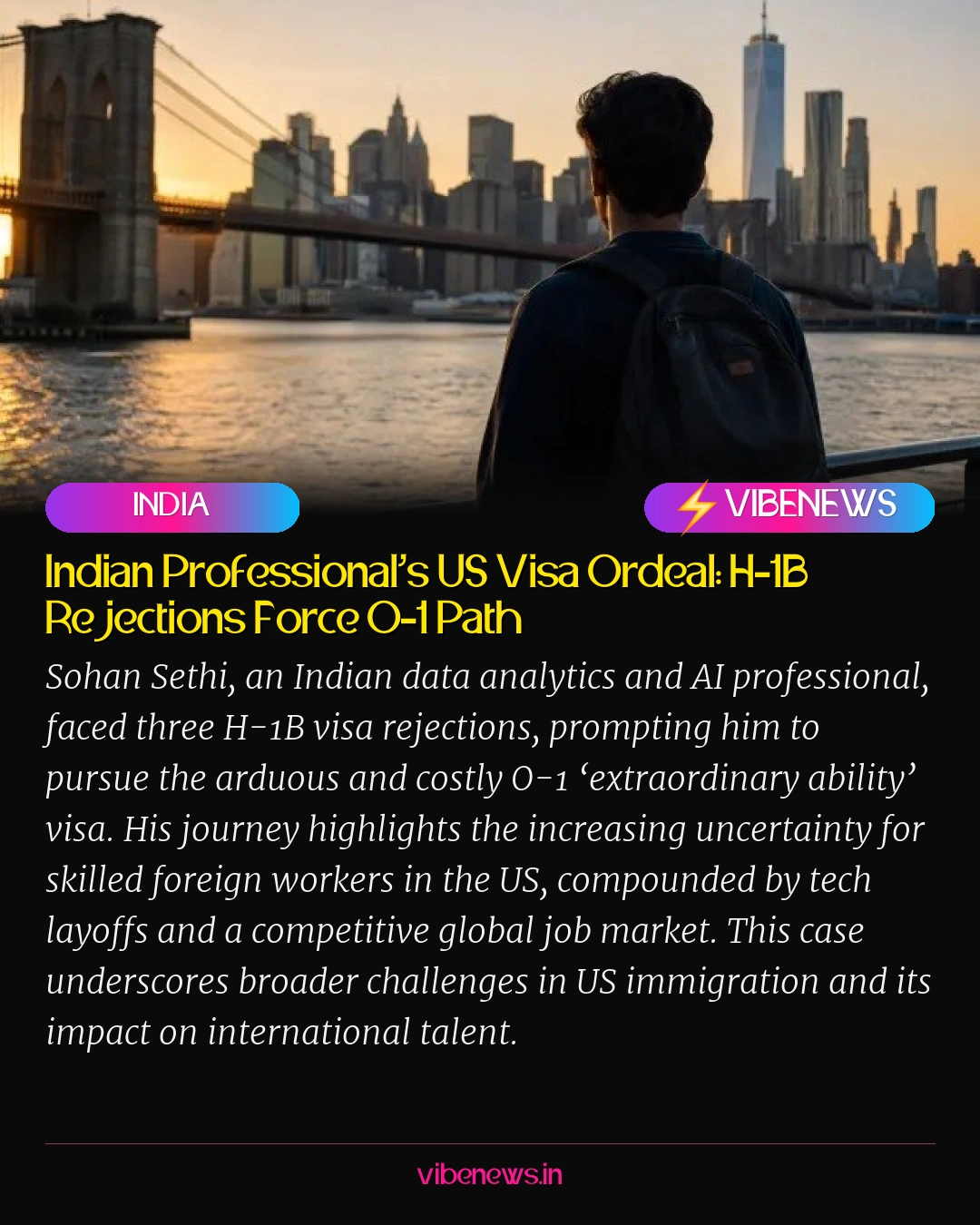
For Sohan Sethi, a 29-year-old Indian data analytics and AI professional, the stability of his career in the United States was not threatened by job performance but by the precarious nature of his immigration status. Despite a rapidly advancing career, Sethi faced the H-1B lottery three times, receiving rejections on each occasion. With his STEM OPT authorization nearing its expiration in July, he was left with a critical window to secure an alternative pathway to remain in the country.
His eventual solution was the O-1 visa, a category designated for individuals with extraordinary ability. However, this route demanded an extensive application process, culminating in a 700-page submission, and incurred significant legal fees amounting to approximately $13,000, or nearly Rs 12 lakh.
Sethi’s Professional Ascent and the O-1 Imperative
Sethi’s journey in America began after completing his computer engineering degree at the University of Mumbai. He transitioned from a business analyst role in India to pursuing a master’s degree at the University of Illinois Chicago, which he commenced in January 2022.
Upon graduating in May 2023, he joined a healthcare company as a senior business analyst, quickly ascending to manager of analytics and reporting within 18 months. Yet, his professional achievements offered no shield against the unpredictable H-1B system.
Following his second H-1B rejection in April 2025, Sethi recognized the futility of relying solely on the lottery. He proactively began preparing for the O-1 visa in June 2025, nearly a year before his OPT was set to expire, demonstrating foresight in a highly uncertain environment.
Unlike the H-1B, which is subject to an annual lottery, the O-1 visa requires applicants to demonstrate sustained national or international acclaim in their field. Sethi dedicated months to meticulously gathering evidence, including awards, media coverage, published research, strong recommendation letters, and proof of his professional contributions. By February 2026, he had compiled over 700 pages of supporting documentation, just before his third H-1B rejection arrived in March.
With his STEM OPT set to expire on July 5, Sethi had approximately 100 days to finalize his immigration status. He filed his O-1 petition in April, though a subsequent request for additional evidence prolonged the period of uncertainty. Despite considering returning to India or relocating to Canada or the UK, Sethi ultimately committed to building his career in the US.
He articulated his decision, stating that he found unparalleled opportunities, infrastructure, and exposure in data analytics and AI within the United States, which he believed were difficult to replicate elsewhere.
The Shifting Sands of H-1B Visas
Sethi’s experience is emblematic of a broader trend where the H-1B visa pathway has become increasingly fraught with uncertainty for Indian professionals. The pressure extends beyond those awaiting lottery results to individuals already working in the US, where job loss can trigger an immediate immigration crisis.
Under H-1B regulations, workers who lose their employment typically have a 60-day grace period to secure a new sponsoring employer. Failure to do so can necessitate departure from the country. This challenge has intensified amidst widespread layoffs by major technology companies, including Amazon, Microsoft, and Meta, coupled with a shift in hiring priorities driven by advancements in AI.
Some laid-off H-1B workers have explored converting to B-2 visitor status to gain additional time. However, immigration attorneys have reported an increase in requests for evidence and outright denials for such change-of-status applications, further complicating an already stressful situation.
India’s Evolving Tech Landscape and Returnee Professionals
Concurrently, Indian professionals returning home are discovering that the domestic technology market presents its own set of complexities. Data from Xpheno indicates a significant number of professionals returning from the US: approximately 7,300 in 2026 so far, following 15,000 in 2025 and 9,700 in 2024.
The Indian technology hiring environment has become more selective, with a pronounced emphasis on specialized skills. AI’s transformative impact is rendering some traditional technology roles less relevant, necessitating upskilling and adaptation.
Despite these shifts, major Indian cities like Bengaluru, Hyderabad, and Gurugram remain vital hiring hubs, particularly as Global Capability Centres (GCCs) continue to expand their operations across India. Roopank Chaudhary, Partner and Rewards Consulting Leader, Talent Solutions, India, at Aon, noted that India’s tech hiring prioritizes skills directly supporting innovation, AI adoption, and business transformation.
Editorial Context
The narrative of Sohan Sethi underscores a critical juncture in global talent mobility and immigration policy. The increasing difficulty for highly skilled professionals to secure and maintain work visas in the US has profound long-term implications for both the American technology sector and the global distribution of talent. As the US grapples with its immigration framework, other nations, including Canada and the UK, are actively vying for skilled workers, potentially altering the landscape of innovation and economic growth.
For India, the return of skilled professionals presents a dual challenge and opportunity. While it can bolster the domestic tech ecosystem, it also highlights the need for robust job creation and skill alignment within the country. The ongoing evolution of AI further complicates this dynamic, demanding continuous adaptation from both individuals and national economies. This situation necessitates a re-evaluation of immigration policies to ensure they remain responsive to global economic realities and the imperative of fostering innovation.
TL;DR
- Sohan Sethi, an Indian data analytics and AI professional, faced three rejections for the H-1B visa, a common pathway for skilled foreign workers in the US.
- To remain in the US, Sethi pursued the O-1 visa for ‘extraordinary ability,’ which involved a 700-page application and approximately $13,000 (Rs 12 lakh) in legal fees.
- His STEM OPT was set to expire in July, leaving him a narrow window to secure an alternative visa after his third H-1B rejection in March.
- The H-1B system’s lottery-based nature and the 60-day grace period for laid-off workers contribute to significant uncertainty for Indian professionals in the US.
- Major tech layoffs and the rise of AI are making the US job market more challenging for H-1B holders, with even B-2 visitor status conversions facing increased scrutiny.
- India’s tech market is becoming more selective for returning professionals, with AI influencing hiring priorities, though cities like Bengaluru and Hyderabad remain key hubs for Global Capability Centres.