
A recent social media post has ignited a fervent discussion across India, challenging the long-held belief that an Indian Institute of Technology (IIT) degree is the sole gateway to a successful career. Lavanya Jain, a 22-year-old who reportedly dropped out of his BTech program, claims to be earning over Rs 5 lakh monthly, a figure he suggests surpasses the highest placement packages offered by his former college.
Jain’s assertions, shared widely on X (formerly Twitter), have resonated with many, particularly in a country where the pursuit of an IIT education often dictates academic trajectories from a young age. While the specific figures and background details of his claims have not been independently verified, the narrative itself has tapped into a growing sentiment about the changing dynamics of the job market and the value of traditional credentials.
The Unconventional Path to Success
Lavanya Jain’s journey, as detailed in his viral post, is a stark departure from the conventional academic route. He revealed that he left his Electronics and Communications Engineering BTech program in his final semester, a decision he now describes as one of the best of his life. This move, often seen as risky in India’s education-centric society, appears to have paved the way for an alternative career path.
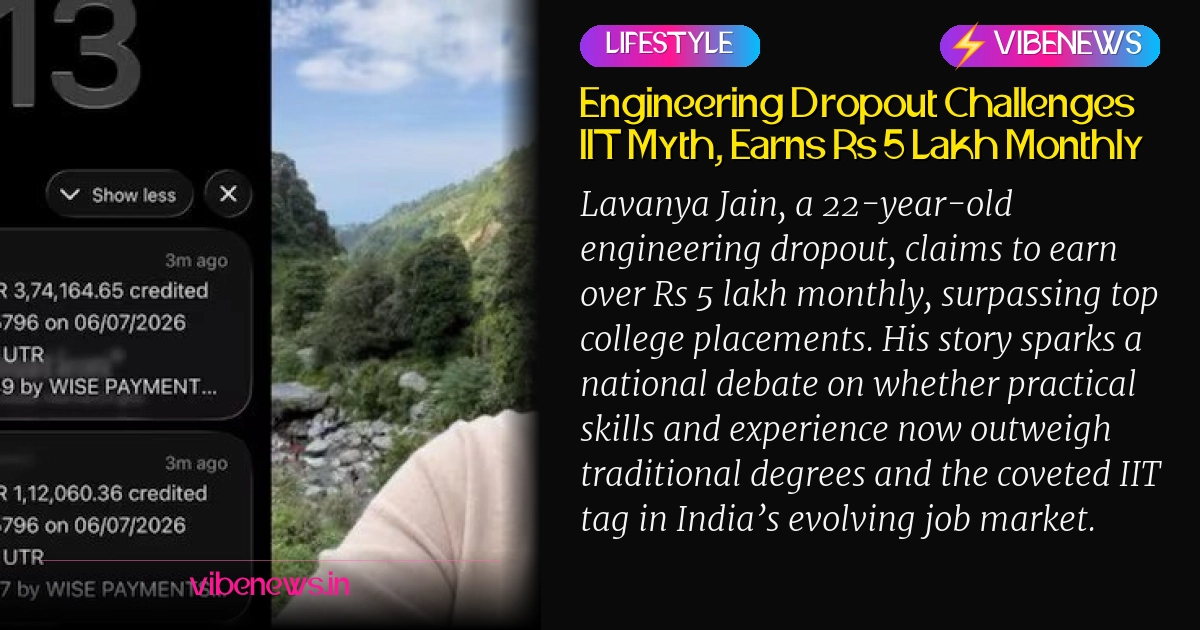
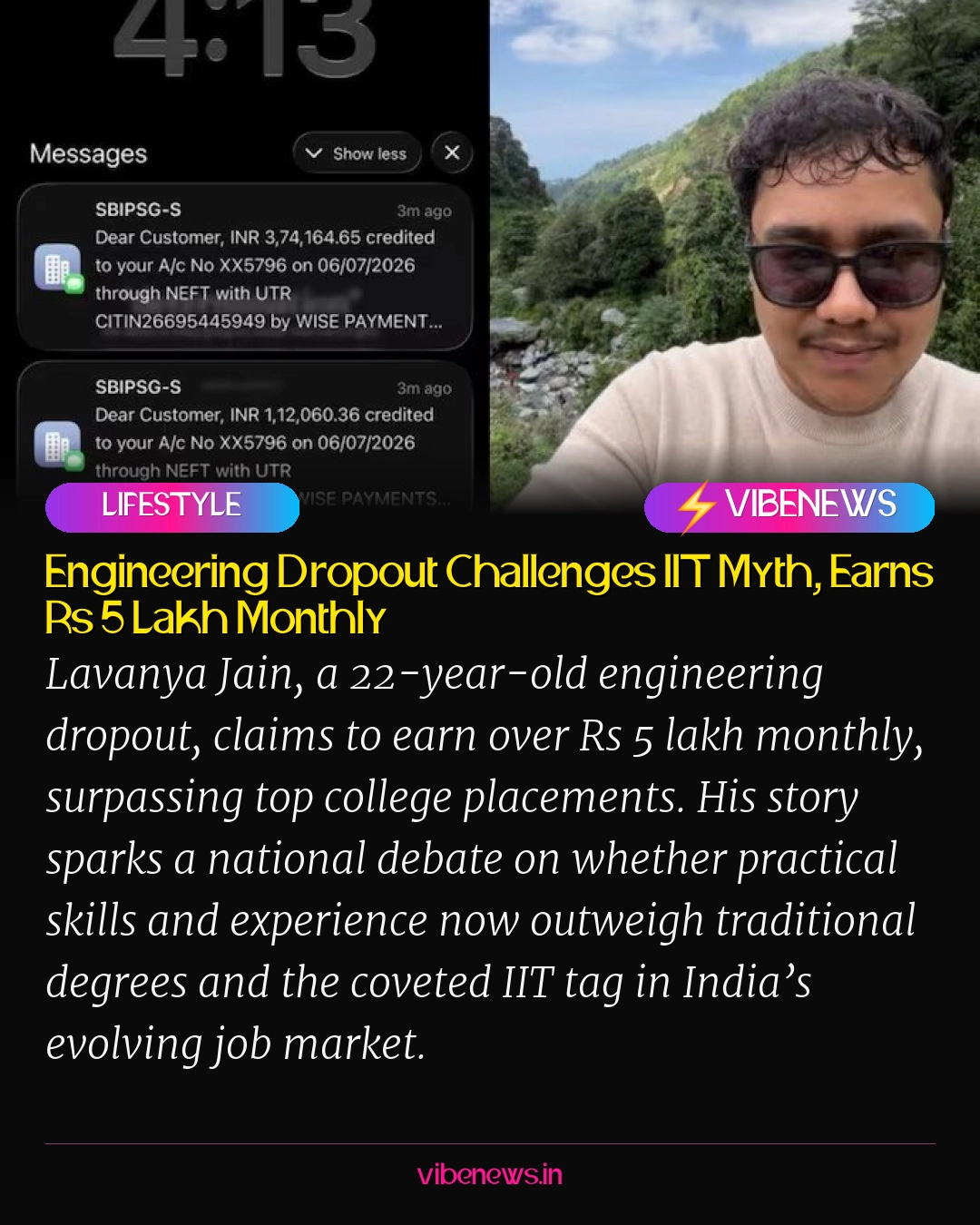
According to his claims, Jain now works part-time as a contractor, generating a primary income that comfortably funds his lifestyle. He also states that he has cultivated five sources of passive income, further diversifying his financial portfolio. To substantiate his earnings, he shared screenshots of two Wise Payments transactions, reflecting deposits of Rs 3.74 lakh and Rs 1.12 lakh, totaling nearly Rs 4.86 lakh in a single month.
Jain clarified that his post was not intended as a boast but rather as a reminder that an "IIT is just a tag." He acknowledged the benefits of an IIT education, particularly its robust alumni network and enhanced visibility, but argued that these advantages do not singularly determine professional growth. His provocative closing remark, "What’s the use when you got a couple of IITians working under you lol," underscored his belief that practical skills and execution ultimately trump educational pedigree.
Re-evaluating India’s Premier Institutions
For decades, cracking the Joint Entrance Examination (JEE) to secure a seat at an IIT has been the ultimate academic aspiration for millions of Indian students. These institutions, established as centers of excellence, have consistently produced leaders, innovators, and highly sought-after professionals, both domestically and internationally. The ‘IIT tag’ has traditionally been synonymous with intellectual prowess, guaranteed employment, and a secure future.
The intense competition, coupled with societal and parental pressure, has created a massive coaching industry, with students often dedicating years to preparing for these entrance exams. The narrative of an IIT degree as a golden ticket has been deeply ingrained in the national psyche, shaping career choices and societal expectations. Lavanya Jain’s story, whether fully verifiable or not, directly confronts this deeply entrenched belief system.
The Evolving Landscape of Employment
Jain’s experience reflects a broader, ongoing transformation within the global technology sector and beyond. The rise of remote work, the gig economy, global contracting, and creator-led careers has fundamentally altered traditional employment models. These shifts have created unprecedented opportunities for individuals to leverage specialized skills, build portfolios, and secure high-paying roles without necessarily adhering to conventional academic pathways.
Companies are increasingly prioritizing demonstrable skills, practical experience, and a proven track record over formal degrees alone. Online learning platforms, bootcamps, and self-taught expertise are gaining traction as legitimate avenues for skill acquisition. This paradigm shift empowers individuals to carve out unique career trajectories, often bypassing the need for a four-year degree from a premier institution.
Beyond Traditional Credentials
The debate sparked by Jain’s post extends beyond just IITs to the broader value of higher education in a rapidly changing world. While premier institutes continue to offer invaluable academic rigor, research opportunities, and networking advantages, stories like Lavanya’s highlight the growing importance of adaptability, continuous learning, and entrepreneurial spirit. The ability to acquire and apply relevant skills quickly, innovate, and navigate diverse work environments is becoming paramount.
This discussion is particularly pertinent for India, a young nation with a vast talent pool and a burgeoning startup ecosystem. It encourages a re-evaluation of educational priorities, urging students and educators alike to consider a more holistic approach that balances theoretical knowledge with practical application and real-world problem-solving. It also offers a glimmer of hope for those who may not fit the traditional mold of academic success but possess immense talent and drive.
Editorial Context: A Long-Term Shift
The conversation initiated by Lavanya Jain’s social media post, regardless of the independent verification of his specific claims, underscores a significant, long-term shift in how success is perceived and achieved in India. It highlights the increasing fluidity of career paths and the diminishing sole reliance on institutional prestige. This development is crucial for India’s future workforce, as it encourages a move towards a skill-based economy rather than a degree-centric one.
Over the long term, such narratives can empower a new generation to explore diverse educational and professional avenues, fostering innovation and entrepreneurship. It challenges the immense pressure placed on students to conform to a single, highly competitive academic track. While the value of quality education remains undeniable, the evolving landscape suggests that adaptability, continuous skill development, and a proactive approach to career building will be far more critical than a mere institutional ‘tag’ in defining future success.
TL;DR
- Lavanya Jain, a 22-year-old engineering dropout, claims to earn over Rs 5 lakh monthly, surpassing top college placements.
- His viral social media post challenges the traditional notion that an IIT degree is the only path to career success in India.
- Jain reportedly dropped out of his BTech program in his final semester and now works part-time as a contractor with multiple passive income streams.
- He shared screenshots of Wise Payments transactions totaling nearly Rs 4.86 lakh to support his earnings claims.
- Jain argues that an IIT is "just a tag" and that professional growth depends more on skills and execution than educational pedigree.
- His story reflects a broader shift in the tech sector towards remote work, freelancing, and skill-based hiring over traditional degrees.