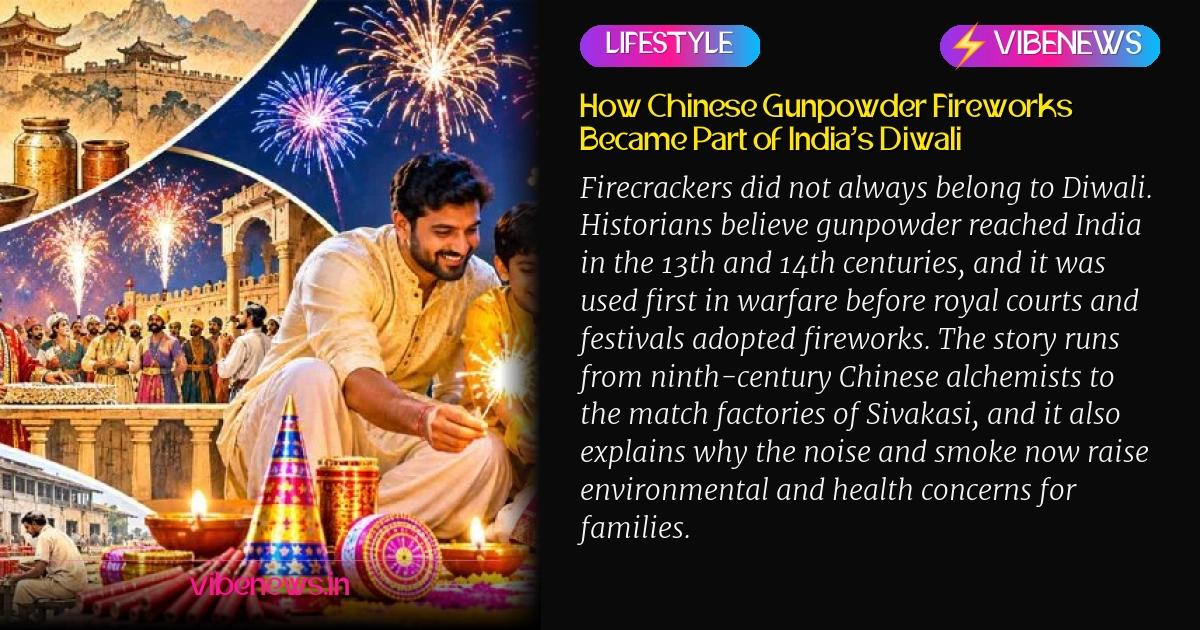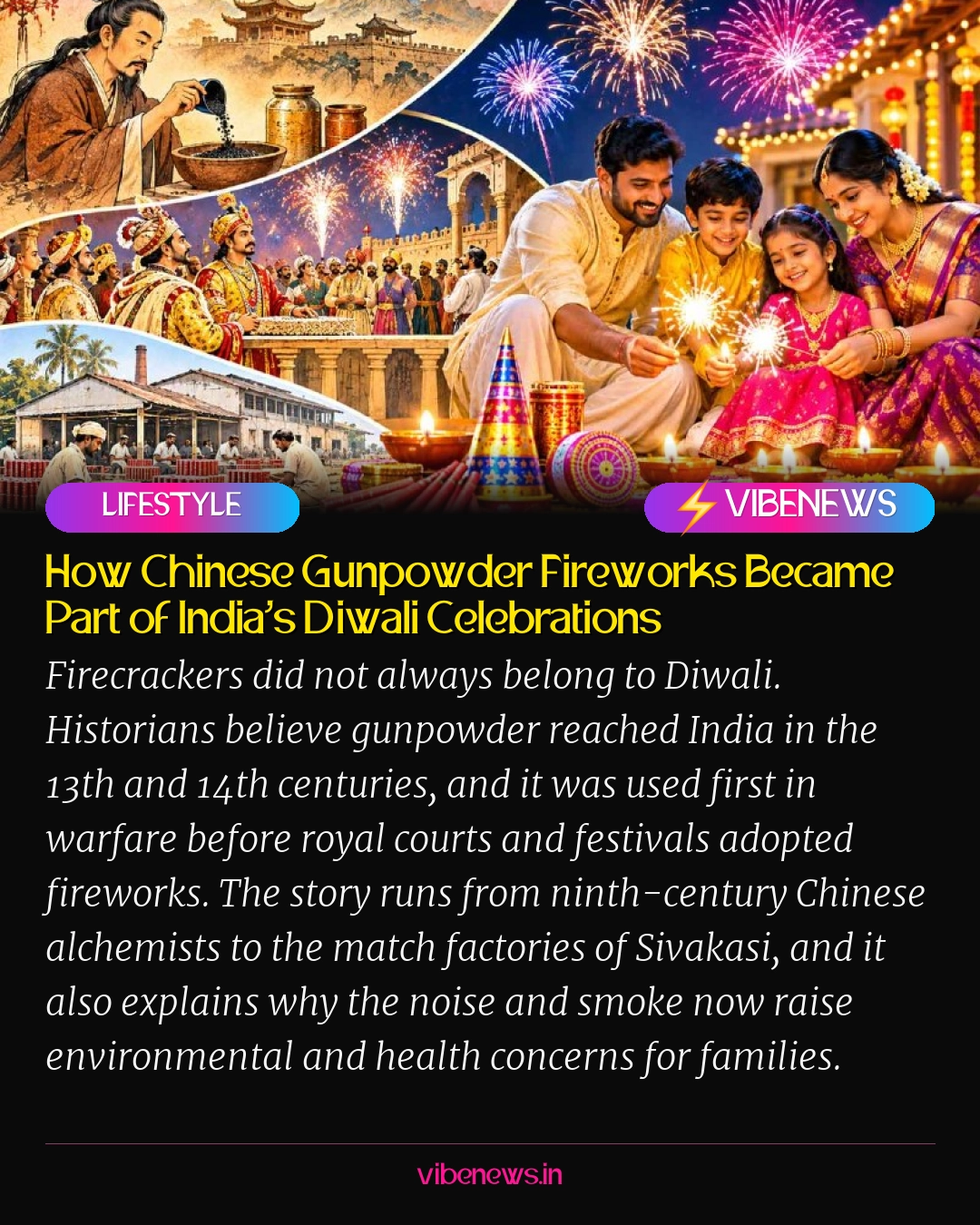
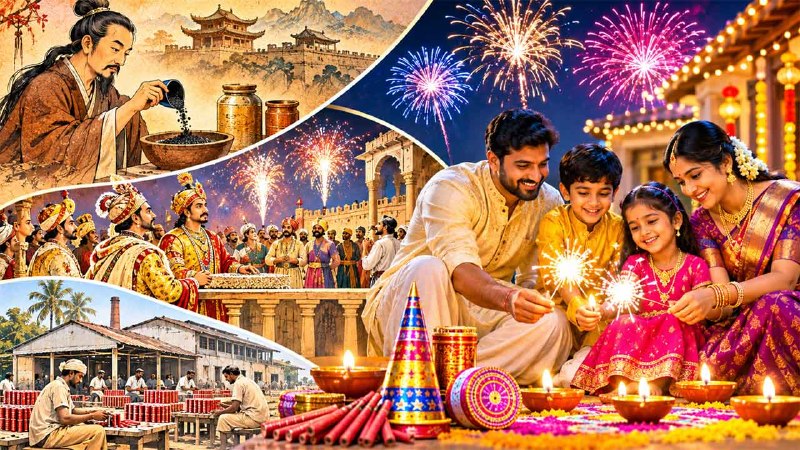
Historians believe gunpowder reached India in the 13th and 14th centuries, but fireworks took considerably longer to become part of Diwali. The lamps of Diwali have always been lit, but the crackers that now fill the night sky arrived later, and their path from China to Indian festivals is longer than most people assume.
The Chinese roots of the crackle
The story begins in China. Historical evidence suggests that alchemists in China discovered gunpowder around the 9th century. The mixture was made from saltpetre, which is potassium nitrate, along with sulphur and charcoal.
At first, the material was used in various experiments. Then people began packing the mixture into bamboo tubes and setting it off. Chinese communities of the time believed that the loud bang could drive away evil spirits.
The loud bang, the Chinese believed, would drive away evil spirits.
Over time, the practice moved from ritual into entertainment. Festivals and celebrations began to feature it as a form of amusement, and the custom spread to other parts of the world.
Gunpowder arrives in India, first for war
Nobody can point to a precise date when the knowledge of fireworks reached India. Historians think trade, travel and warfare carried gunpowder knowledge into the country in the 13th and 14th centuries. In the early years, it was used mainly in battles.
Later, the material found its way into celebrations. Royal festivities, weddings and other occasions began to include fireworks displays.
Vijayanagara and the Mughal courts
One of the clearest early records comes from the Vijayanagara Empire. In 1443, Abdur Razzaq, an envoy of the Timurid Sultan Shah Rukh, visited the court of the Vijayanagara king Deva Raya. He described various kinds of fireworks displays during the Mahanavami celebrations held there.
That account suggests that by the 15th century, fireworks were already part of festivals and royal ceremonies in India.
The Mughal period gave fireworks even more prominence. Displays became a symbol of royal grandeur. Fireworks lit up the sky during royal weddings, special events and festivals. A 1633 painting linked to the wedding of Mughal prince Dara Shikoh shows fireworks displays. Mughal paintings from the 18th century also show women setting off fireworks.
When Diwali and fireworks came together
Lighting lamps for Diwali is a very old tradition. Setting off firecrackers, however, was not part of the festival from the beginning.
According to the research of historian P.K. Gode, fireworks may have entered Diwali celebrations after around 1400, when gunpowder had already begun to be used for war in India. Some paintings from the 16th and 17th centuries show fireworks being fired during Diwali. Mughal-era paintings also show women and members of royal families celebrating with fireworks.
By the 18th century, fireworks had become a larger part of royal Diwali celebrations. Marathi historical texts mention that kings in the Kota region of Rajasthan held Diwali celebrations over four days, with large-scale fireworks displays.
How Sivakasi became the firecracker capital
Today, when people in India think of firecracker manufacturing, the name that comes up first is Sivakasi in Tamil Nadu. The town is known across the country for making fireworks.
Its rise is tied to a match factory. In 1923, two brothers, Shanmuga Nadar and Ayya Nadar, went to Kolkata to learn how to make safety matches. After returning, they started a match industry in Sivakasi. They later trained in firecracker making and entered that field as well.
After independence, the domestic fireworks industry expanded. Sivakasi gradually became the main centre of firecracker production. New factories came up, output rose, and rising purchasing power brought fireworks within reach of ordinary households.
From royal entertainment to a common celebration
Fireworks that were once limited to royal forts and courts slowly became part of everyday celebrations. The practice spread further in the 19th century. In the 20th century, as manufacturing grew and firecrackers became more widely available, they took a bigger place in Diwali festivities.
That is why Diwali now brings to mind both lamps and the noise of crackers. The two traditions came from very different origins, one ancient and rooted in the home, the other borrowed from gunpowder and royal spectacle.
The cost of the celebration
The history is fascinating, but the source also raises a warning. Smoke, dust and noise from firecrackers affect air quality. Children, elderly people and those with breathing problems may be especially vulnerable.
For that reason, the report says families should take care that their celebrations do not become a problem for others. Celebrating Diwali in a safe and environmentally friendly way is the better choice.
TL;DR
- Gunpowder is believed to have reached India in the 13th and 14th centuries, mainly through trade, travel and warfare.
- Fireworks entered Diwali celebrations later, possibly after around 1400, according to historian P.K. Gode’s research.
- A 1443 account by envoy Abdur Razzaq describes fireworks at Mahanavami celebrations in the Vijayanagara court.
- Sivakasi’s firecracker industry grew from a match factory started by two brothers after their 1923 training in Kolkata.
- Smoke, dust and noise from firecrackers can affect air quality and pose risks to children, elderly people and those with breathing problems.