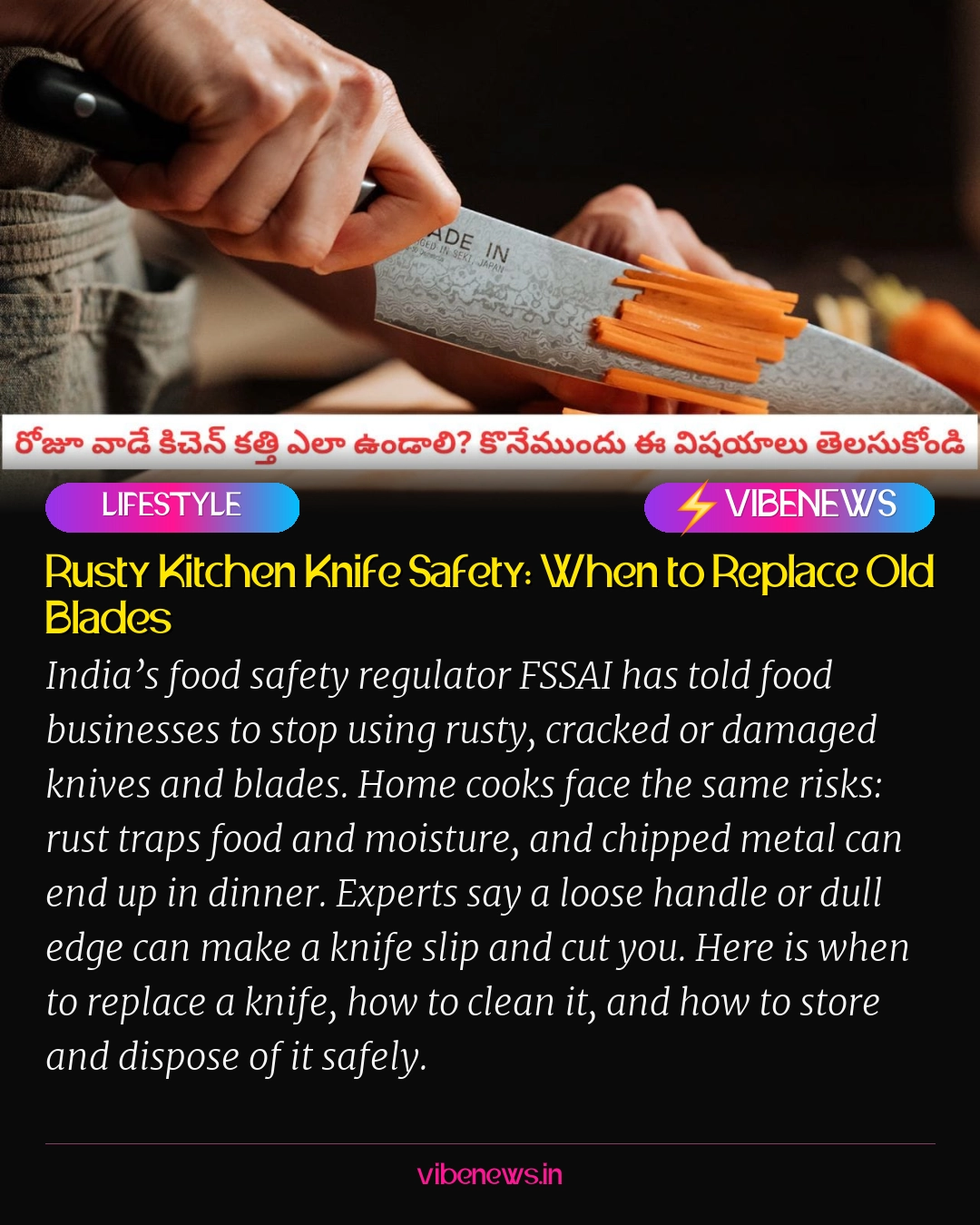

India’s food safety regulator, FSSAI, has advised food businesses not to use rusty, cracked or damaged knives and blades. The guidance came in June 2026. Its rules mainly target commercial kitchens, but the same risks sit in almost every home kitchen.
A knife you use every day can quietly turn into a hazard. Rust, chips and loose handles do not just look bad. They put food, and your hands, at risk.
Rust is more than a cosmetic problem
Rust on a blade should never be ignored. The corroded surface turns rough, and that roughness gives food scraps and moisture a place to collect. Tiny particles of rust or metal can also mix into the food you are preparing.
The usual habit is to scrub the rust off and keep using the knife. That is not always the safe choice. Check the blade carefully first and ask whether it can still be used safely. If the rust runs deep, the blade is damaged, or the rust cannot be fully removed, replace the knife.
Chips, cracks and loose handles mean stop now
Stop using a knife right away if the edge is chipping, the blade has cracks, or small pieces of metal are coming loose. Each of these signs can send metal fragments into vegetables, fruit or meat.
The handle matters as much as the blade. A broken handle or one that does not grip well can make the knife slip out of your hand and cause a serious cut. When you buy a knife, check that the blade and handle are firmly attached. If the knife wobbles, the handle cracks, or the blade shows deep scratches or cracks, replace it.
A rusty blade has a rough surface where food residue and moisture collect, and a broken or damaged blade should not be used at all.
What a good everyday knife looks like
For daily cooking at home, a good quality stainless steel knife is the safest bet. Stainless steel resists rust and is made from materials suited to food contact. The knife touches your food directly, so the material matters.
Choose a knife that is easy to clean and comfortable to hold. A medium-sized, sharp knife handles most vegetables and fruit in many households. Keep a small knife for small jobs and a larger one for big vegetables or bulky ingredients.
Sharpness is a safety issue too. A dull knife needs more force, and that extra force makes it more likely to slip and injure you. A sharp blade cuts with control.
Cleaning right after use prevents rust
Clean a knife as soon as you finish using it. Wash it with dishwashing liquid, rinse it under clean water, then dry it with a cloth or let it air dry fully.
Acidic foods need extra attention. Lemon, tomato and tamarind can leave residue that sits on the blade. Do not let that residue linger. Moisture and food left on a blade for long periods can cause rust or stains on some knives.
Do not toss knives into the sink in a pile with other utensils. Wash each knife separately and carefully so you do not cut your hand. Once knives are fully dry, store them in a safe rack or a dedicated drawer. Keep them away from children.
Stop cross-contamination before it starts
Raw meat, fish and chicken carry their own risks. Never use a knife that has just cut raw meat, fish or chicken on vegetables or other ready-to-eat food without cleaning it first. Wash the knife and the cutting board with soap in between uses.
Where possible, use separate cutting boards for raw meat and for vegetables. This simple habit cuts down the chance of spreading bacteria from one food to another.
Before you pick up any knife, look it over. Check for rust, cracks, and metal coating that is flaking off. If you see any of these signs, do not use the knife for food.
Dispose of old blades safely
Do not throw a damaged knife into regular household trash. Sharp blades can injure garbage collectors and anyone who handles the bin. Place the knife in a sturdy container that a blade cannot puncture, and then dispose of it.
The message from the guidance is simple. A knife is a tool, and a damaged tool is not worth the risk. Replacing a rusty or broken knife costs far less than a cut, a contaminated meal or a trip to the doctor.
TL;DR
- FSSAI has advised food businesses not to use rusty, cracked or damaged knives and blades, as of June 2026.
- Rust gives food scraps and moisture a place to collect, and tiny rust or metal particles can end up in food.
- Stop using a knife immediately if its edge is chipping, the blade is cracked, or metal pieces are coming loose.
- A loose handle or dull blade can make a knife slip, so replace knives that wobble or need extra force.
- Wash knives right after use with dishwashing liquid, rinse, dry fully, and never use a knife that cut raw meat on ready-to-eat food without cleaning it.
- Dispose of damaged blades in a sturdy, puncture-resistant container, not regular household trash.