Paddy crops are withering across several acres in the erstwhile Palamuru region, and the Bharat Rashtra Samithi (BRS) is pinning the blame on the Congress government. The party says pending works on the Palamuru-Rangareddy Lift Irrigation (PRLI) project have not been completed, and farmers are paying the price.
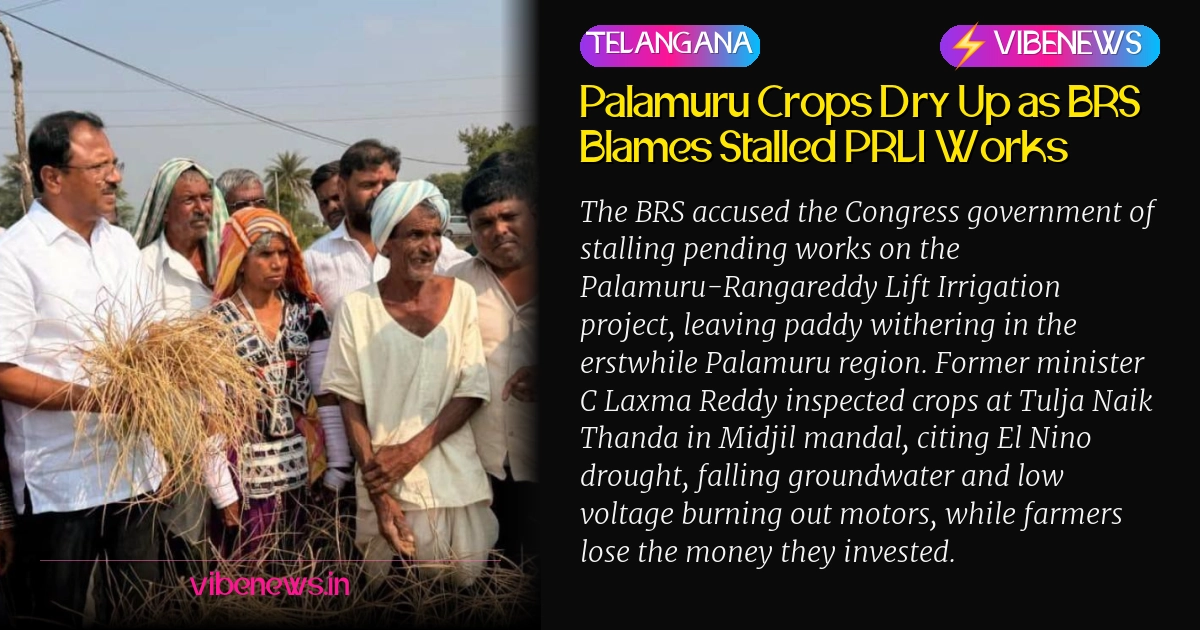
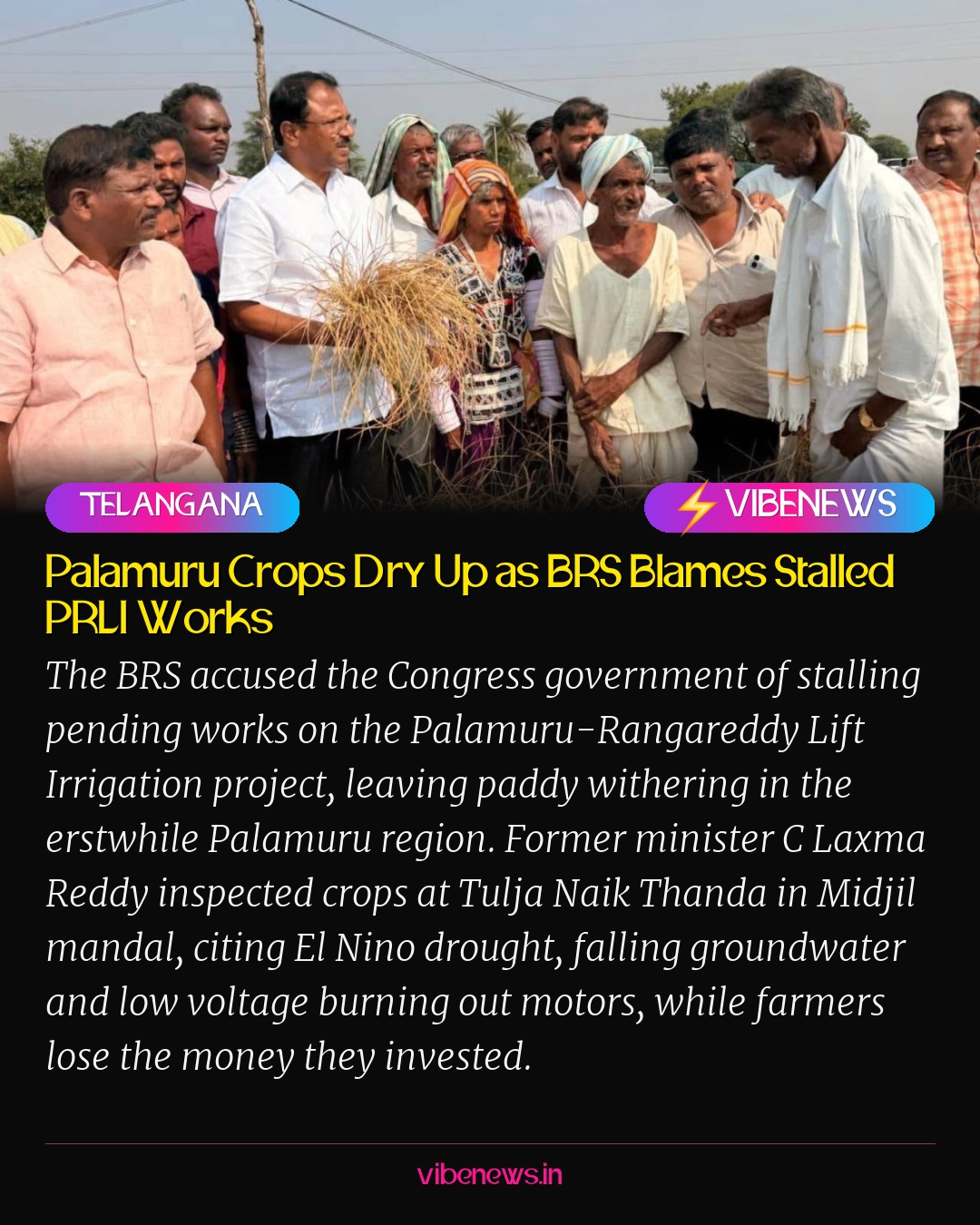
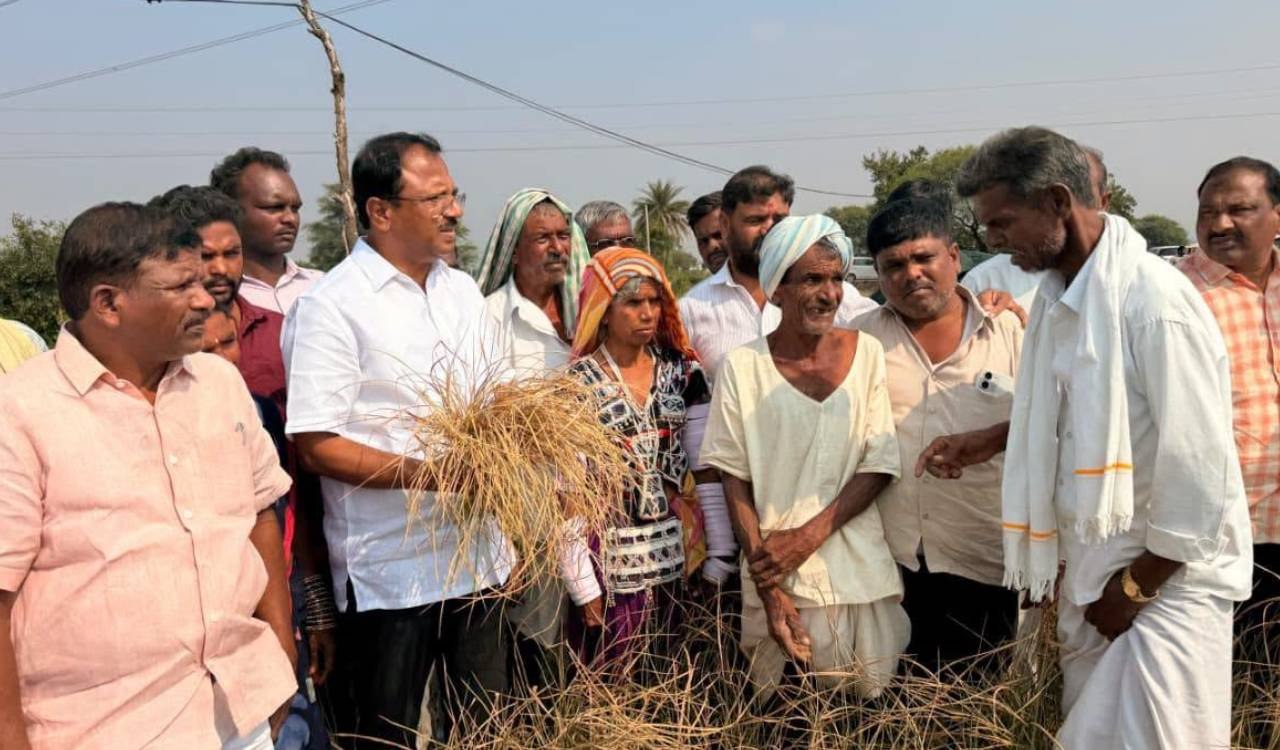
Former Minister C Laxma Reddy inspected the damage at Tulja Naik Thanda in Midjil mandal on Saturday. He walked past withered paddy and said standing crops were failing in several parts of the State, not just in one village. Farmers had put money into their land and worked it hard, he said. Now their efforts are going to waste.
Laxma Reddy did not argue that the weather was blameless. He acknowledged the El Nino effect and the drought-like conditions gripping the area. But he insisted the crops around Midjil should not have withered at all, because the fields sit close to the Kalwakurthy Lift Irrigation (KLI) canal. That proximity, in his telling, is the heart of the grievance.
“Had the Palamuru-Rangareddy project been completed, this situation would not have arisen,” Laxma Reddy said.
That single line carries the whole charge. The BRS leader alleged that the Congress government had kept the project works pending for the past three years. He said the government could have brought water to the Karivena Reservoir but failed to do so. These are his claims, and they form the core political accusation in this story.
Water is not the only pressure on farmers here. Groundwater levels have fallen sharply, according to the report, and that drop removes one of the few backup sources farmers rely on when canal water is unavailable. Power problems are adding a second layer of damage. Low voltage is causing motors and transformers to burn out, and Laxma Reddy said the electricity crisis is widespread across the State and is resulting in crop losses.
Why this matters for Telangana. This is not a distant policy argument. The Palamuru-Rangareddy project sits inside Telangana, and the dispute goes straight to the question of whether a major lift irrigation scheme can protect farm fields when the rains fail. Laxma Reddy’s claim that completing the project would have prevented these losses puts the state government’s handling of unfinished infrastructure under direct scrutiny. The crops at Midjil are not an abstract statistic. They are the visible proof of a promise that, according to the BRS, has not been kept.
The warning beyond one mandal. Laxma Reddy did not limit his concern to Midjil. He said standing crops were withering in several parts of the State. That pattern matters. When a dry spell, falling groundwater and unreliable power arrive at the same time, a bad season can turn into a crisis for farm households. Each of those pressures alone is hard to absorb. Together, they leave little room for error, and the people least able to absorb a lost crop are small cultivators who have already spent their savings on seed, labour and water.
The politics of blame. The accusation is sharp, and it comes from the opposition at a moment when farmers are visibly under strain. The BRS is framing the failure as a choice of priorities, not an accident of nature. Laxma Reddy acknowledged the drought, which shows the argument rests less on denying the weather than on arguing that a finished project would have softened its impact. That distinction will matter to voters in the region, because it shifts the question from whether the rains failed to why the infrastructure that was supposed to backstop them was not ready.
What the report does not say. The available account does not include a response from the Congress government to the BRS allegations. It does not give a figure for how many acres have been lost across the region or the State. It also does not detail the current status of the pending PRLI works or a timeline for completion. Those gaps leave the central claim standing on the BRS side of the record for now. Readers should weigh the allegations against official data once it becomes available.
What comes next. The immediate question is whether the damage at Midjil will prompt a formal response on the PRLI works, the Karivena Reservoir water supply, and the power supply problems that Laxma Reddy described. Farmers in the erstwhile Palamuru region are watching whether the dispute produces water, power and repairs on the ground, or stays a fight over who failed them. For now, the fields at Tulja Naik Thanda show what the wait is costing the people who planted them.
TL;DR
- BRS accuses the Congress government of leaving PRLI project works pending, blaming it for crop losses in the Palamuru region.
- Former Minister C Laxma Reddy inspected withered paddy at Tulja Naik Thanda in Midjil mandal on Saturday.
- Laxma Reddy acknowledged El Nino and drought-like conditions but said Midjil crops should not have withered near the KLI canal.
- He alleged the government kept project works pending for three years and failed to bring water to Karivena Reservoir.
- Groundwater has fallen sharply, and low voltage is burning out motors and transformers across the State.