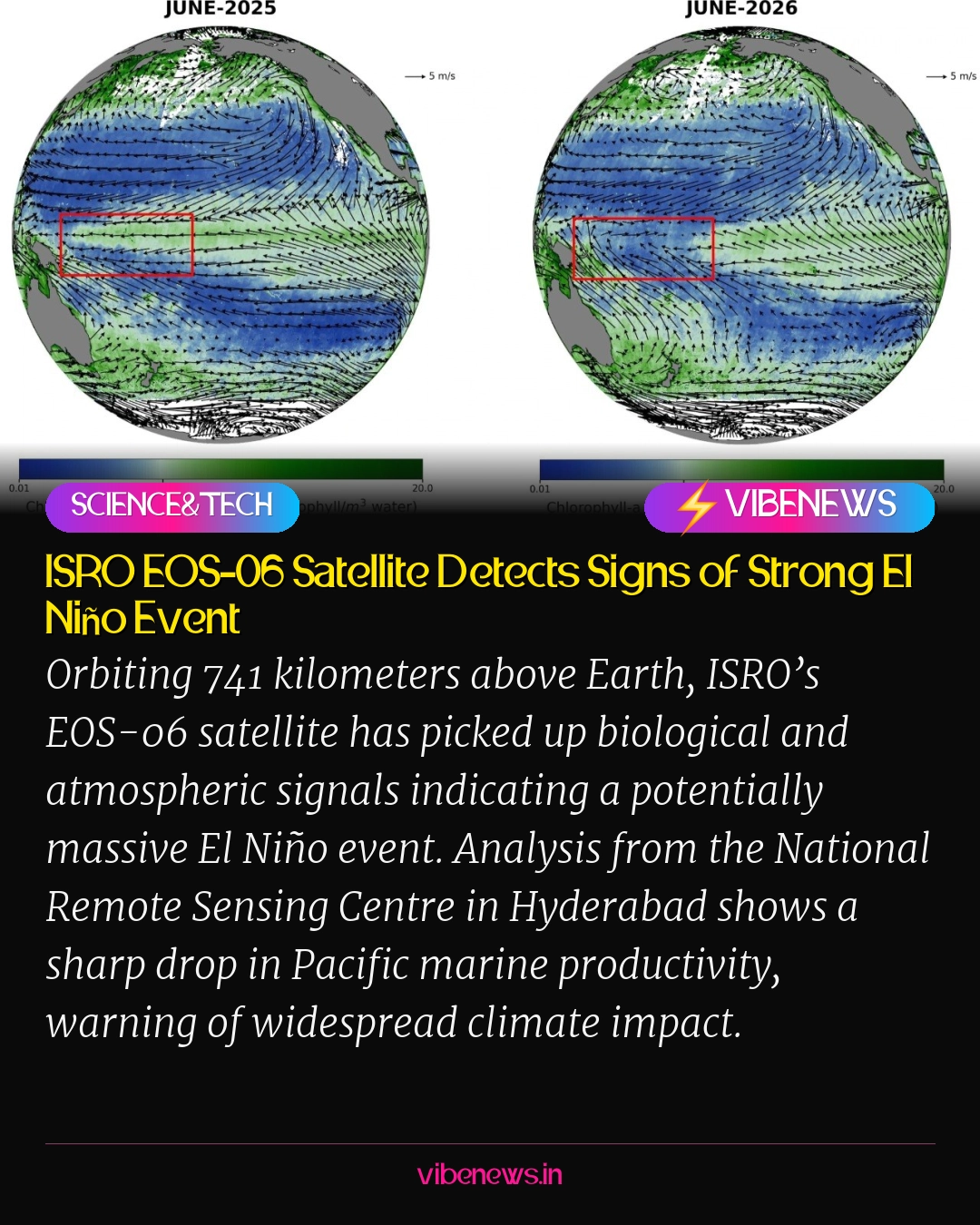

High above the planet at an altitude of 741 kilometers, Indian space technology is witnessing a profound environmental transformation unfold across the vast expanse of the equatorial Pacific Ocean. Long before traditional weather instruments register widespread rainfall shifts on land, ISRO’s EOS-06 satellite—famously known as Oceansat-3—has detected subtle biological and atmospheric signatures that point toward an escalating El Niño phenomenon. These cosmic observations indicate that global climate dynamics may be shifting toward a formidable event, dubbed by some observers as an emerging ‘Godzilla El Niño’ whose most severe consequences have yet to manifest.
This satellite-driven discovery aligns closely with recent outlooks issued by global climate agencies. In its update, the World Meteorological Organization estimated an 80 percent probability of El Niño conditions materializing, with multiple predictive models projecting a high-intensity event. As atmospheric conditions intensify, spaceborne observations from EOS-06 have captured a distinct drop in marine productivity spread across the tropical Pacific Ocean, offering scientists a vivid look at the cascade of environmental changes taking place underwater.
Microscopic Signals from Space
The primary signal captivating researchers is a sudden, localized drop in chlorophyll-a, the essential photosynthetic pigment found in microscopic marine plants known as phytoplankton. Serving as the invisible foundation of the entire oceanic food web, these microscopic organisms react almost instantly to changes in ocean temperature and nutrient levels. Data gathered in June 2026 by ISRO’s National Remote Sensing Centre (NRSC) in Hyderabad, Telangana, revealed a notable reduction in surface chlorophyll-a levels compared to the neutral ENSO baseline periods of 2024 and 2025.
Because biological organisms respond far more rapidly to physical changes in the water column than thermal bulk measurements do, chlorophyll depletion provides a significantly earlier warning indicator of El Niño onset than conventional sea surface temperature indices, which often require weeks of sustained warming before reaching official thresholds.
"The important inference is that apart from Sea Surface Temperature (SST), phytoplankton depletion also gives clear indication of El Niño status and its impact on ocean response in the Pacific Ocean," Prakash Chauhan said.
According to Dr. Prakash Chauhan, Director of ISRO’s NRSC in Hyderabad, the warming of upper ocean layers in the eastern Pacific suppresses the upwelling of cold, nutrient-rich water from the deep ocean. As this vital nutrient supply diminishes, phytoplankton growth plummets. This biological shift is accurately recorded by the Ocean Colour Monitor aboard EOS-06, demonstrating the remarkable power of space monitoring in tracking living ecosystems.
Wind Reversals and Ocean Dynamics
In tandem with optical biological measurements, the EOS-06 satellite carries a sophisticated Scatterometer that monitors physical atmospheric dynamics above the sea surface. Recent data shows a classic signature of El Niño development: a distinct reversal of ocean surface winds from trade-wind easterlies to westerlies. During typical non-El Niño years, steady trade winds push warm surface water toward the western Pacific, enabling nutrient-rich upwelling off the coast of South America. When these winds weaken or reverse, warm water surges eastward, collapsing deep-water upwelling and causing marine productivity to plummet across thousands of miles of open ocean.
This alteration in ocean heat distribution disrupts large-scale atmospheric circulation patterns, exerting profound influences on global rainfall distribution, drought conditions, and storm tracks across multiple continents.
Monsoon Impact and Regional Relevance
For India, the strengthening of El Niño carries major agricultural and climatic weight, as the phenomenon has historically been linked with erratic or deficient southwest monsoon rainfall. Variable atmospheric circulation over the Pacific Ocean alters the broader air currents that drive monsoon systems over the Indian subcontinent. The India Meteorological Department (IMD) confirmed that moderate El Niño conditions are currently established across the central and eastern equatorial Pacific and are expected to strengthen further throughout the monsoon season, corroborated by the Monsoon Mission Coupled Forecast System.
The potential for a powerful El Niño taking shape at a time when global surface temperatures are already exceptionally high has focused global scientific attention on these remote orbital findings.
Advanced Space Technology in Action
Launched aboard the Polar Satellite Launch Vehicle (PSLV) on November 22, 2022, EOS-06 was designed specifically to observe earth-system interactions with exceptional detail. By combining real-time chlorophyll tracking from the Ocean Colour Monitor-3 with precise wind velocity fields from the Scatterometer, the satellite forms a dual-mode early warning system. Scientists emphasize that while satellite measurements of wind reversals and chlorophyll loss offer compelling early proof, monitoring will continue alongside parameters such as thermocline depth, sea level anomaly, and surface temperature. Nevertheless, from its high vantage point in orbit, the Indian satellite has proved its capability to capture the earliest footprints of one of Earth’s most impactful climate cycles.
TL;DR
- ISRO’s EOS-06 satellite detected early biological indicators of a powerful emerging El Niño from 741 kilometers above Earth.
- Data analyzed by the National Remote Sensing Centre in Hyderabad reveals a sharp drop in ocean chlorophyll-a levels.
- Satellite sensors also registered a dramatic reversal of tropical ocean surface winds from easterlies to westerlies.
- Chlorophyll depletion offers an earlier warning signal for El Niño than traditional ocean surface temperature measurements.
- The World Meteorological Organization estimates an 80 percent probability of El Niño conditions developing and intensifying.