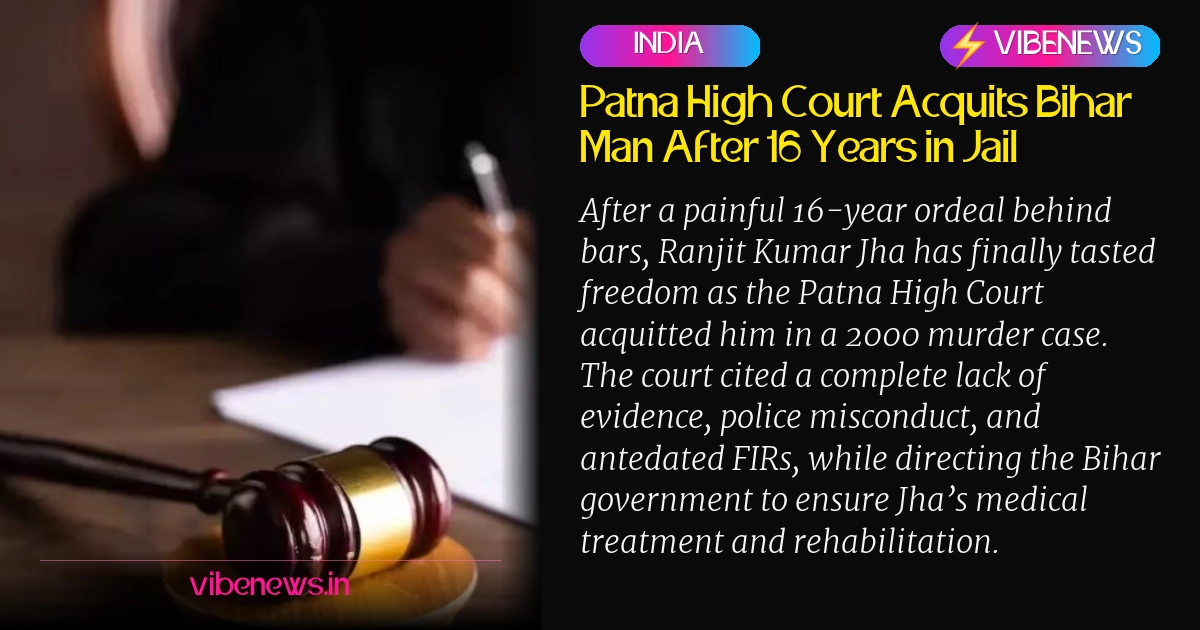
For sixteen long years, Ranjit Kumar Jha remained trapped behind bars for a crime he never committed, watching his youth fade away in the shadows of incarceration. In a triumphant victory for justice that brings relief and vindication, the Patna High Court has finally exonerated Jha in connection with a 2000 murder case, holding that the prosecution completely failed to establish any charges against him.
A Web of Lies and Fabricated Evidence
The tragic saga began when Jha was wrongfully convicted under Section 302 of the IPC by a trial court in Samastipur for the alleged murder of Pawan Kumar Jha over a petty dispute of Rs 3,300. The prosecution claimed that the deceased’s brother witnessed Jha fleeing the crime scene. However, a division bench of Justices Rajeev Ranjan Prasad and Kumar Manish tore apart the prosecution’s false narrative in its September 10 judgment, uncovering shocking levels of police connivance and fabrication.
The High Court highlighted glaring inconsistencies in the testimonies of hostile witnesses and questioned why independent witnesses were never examined. Crucial physical evidence was glaringly absent or mishandled. While the informant claimed to have seen the suspect using a torch, the torch was neither seized nor produced in court, and the investigating officer found no other light source at the scene.
Furthermore, although a pistol was recovered by the police, authorities inexplicably failed to send it for forensic examination to verify if it fired the fatal bullet.
“The pistol was found active, but it was not sent to the FSL to get a report as to whether the firing was done on the deceased by the said pistol on the date/time mentioned by the prosecution,” the court observed.
Antedated FIR and Police Misconduct
The bench also uncovered troubling discrepancies regarding the official paperwork. While the First Information Report (FIR) was listed as registered on October 5, 2000, it was not received by the magistrate until October 9, leading the court to conclude that the document was deliberately antedated.
Delivering a scathing rebuke of law enforcement, the bench noted that police officials, right from the SHO to the IO, had actively indulged in preparing a false case against Jha in collusion with inimical witnesses.
“In result, this court finds that it is a case of no evidence against the appellant,” the bench said while acquitting Jha.
Restoring Dignity After Severe Human Toll
The heart-wrenching cost of this miscarriage of justice was not lost on the court. Prolonged wrongful incarceration took a severe emotional and physical toll on Jha, causing him to suffer from severe depression and mental illness during his time in prison, compounded by delays in considering his premature release.
Bringing a sense of hope and closure to this agonizing chapter, the High Court directed the Bihar Director General of Police to submit an action-taken report within two months against the guilty police officers. Additionally, the court ordered the state government to immediately prepare a comprehensive rehabilitation plan, ensuring proper medical treatment and support for Jha as he rebuilds his life after sixteen lost years.
TL;DR
- Patna High Court acquits Ranjit Kumar Jha after 16 years in prison for a 2000 murder case.
- Judges found zero evidence and noted police connivance with inimical witnesses to frame Jha.
- The court highlighted major investigative failures, including untested weapons and unproduced light sources.
- Bihar DGP directed to submit an action-taken report on guilty police officials within two months.
- Court ordered full state rehabilitation and medical treatment for Jha, who suffered depression in jail.