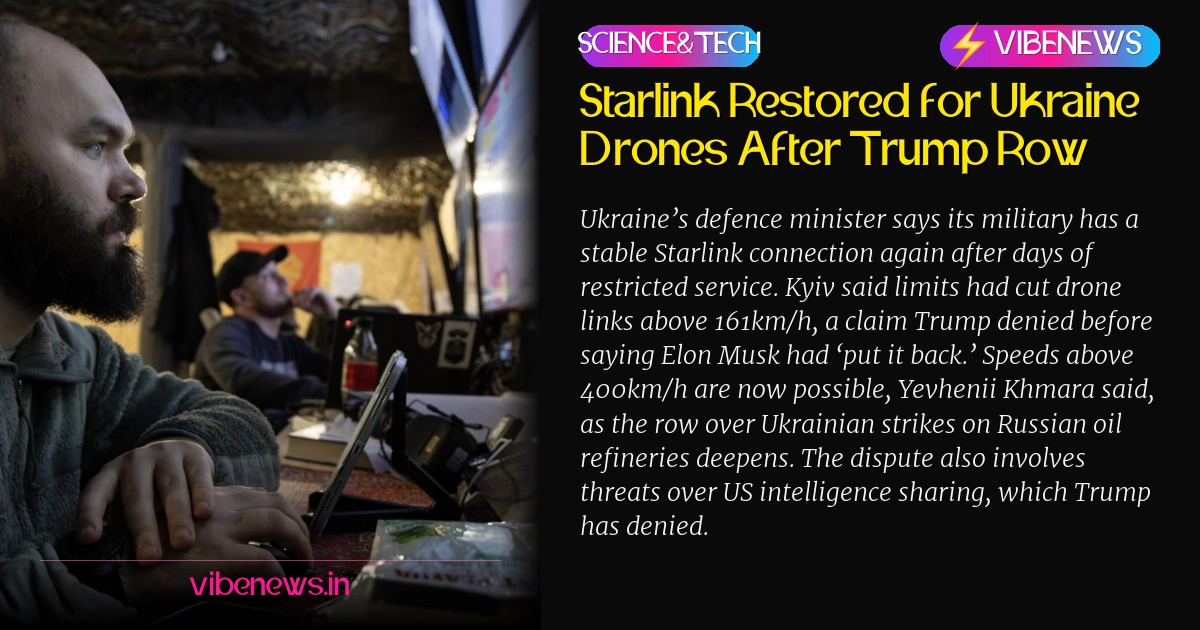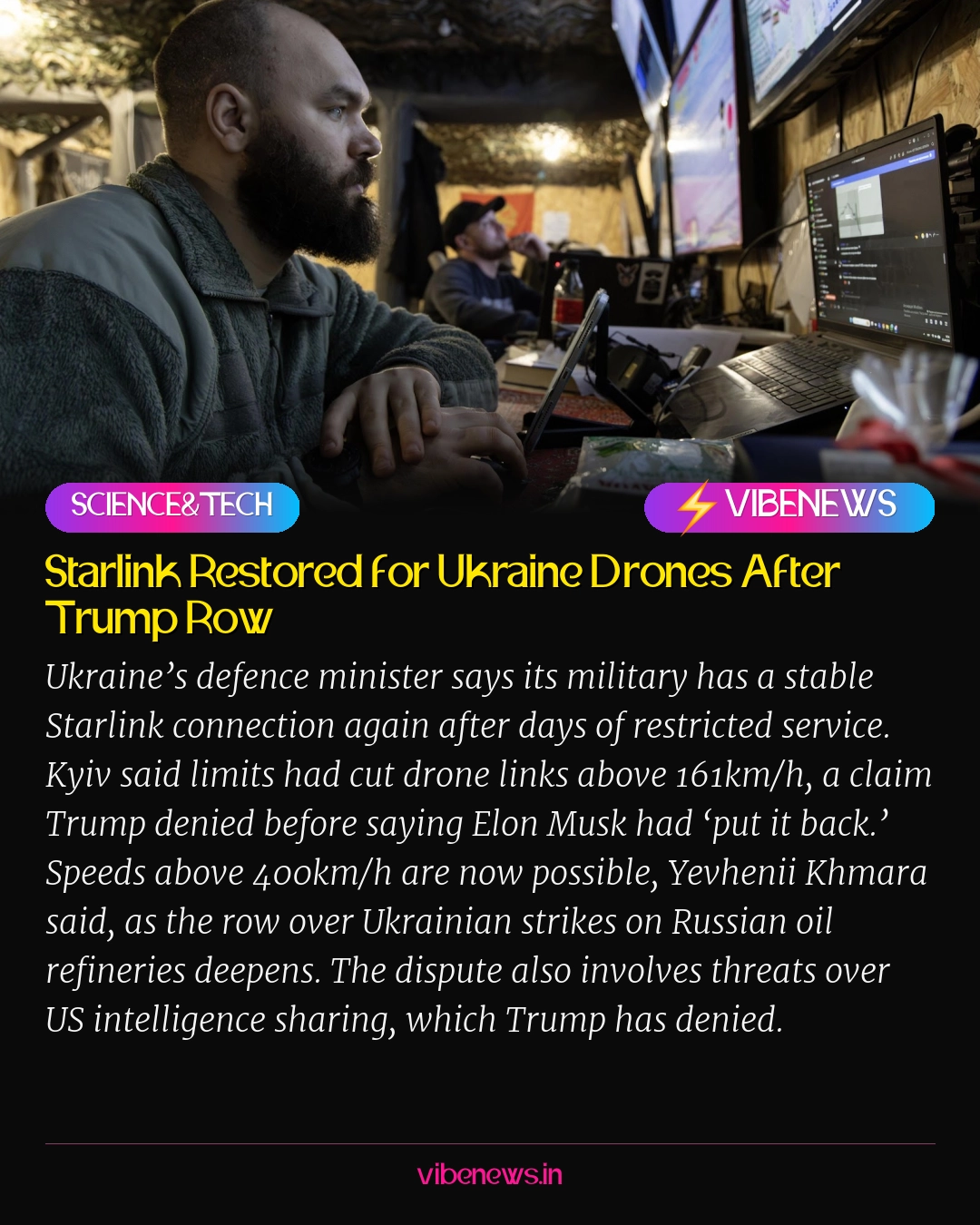

Ukraine says Starlink is stable again after days of drone disruption
Ukraine has a stable Starlink connection again after days of restricted satellite internet service, Defence Minister Yevhenii Khmara said in a statement on Saturday. Speeds of more than 400km/h are now possible on the network, he said, which indicates full capability has been restored.
The disruption hit at the worst possible moment. Kyiv relies on Starlink and its military-grade counterpart Starshield to pilot drones and run operations inside Ukraine. Last week, Ukraine accused US President Donald Trump of telling Starlink owner Elon Musk to place limits on the service. According to Kyiv, those limits meant drones lost their connection when travelling at 161km/h (100mph) or more.
Trump denied doing so. He then said Musk had “put it back.” Musk, for his part, had suggested the Pentagon could be behind the recent issues, pointing out that Starshield is controlled by the US military.
Why the network matters on the front line
Ukraine’s military uses the network of around 10,000 low Earth orbit satellites extensively, particularly in remote areas of the battlefield. For commanders, a dropped link is not a minor inconvenience. It can mean a drone falls out of control or a supply run goes dark.
Khmara framed the restoration in those terms. “This result is above all important for our front, for our soldiers, for the operation of drones, for logistics and for communications,” he said.
A diplomatic row with a wider reach
The Starlink problem did not arrive in isolation. It emerged during a broader diplomatic row between Trump and Ukrainian President Volodymyr Zelensky over Ukrainian strikes on Russian oil infrastructure.
Zelensky said that, alongside the apparent limits on Starlink, the US had threatened to withdraw intelligence sharing if the strikes did not stop. Trump also denied that claim.
The political backdrop is midterm elections next month. Trump has waived some sanctions on Russia and agreed a deal to import Russian diesel for the US market, a move criticised by Ukraine and its European allies.
Trump has argued that strikes on Russian oil refineries have pushed global prices higher. Kyiv says those refineries are crucial to stemming the main revenue source for Moscow’s war effort. The attacks have had an impact on global fuel prices, but the rises seen this year have primarily been due to the Iran war, according to the reporting.
Fighting continues on the ground
While the connectivity fight played out in political statements, the battlefield kept moving. Russia’s ministry of defence said on Telegram on Saturday that its air defences shot down 616 Ukrainian fixed-wing drones, which struck a number of regions across the country, including Russian-annexed Crimea.
Sergey Aksyonov, the Moscow-backed governor of the region, said restrictions on electricity and water had been introduced because of power cuts caused by the drone strike.
Ukrainian authorities said they had struck a missile component manufacturer, a chemical plant and an aircraft at a military airfield inside Russia in the past 24 hours. They also said Russia carried out 88 air strikes on Friday, using 309 glide bombs and 10,270 kamikaze drones.
What comes next
For now, the immediate crisis appears to be easing. Ukraine’s military has its connectivity back, and the speeds Khmara described suggest the network is working at full capacity. The unresolved questions are larger. Who imposed the limits, and why, remains disputed between Kyiv, Washington and Musk. Ukraine’s dependence on a single commercial network, with a military variant controlled by a foreign government, has now been exposed in the middle of a war.
TL;DR
- Ukraine says its Starlink connection is stable again after days of restricted service.
- Kyiv accused Trump of pressing Musk to limit the network; Trump denied it and said Musk had ‘put it back.’
- Drones reportedly lost connection above 161km/h (100mph) during the disruption.
- Defence Minister Yevhenii Khmara says speeds above 400km/h are now possible again.
- The row is tied to Ukrainian strikes on Russian oil refineries and alleged threats over intelligence sharing.