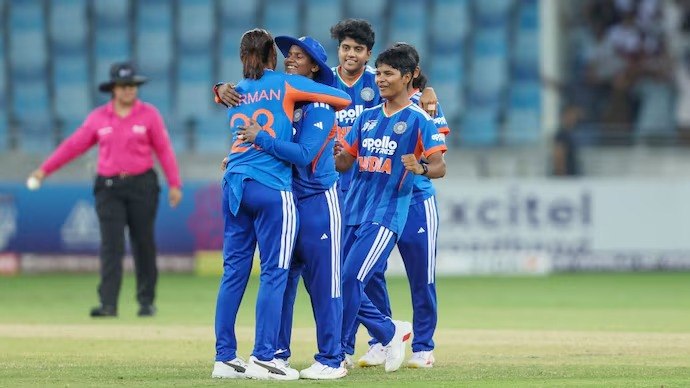
India secured their eighth Women’s Asia Cup trophy in Dubai through commanding statistical victories over regional opposition, yet the triumph fails to conceal systemic issues across the national squad’s setup. While blowout victories against Thailand by 94 runs, Pakistan for 55, and Hong Kong China for 56 created an illusion of absolute supremacy, the underlying performances exposed familiar vulnerabilities that previously derailed India’s T20 World Cup campaign in England.
Top-Heavy Batting Masks Middle-Order Collapse
The campaign relied almost entirely on the explosive opening partnership of Shafali Verma, who finished as the tournament’s top scorer with 236 runs, and Smriti Mandhana, who contributed 213 runs. Beyond this pair, the batting output disintegrated rapidly, exposing severe structural flaws that top-tier international teams will ruthlessly exploit.
The prolonged crisis at the No. 3 batting position remained completely unresolved throughout the tournament. In the absence of Jemimah Rodrigues, management assigned the role to Pratika Rawal, who struggled immensely by compiling just 56 runs across four innings at an average of 14 and a strike rate of 98.24. Rawal was ultimately dropped for the final in favor of Kamalini, while captain Harmanpreet Kaur promoted herself to No. 3 in the title match only to produce a laboring 14 off 14 deliveries. This ongoing experimentation mirrors previous failed reshuffles involving Yastika Bhatia and Rodrigues during the T20 World Cup, confirming that management has yet to establish a dependable top-order anchor.
Alarming Lack of Lower-Order Power and Depth
The statistical disparity across the batting order is damning. Behind Verma and Mandhana, India’s third-highest run-scorer in the entire tournament was Harmanpreet Kaur with a modest total of just 71 runs. The lower middle order offered virtually no resistance or finishing power. Wicketkeeper-batter Richa Ghosh, burdened with late-overs acceleration due to injuries to key all-rounders Pooja Vastrakar, Amanjot Kaur, and Kashvee Gautam, registered only 49 runs in five matches, hitting just two fours and three sixes. Specialist batter Bharti Fulmali looked out of her depth, managing a dismal 17 runs across five appearances.
Pace Department Fragility and Fielding Misery
While spinners Deepti Sharma with 14 wickets, Sree Charani with 12, and Prema Rawat dominated on spin-friendly Dubai pitches, the pace attack highlighted significant vulnerability with the new ball. Nandani Sharma showed promise with seven wickets, but Kranti Gaud managed only two, leaving the fast-bowling unit without an experienced leader. Renuka Singh remained on the sidelines for the entire tournament without playing a single match after struggling for form prior to the upcoming Asian Games, leaving severe questions about seam control.
Compounding these tactical shortcomings was a sloppy fielded display that saw Indian fielders drop 12 catches across five matches. While weaker Asian nations failed to capitalize on these mistakes in Dubai, such permissive fielding standards in high-stakes fixtures against elite international opponents remain an unacceptable liability.
If those issues remain unresolved, another Asian Games gold could simply end up papering over cracks that are slowly beginning to widen.
As the squad prepares to head to Japan to defend their Asian Games gold medal following a short break, the tournament in Dubai proved that trophies alone cannot obscure technical defects. Without long-term solutions for the No. 3 spot, middle-order power hitters, pace leadership, and fielding sharpness, India’s dominance will remain fragile when facing top-ranked global rivals.
TL;DR
- India won the Women’s Asia Cup in Dubai, but glaring tactical weaknesses persist across the squad.
- Openers Shafali Verma (236 runs) and Smriti Mandhana (213 runs) carried the entire batting lineup.
- Severe No. 3 batting instability continued as Pratika Rawal managed only 56 runs before being dropped.
- India dropped 12 catches in five matches, highlighting ongoing fielding concerns.
- Fast bowling lacked leadership with Renuka Singh unplayed and Kranti Gaud taking just two wickets.