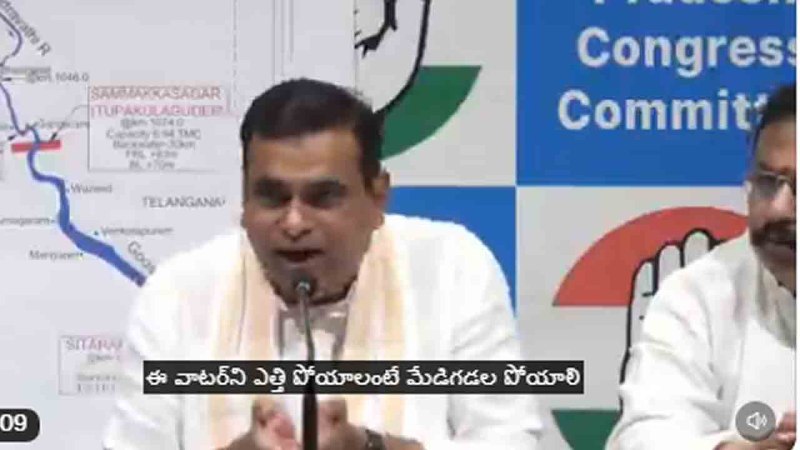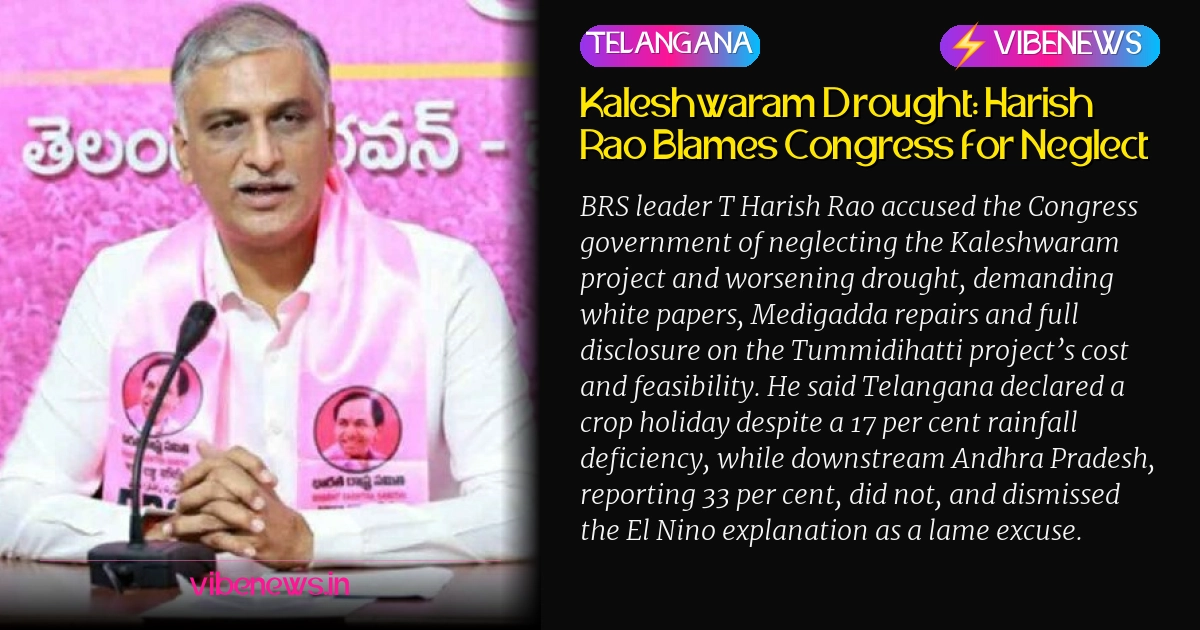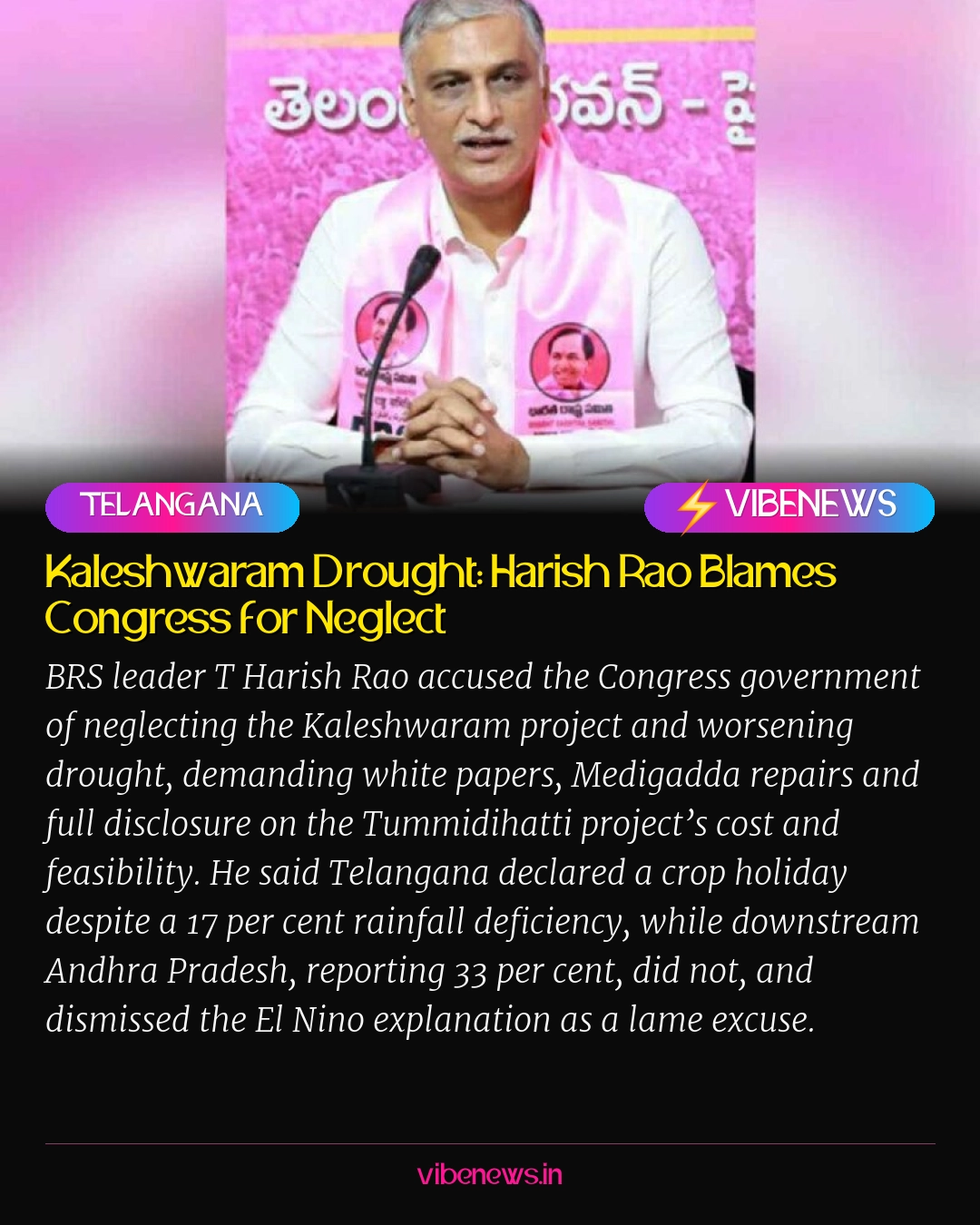
BRS deputy floor leader T Harish Rao on Monday accused the Congress government of neglecting the Kaleshwaram Lift Irrigation Scheme and aggravating drought conditions across Telangana, calling the government’s renewed talks with Maharashtra over the Tummidihatti project diversionary politics. He made the charge to reporters at Telangana Bhavan in Hyderabad.
Rao said the government’s engagement with Maharashtra was an attempt to cover up its failure to revive Kaleshwaram, which he described as the state’s only lifeline against drought. The statement was published on 26 October 2026.
Kaleshwaram kept idle
Rao held the Congress government squarely responsible for the dry conditions. He said the ruling party had kept the project idle for nearly three years to deny credit to BRS chief and former Chief Minister K Chandrashekar Rao. He urged the government to set politics aside and prioritise water supply to people.
He questioned why the government had not lifted water when flows in the Godavari and Krishna were better, and he rejected its argument on water availability. He also called the government’s blame on El Nino a lame excuse. In its place, he demanded a white paper on water flows in both rivers over the last five months.
The BRS leader’s demands were specific. He wanted an immediate resumption of water lifting from the Kannepalli pump house and urgent repairs to the Medigadda barrage. He also asked the government to disclose water availability, pump operating hours and the quantity of water lifted so far. In his view, the failure to use available water was the core reason the drought had deepened.
The crop holiday question
Rao pointed to the state’s own decisions to make his case. He asked why Telangana had announced a crop holiday despite a 17 per cent rainfall deficiency, while downstream Andhra Pradesh, which reported a 33 per cent deficiency, had not. For him, the contrast exposed a government that was not using its infrastructure to protect farmers.
The Andhra Pradesh comparison matters beyond Telangana’s borders. Water released from Telangana’s projects flows downstream, and Rao alleged that the government was allowing water to flow downstream while farmers in his own state faced hardship. That claim places the Kaleshwaram dispute squarely inside a shared river system that affects both states.
Devadula and Kalwakurthy under the scanner
Rao sought white papers on the operation of two more lift irrigation schemes, Devadula and Kalwakurthy. He alleged that effective operation of Devadula could have irrigated parts of the erstwhile Karimnagar district and large areas of the erstwhile Warangal district.
At Kalwakurthy, he said only two of the five motors were operating, and pumping was restricted to 12 hours a day. He set this against Andhra Pradesh’s use of the Pattiseema lift scheme and asked why Telangana was not running its own irrigation projects effectively.
He also made a serious allegation about the officials who advised the government. Rao said retired engineers who recommended operating the Kannepalli pumps had been threatened with punitive action. The claim, made without any response from the government in the report, adds a charge of intimidation to the political dispute.
The Tummidihatti argument
Rao’s sharpest criticism was aimed at the timing and handling of the Tummidihatti talks. He said the BRS government held negotiations with Maharashtra soon after taking office in 2014, with several rounds of talks that year and in 2015. Former Chief Minister Chandrashekar Rao personally urged Maharashtra to agree to a water level of 152 metres at Tummidihatti, Rao said.
By contrast, he said the present government took 1,054 days to hold its first meeting with Maharashtra. That gap became the centrepiece of his attack on the current administration’s commitment to the project.
Rao explained that the BRS had shifted its focus to Kaleshwaram after the Central Water Commission indicated that the required water was not available at Tummidihatti. He cited communications dated February 18, March 4 and March 13, 2015. In those letters, he said, the Centre questioned the availability of 160 TMCft and advised Telangana to explore alternatives.
He added that Hyderabad and other districts need about 50 TMCft for drinking water. Against that figure, he asked whether Tummidihatti could meet the state’s irrigation needs at all.
Cost and feasibility under fire
Rao said his party had no objection to the Congress pursuing Tummidihatti. His objection was to the proposal’s feasibility, water availability and likely cost. He challenged the government’s plan to spend about Rs 25,000 crore to bring water from Tummidihatti to Sundilla.
He suspected the cost could rise to Rs 30,000 crore or Rs 40,000 crore even before work began. He demanded that the government release the detailed project report and explain how water could flow by gravity from Tummidihatti to Yellampalli.
Then he put his own position on the line. The exchange below captured the sharpest moment of the press interaction.
"If Irrigation Minister Uttam Kumar Reddy proves that water could be supplied from Tummidihatti to Yellampalli through gravity without using lifts, I will resign immediately. Otherwise, will Uttam Kumar Reddy resign from his post?"
The challenge put the issue of gravity flow at the centre of the dispute, and it framed the Irrigation Minister’s answer as a test of credibility.
What BRS says it had planned
Rao set out the earlier BRS plans as a benchmark. He said the party had planned to lift 240 TMCft at Medigadda. It also developed the Chennur lift irrigation scheme to irrigate one lakh acres in the erstwhile Adilabad district. In addition, it prepared a detailed project report for a 20-TMCft Wardha project.
According to Rao, the Wardha proposal was returned by the Centre after the Congress came to power. He presented that as further evidence that projects under the previous government had been stalled.
Repairs and the dam safety question
Rao cited findings attributed to the National Dam Safety Authority and the Central Water and Power Research Station. He said these findings showed the state could decide on lifting water. He also said the Annaram and Sundilla barrages were reported to be in good condition.
He accused the government of delaying repairs to Medigadda for political reasons. He then questioned Chief Minister A Revanth Reddy’s assertion that money could be obtained through various means but water could not be bought. Rao asked why the government was not lifting water when the opportunity existed.
Keeping Kaleshwaram idle, he argued, was worsening the drought and hurting farmers. He closed by urging the government to stop political diversions and safeguard the State’s interests.
What remains unanswered
The report presents Rao’s allegations and demands, and it does not include a response from the Congress government on the specific claims about pump hours, engineers or the Tummidihatti cost estimates. Those questions are now the core of the argument. The government has the documents Rao is asking for, including water availability data, pump operating records and the detailed project report.
For farmers in both Telangana and downstream Andhra Pradesh, the dispute is no longer abstract. It concerns whether pumps run, whether barrages get repaired and whether water reaches fields during a drought that has already forced a crop holiday in one state.
TL;DR
- BRS’s T Harish Rao accused the Congress government of neglecting Kaleshwaram and aggravating Telangana’s drought conditions.
- He demanded a white paper on Godavari and Krishna river flows over the last five months.
- Rao said Kannepalli pump lifting and Medigadda barrage repairs must resume immediately.
- He questioned why Telangana declared a crop holiday at a 17 per cent rainfall deficiency, unlike downstream Andhra Pradesh at 33 per cent.
- Rao challenged the Rs 25,000 crore Tummidihatti proposal and said he would resign if gravity supply is proven.