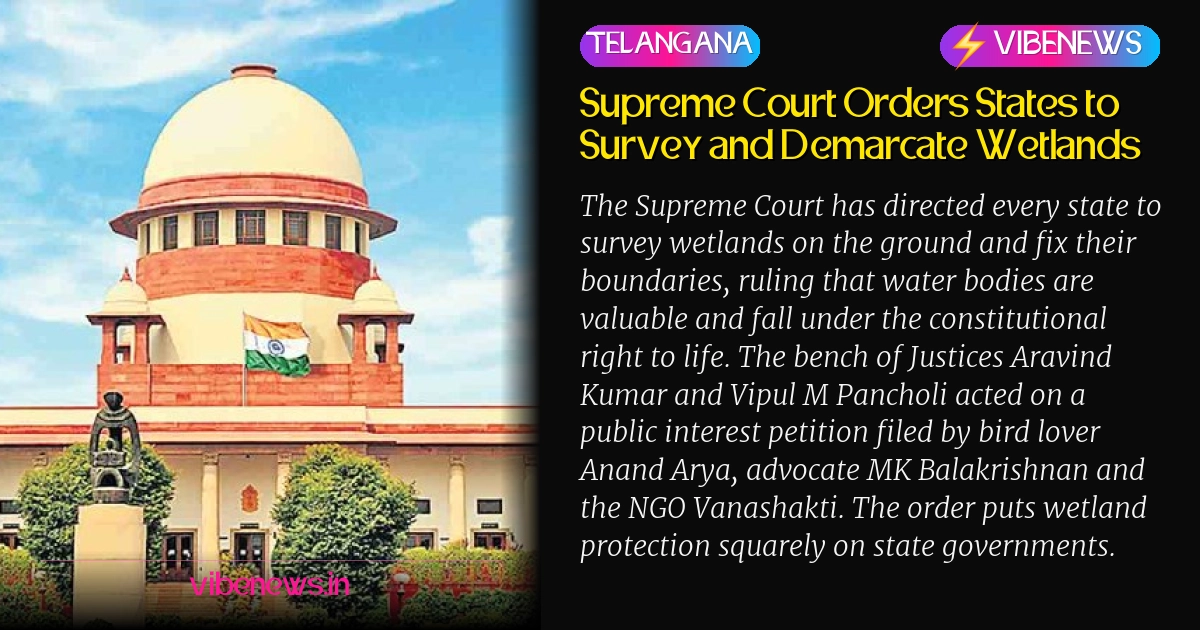

The Supreme Court has ordered every state in the country to physically survey its wetlands and mark their boundaries, ruling that courts cannot sit back when water bodies are left without protection. The order was issued from New Delhi on October 24.
A direct instruction to every state
A bench of Justice Aravind Kumar and Justice Vipul M Pancholi directed all states to examine wetlands at the ground level and identify their exact limits. The instruction is not advisory. It places the job of mapping these water bodies on state governments, which have to act on it.
The bench made clear that the court would not look away from the damage that follows when water bodies are left unguarded. In its words, the court had not remained a silent spectator to the consequences of failing to protect these resources, and it would not start now.
Water bodies as a constitutional concern
The bench went further than a routine administrative direction. It said these water bodies are extremely valuable and that they come within the scope of the right to life guaranteed by the Constitution. By placing wetlands under that right, the court has tied the protection of lakes, marshes and other water bodies to a fundamental guarantee, not just to environmental regulation.
That framing matters. Legal arguments about environmental protection often get treated as technical disputes over land use and permits. Here, the bench treated the loss of water bodies as something that bears on how people live.
Who brought the case
The order came in a public interest litigation, or PIL, filed by three petitioners: bird lover Anand Arya, advocate MK Balakrishnan, and the NGO Vanashakti. A PIL allows people or organisations to bring issues of public concern before the courts, even when they are not directly affected themselves. In this case, the petitioners pressed the court on the lack of protection for wetlands, and the court responded with a nationwide directive.
The court cannot remain a mute spectator to the consequences of failing to protect water bodies.
That line sums up the ruling’s tone. The bench is not asking states to consider the issue. It is telling them the court will watch whether they act.
Why this reaches beyond one state
The direction went to all states, not one. That means the survey and demarcation exercise will apply across the country, from wetlands in cities to those in rural areas. Because the order requires physical checks on the ground, it will test how much state administrations actually know about the water bodies within their borders. Many wetlands may never have been formally recorded with clear boundaries, and this order forces that gap into the open.
For citizens, the practical consequence is straightforward. Once boundaries are fixed, it becomes harder for encroachment, filling or conversion of these areas to pass without notice. The ruling does not spell out penalties in the report available, but it sets a clear obligation on governments to identify what needs protecting.
What happens next
The order requires states to carry out surveys and mark boundaries. The timeline, reporting process and enforcement steps will determine how much change the ruling produces on the ground. Environmental groups and residents who depend on wetlands for water, flood control and wildlife will be watching whether the directive moves from paper to practice.
For now, the message from the country’s highest court is direct. Water bodies are not optional assets that can be neglected until they disappear. They are protected under the constitutional right to life, and the states have been told to find them, map them and defend them.
TL;DR
- Supreme Court orders all states to survey wetlands on the ground and demarcate their boundaries.
- The bench said water bodies are extremely valuable and fall within the constitutional right to life.
- Justices Aravind Kumar and Vipul M Pancholi heard the public interest petition.
- The PIL was filed by Anand Arya, advocate MK Balakrishnan and the NGO Vanashakti.
- The court said it cannot remain a mute spectator to failure to protect water bodies.