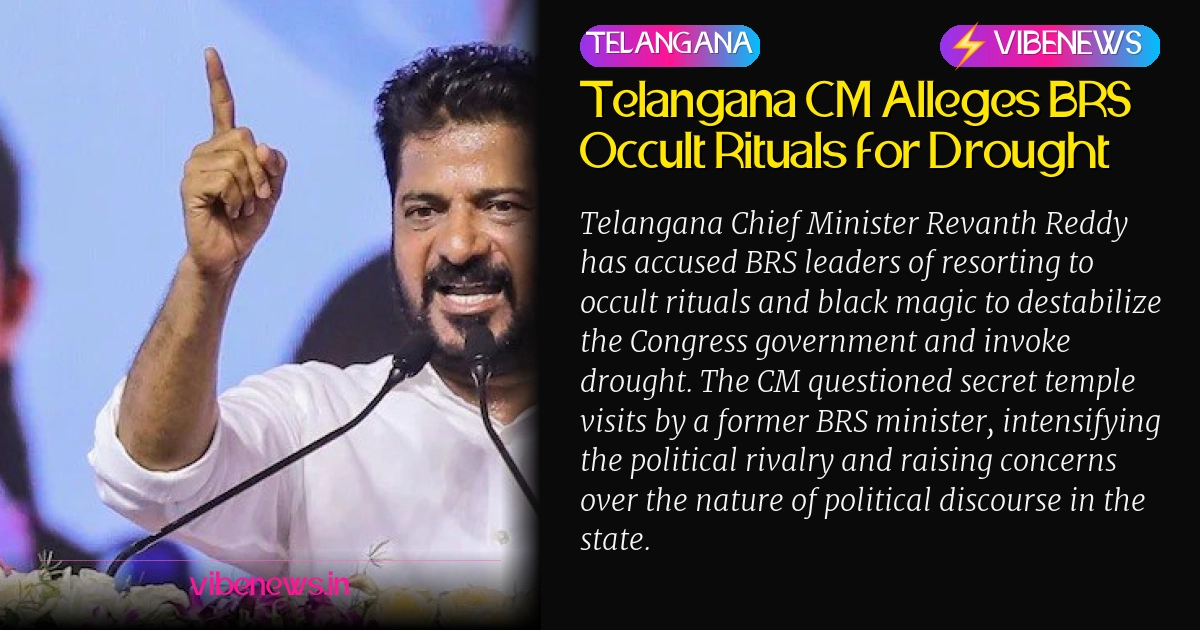
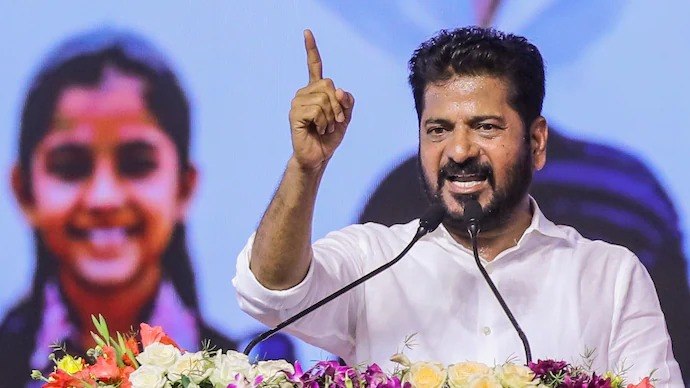
Telangana Chief Minister A Revanth Reddy has escalated his criticism of the Bharat Rashtra Samithi (BRS), publicly alleging that its leaders engaged in occult rituals. Reddy claimed these practices were intended to undermine the Congress government, hoping to induce drought, foster farmers’ distress, and ultimately lead to the administration’s downfall. The Chief Minister also raised pointed questions regarding the undisclosed temple visits of a prominent former BRS minister.
Addressing a public gathering in Sangareddy town, where he launched the distribution of smart PDS ration cards, Reddy specifically targeted BRS MLA T Harish Rao without explicitly naming him. He questioned why details of alleged visits to temples in Tamil Nadu and Karnataka were not made public, urging Rao to disclose the temples visited and the nature of any rituals performed. Reddy asserted that BRS leaders had stooped to extreme measures in their pursuit of power, even resorting to black magic to engineer a crisis within the state.
Allegations of Secret Rituals and Political Desperation
The Chief Minister’s accusations are not entirely new to the political landscape of Telangana. Earlier, on August 4, Telangana Congress president B Mahesh Kumar Goud had also alleged that Harish Rao performed ‘kshudra puja,’ a term often associated with malevolent occult rituals, to prevent rainfall in the state. This, Goud suggested, was an attempt to gain political mileage from a resultant drought, an accusation that Harish Rao vehemently denied and responded to with a legal notice.
The concept of ‘kshudra puja’ or black magic, while often dismissed in modern discourse, carries significant weight in certain cultural contexts within India. Its invocation in political rhetoric suggests a deep level of animosity and a willingness to employ highly charged, unverified claims to discredit opponents. Reddy’s challenge for Harish Rao to reveal his secret temple visits further fuels speculation, implying that these visits were not for spiritual solace but for clandestine purposes linked to the alleged rituals.
Congress’s Governance and Developmental Push
Amidst these serious allegations, Chief Minister Reddy also took the opportunity to highlight the perceived successes and good intentions of his Congress government. He pointed to the Yellampalli project on the Godavari and the Krishna river receiving water despite the El Nino effect, attributing this to the government’s positive intentions. This was presented as a direct counter to the alleged attempts by the opposition to invoke drought.
Reddy detailed several key initiatives undertaken by his administration since coming to power. He stated that 70,000 government vacancies had been filled within a year, addressing a significant demand from the state’s youth. Furthermore, he claimed that seven lakh ‘Indiramma’ houses for the poor had been constructed in two years, directly challenging the BRS to compare this achievement with their unfulfilled promise of double-bedroom houses.
The Chief Minister also underscored the financial support provided to farmers through the Rythu Bharosa investment scheme, noting that Rs 36,000 crore had been transferred to the accounts of 70 lakh farmers. He challenged BRS president K Chandrasekhar Rao (KCR) to a debate in the Assembly on this issue, emphasizing the Congress government’s commitment to agricultural welfare. Additionally, Reddy highlighted the distribution of over two lakh quintals of fine rice monthly through PDS shops to 3.48 crore people, contrasting it with the coarse rice allegedly distributed by the previous BRS regime, which he claimed was unfit for human consumption and used for poultry feed or industrial purposes.
The Shifting Sands of Telangana Politics
The current political climate in Telangana is marked by an intense rivalry following the Congress party’s victory in the recent assembly elections, which ended a decade of BRS rule. The BRS, now in opposition, is actively seeking to regain its footing, while the Congress government is keen to consolidate its power and deliver on its electoral promises. Accusations of this nature serve to further polarize the political discourse, aiming to undermine public trust in the opposition while bolstering the image of the ruling party.
The absence of an immediate reaction from the BRS to the Chief Minister’s latest allegations leaves room for further political maneuvering. Such a silence could be interpreted in various ways, from strategic contemplation to an attempt to avoid legitimizing the claims with a direct response. However, the previous legal notice issued by Harish Rao indicates that the BRS is not entirely passive in the face of such serious charges.
Editorial Context: The Erosion of Political Discourse
The deployment of accusations involving occult practices in mainstream political discourse represents a concerning trend. While political rhetoric often involves sharp criticism and strong allegations, invoking ‘black magic’ can push the boundaries of acceptable debate, potentially diverting attention from substantive policy discussions and governance issues. Such claims, often difficult to verify, can instead fuel sensationalism and superstition, rather than fostering informed public engagement.
In the long term, this type of political warfare risks eroding public trust in democratic institutions and the political process itself. When leaders resort to unverified, culturally charged accusations, it can diminish the quality of public debate and make it harder for citizens to distinguish between genuine policy failures and politically motivated attacks. It underscores the challenge for political parties to maintain a focus on development and accountability, even amidst fierce electoral competition.
TL;DR
- Telangana CM Revanth Reddy accused BRS leaders of performing occult rituals to cause drought and destabilize the Congress government.
- Reddy specifically questioned former BRS minister T Harish Rao’s secret temple visits in Tamil Nadu and Karnataka, linking them to the alleged rituals.
- The CM highlighted Congress government’s achievements, including filling 70,000 job vacancies, building 7 lakh ‘Indiramma’ houses, and transferring Rs 36,000 crore to farmers under Rythu Bharosa.
- Reddy challenged BRS president K Chandrasekhar Rao (KCR) to a debate on the Rythu Bharosa scheme and criticized the previous BRS regime’s PDS rice quality.
- The accusations intensify the political rivalry in Telangana following Congress’s recent victory over the decade-long BRS rule.
- The use of ‘black magic’ allegations in political discourse raises concerns about the quality of public debate and potential erosion of trust.