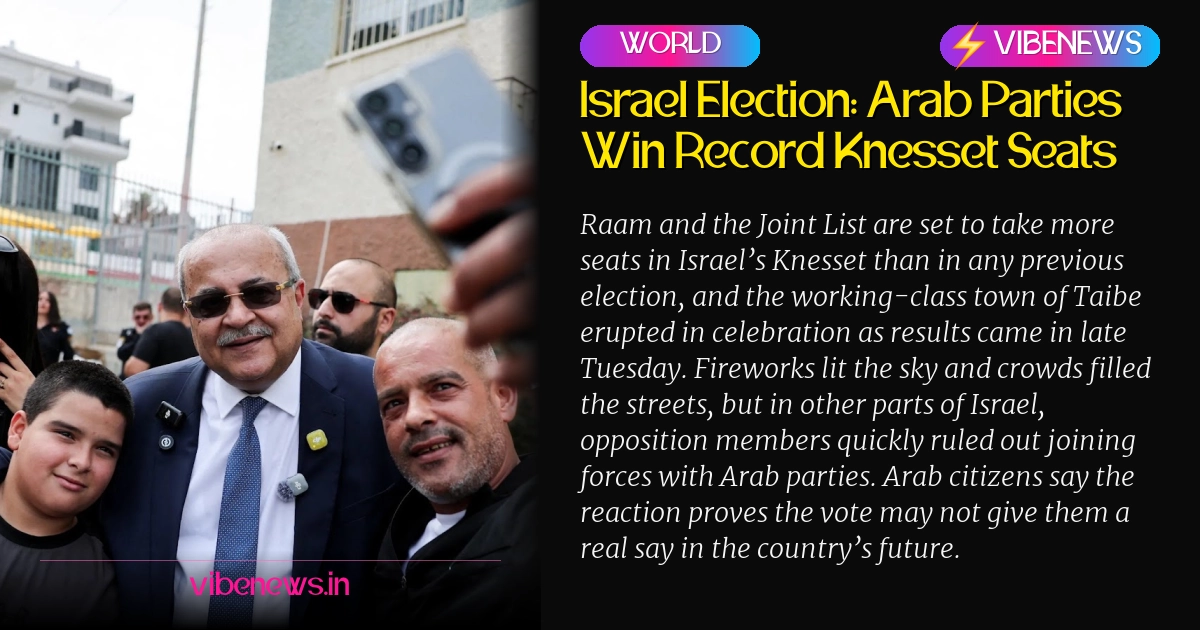

Arab-led parties Raam and the Joint List are set to take more seats in Israel’s Knesset than they have in any previous election, and the town of Taibe went into the streets to celebrate as the results became clear late on Tuesday.
Fireworks streaked over Taibe, a predominantly Arab town in the middle of the country. Cheering crowds followed, and the celebration spilled onto the streets within hours of the first clear picture of the vote.
For the two parties, the result is a watershed. Raam and the Joint List are collectively on course for more seats in the Knesset, Israel’s Parliament, than any Arab-led bloc has won before. That is the core fact driving the mood in Taibe and across Arab communities in the country.
A town that turned out in force
Taibe is a working-class town, and residents turned out at a rate that stood out in this election. More than 80 percent of residents voted this week. For many people there, the high turnout was the point of the exercise.
Amir Hajj Yahya, 30, had gathered with friends outside a burger joint on Wednesday night when he spoke to reporters. His message was practical. “We should now translate that result into making real improvements in our lives,” he said. The celebration, in other words, is not only about symbolism. Residents want the vote to change daily conditions.
That expectation is what makes the next stage so tense. A large turnout and record seat counts can open doors, but they do not guarantee a seat at the table. Taibe’s residents know that, and the cheering in the square came with an undercurrent of caution.
The reaction that cut the celebration short
While Taibe was celebrating, the mood in other parts of Israel looked very different. Some members of the opposition moved quickly to rule out joining forces with Arab parties to form a government. The message was blunt, and it arrived fast.
Influential television pundits added to the pressure. They warned against the possibility that Arab parties could have a hand in future government policy on security and foreign affairs. Those two areas sit at the center of national politics in Israel, which made the warnings especially pointed.
The contrast is stark. On one side, a town lit up by fireworks and crowds in the streets. On the other, a political class already closing doors before any coalition talks have begun. That gap is where the story’s emotional weight sits.
Fear that the vote may not matter
For many Arab citizens, the response has confirmed a long-held frustration. They say much of Israeli society is unwilling to give them a say in the country’s future. For them, the debate over coalition partners is not an abstract question about arithmetic. It is about whether their votes will count in practice.
Some fear the vote may prove futile. Noreen al-Nashef, 52, a lawyer from Taibe, said she was worried that, despite the high Arab voter turnout, it would not lead to Arab parties having influence over the government and its decision-making. Her concern is not that people failed to show up. It is that showing up may not be enough.
Shadi Hajj Yahya, 34, a truck driver in Taibe, went further. He described the reaction from opposition figures and commentators in direct terms, and he did not soften his view of what it means.
“This reaction is proof of racist attitudes we’re facing,” said Shadi Hajj Yahya, 34, a truck driver in Taibe.
That charge is serious, and it reflects how many Arab residents read the post-election climate. They see the immediate rejection of a partnership as evidence that their political weight is discounted before it is tested. Whether that view will shape the coming negotiations remains an open question.
What comes next for Taibe and the Arab parties
The results are historic on paper. Raam and the Joint List are set to take more seats than in any other election for Arab-led parties, and that gives them a stronger hand than they have had before. But strength on paper and influence in government are not the same thing, and the reaction from parts of the political establishment suggests the distance between the two may be wide.
The next phase will test whether the record count translates into bargaining power. If opposition figures hold to their refusal to work with Arab parties, the seats may sit on the sidelines of decision-making on security and foreign affairs. If they do not, the celebrations in Taibe could mark the start of a different kind of political role.
For now, the streets of Taibe carry a clear message. Residents voted in large numbers, they expected results, and they are watching closely to see whether those results will reach their daily lives. The fireworks have faded, but the question they raised is still hanging over the country.
TL;DR
- Arab-led parties Raam and the Joint List are set to take more Knesset seats than in any previous Israeli election.
- Taibe, a predominantly Arab town, erupted in fireworks and street celebrations as results became clear late Tuesday.
- More than 80 percent of Taibe’s residents voted this week, according to the report.
- Some opposition members quickly ruled out joining forces with Arab parties to form a government.
- Television pundits warned against Arab parties having a hand in future security and foreign affairs policy.
- Many Arab citizens fear the high turnout may still not give them real influence over decision-making.