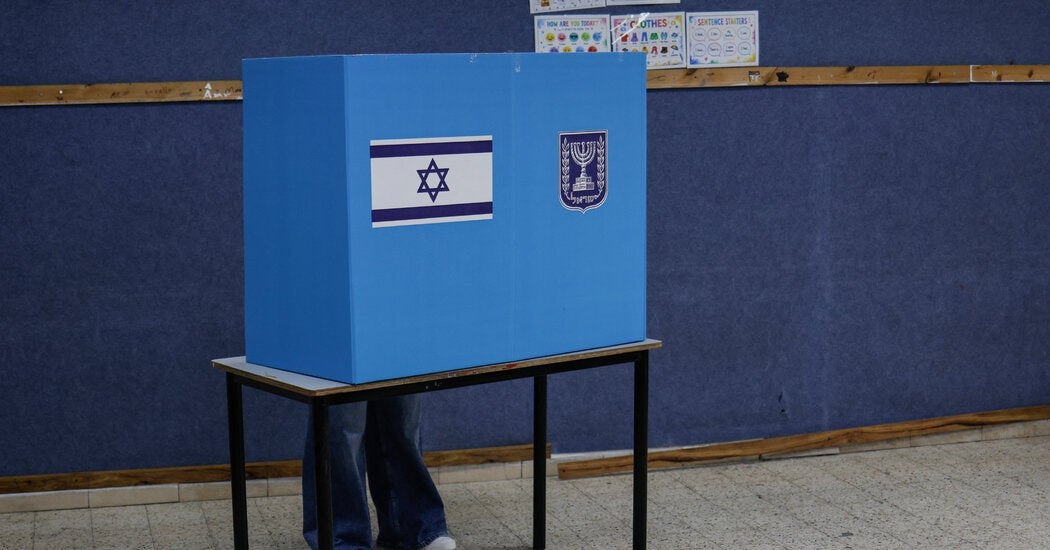
Israelis voted Tuesday in their largest numbers in a generation, and the first exit polls left the country without a clear winner. A bloc of opposition parties led by Gadi Eisenkot was roughly even with the alliance of Prime Minister Benjamin Netanyahu, and neither side can build a government on its own.
Both leaders claimed momentum in late-night speeches. Eisenkot, a former military chief whose son was killed in the Gaza war, took the stage past midnight at his post-election party and struck a tone of triumph. "Tonight we got the answer: The public wants change," he said.
Netanyahu spoke to his supporters a few hours later. He invoked his relationship with President Trump, repeated his pre-election talking points about removing the threat from Iran, and mocked months of polls that showed his Likud party trailing Eisenkot’s. "We must form a strong right-wing government," he declared.
Exit polls, and why they cannot settle it yet
The exit polls from Israel’s three largest television networks did not agree. At first they projected a small lead for Eisenkot’s anti-Netanyahu alliance. One later update gave Netanyahu and his allies the edge, and the other two showed the blocs level.
Exit polls have a spotty record in Israel, particularly in tight races, and the official count is far from complete. Election authorities had counted nearly a million votes, about a fifth of the total, by the early hours of Wednesday.
The votes not captured in exit polls could matter. Hundreds of thousands of Israelis cast ballots at special polling stations on military bases, in hospitals, in prisons and at embassies. In the previous election, those votes leaned toward Netanyahu’s coalition. Election authorities estimated about 600,000 such ballots this year, roughly 10 percent of eligible voters, and those results are not expected before Thursday.
The Likud surge. One of the night’s biggest surprises was Netanyahu’s apparent gain on Election Day. Pre-election surveys had his Likud party at about 20 seats. The exit polls showed Likud winning 24, more than any other party. That is a symbolic win for a prime minister who was in charge on Oct. 7, 2023, but the extra seats appear to have come at the expense of his allies, not the opposition bloc.
Arab parties could decide who governs
The most striking result may be the turnout among Israel’s Arab citizens, who make up about 20 percent of the population. Pre-election surveys suggested the two main Arab parties would win about 13 seats combined. The exit polls put them at 17 or 18 of the Knesset’s 120 seats. Arab parties have never won more than 15.
Mansour Abbas, leader of the Raam party, told an Israeli television interviewer that the turnout showed "frustration and despair" in Arab society had turned to hope. He said he wanted to replace Netanyahu’s government "in every possible way," and that his immediate priority was to ensure a chance of forming a government opposed to Netanyahu.
Many Arab voters said they were furious at Netanyahu over his treatment of Palestinians in the West Bank and Gaza, and over policies they say treat Palestinians inside Israel as second-class citizens. Kholoud Al-Zeinati, 39, who voted in the mixed Jewish-Arab city of Lod, put it simply: "Because we, as the Arab community, are the community that pays the biggest price across so many aspects of life, it’s important to come out and take part."
The problem is that building a coalition with Arab participation remains deeply contentious in Israel. Many Israeli Jews believe a parliamentary majority should not rely on Arab lawmakers. Throughout the campaign, Netanyahu made overt appeals to anti-Arab prejudice.
Raam is the only one of the two parties that has sat in a government before. It joined the short-lived anti-Netanyahu coalition of Prime Minister Naftali Bennett in 2021. That move outraged many right-wing Jewish voters. When the coalition collapsed after about a year, they backed Netanyahu, who went on to form the most hard-line government in Israel’s history.
Why a unity government is so hard to imagine
Analysts are already weighing whether Netanyahu could join Eisenkot or others in the opposition to form a unity government. The obstacles are large. Eisenkot’s voters deeply despise Netanyahu, and the two would have to agree on who serves as prime minister. Netanyahu is unlikely to give up control, while Eisenkot has called the prime minister unfit to lead Israel.
Eisenkot also turned his speech toward the security establishment. Netanyahu now heads a transitional government, he said, and he told the country’s security chiefs and public servants to stand firm against any attempt to challenge them. He added a warning that is already drawing attention: "Netanyahu, don’t dare use Israel’s security for your political needs."
Netanyahu, don’t dare use Israel’s security for your political needs.
Amid reports that Netanyahu has been pushing for renewed attacks on Iran, that line lands hard. It frames the vote as a fight over who controls the country’s most dangerous decisions while a caretaker government is still in place.
Bennett, who leads a party in the opposition alliance, said the sitting prime minister had lost the election. He tied Netanyahu directly to the Hamas-led attack of Oct. 7, 2023, which he called Israel’s worst security failure in decades. "The government of Oct. 7 will go home," he said.
Yair Golan, leader of the Democrats, declared victory for the opposition bloc. He said the public had "fired Netanyahu and Likud," and urged rivals to form a "change government" without letting ego delay it. "From tonight, Israel can breathe," he said. He also signaled willingness to rely on support from outside the opposition alliance, an apparent reference to the Arab parties.
On the other side, Bezalel Smotrich, the finance minister and leader of the far-right Religious Zionism party, used his speech to attack the Arab parties. "Parties that are unable to condemn the massacre of Oct. 7 and are not willing to declare Hamas as a terrorist organization are not legitimate actors in Israeli politics," he told supporters. Itamar Ben-Gvir, the national security minister, neither claimed victory nor conceded, saying only that "the night is still young."
The numbers that still have to fall
Israel’s Central Election Committee put turnout at 77.7 percent, the highest since 1999. The official results are still a long way off. After the count, parliamentary seats will be allocated, and President Isaac Herzog will invite the party leader he believes has the best chance to assemble a governing coalition. A coalition usually needs at least 61 of the 120 lawmakers, though Eisenkot has floated a minority government.
There is precedent for the party with the most seats failing to govern. In 2009, Tzipi Livni’s centrist Kadima won 28 seats, narrowly beating Netanyahu’s Likud with 27. Netanyahu still had more support from allied parties and returned as prime minister.
For now, neither bloc has a clear path. Party leaders are expected to begin discussing alliances in the morning, once the sun is up over Tel Aviv and Jerusalem and the official tallies start to come in. Until then, the one thing that is certain is that the Arab parties will have a say in who governs Israel next.
TL;DR
- Exit polls show Netanyahu’s bloc and Eisenkot’s opposition alliance roughly tied
- Neither bloc can form a government without the support of two Arab parties
- Arab parties are projected to win 17 or 18 seats, their strongest showing ever
- Turnout hit 77.7 percent, the highest since 1999
- About 600,000 special ballots will not be counted before Thursday
- Netanyahu’s Likud was projected to win 24 seats, more than any other party