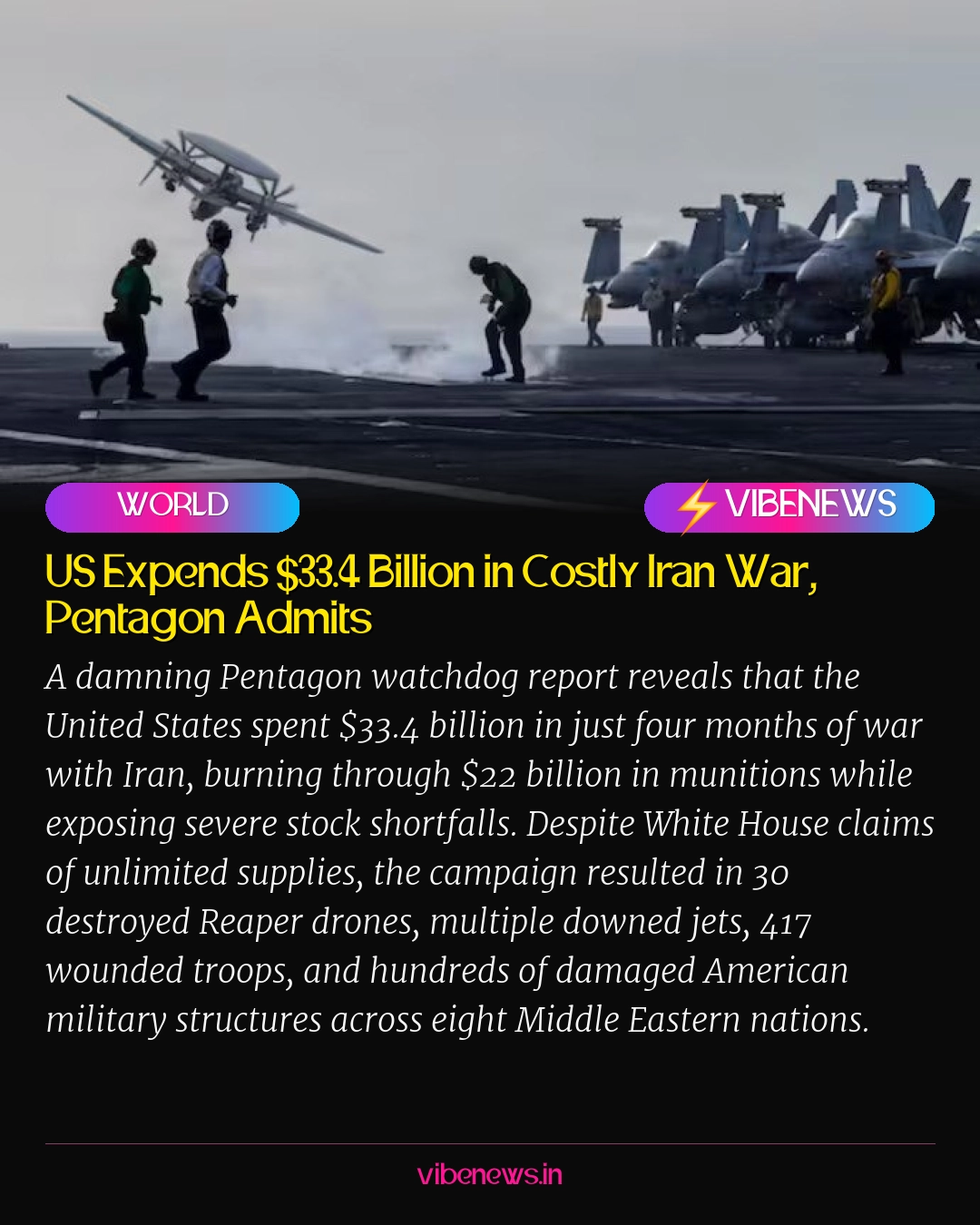
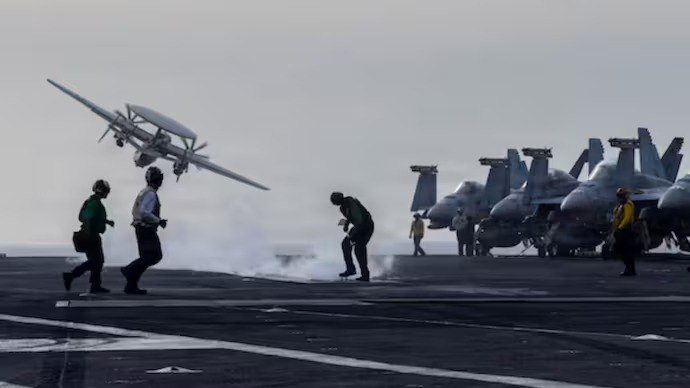
The United States military spent $33.4 billion, expended more than $22 billion in munitions, and suffered widespread equipment and structural losses during four months of conflict with Iran between February 28 and June 30, according to a report released by the Department of Defense Inspector General.
The first official military accounting of the campaign lays bare the immense financial and strategic drain inflicted on American forces, contradicting official statements regarding the sustainability of the war effort. While Washington previously signaled that military stockpiles remained uncompromised, the Pentagon watchdog explicitly documented "strategic inventory shortfalls" alongside severe "industrial base bottlenecks" hindering the replenishment of expended weapons. President Donald Trump had repeatedly rejected claims of depleting supplies, characterizing reports of ammunition deficits as fake news and asserting that US weapon reserves were virtually unlimited.
Staggering Equipment and Aircraft Losses
Financial figures detailed in the watchdog report break down total military expenditures into $22 billion for used munitions, $3.7 billion in direct equipment destruction, and $7.4 billion in additional military operating expenses. Aircraft losses spanned crucial operational assets across the US inventory. The Air Force lost at least four F-15E strike fighters—three of which were downed by friendly fire over Kuwait on March 1, and one shot down during combat operations over Iran in April. Furthermore, Iranian fire damaged an F-35A stealth fighter in March, while an A-10 ground-attack aircraft was brought down in action.
Support platforms were similarly hit. At least seven KC-135 aerial-refueling tankers were damaged or destroyed, and an E-3 Sentry airborne early-warning aircraft was damaged at Prince Sultan Airbase in Saudi Arabia. Rotary and specialized assets lost include an HH-60W helicopter, an MQ-4C Triton surveillance aircraft, and an AH-64 Apache attack helicopter. Combat search-and-rescue operations inside Iran resulted in four AH-6 light attack helicopters becoming unrecoverable and subsequently destroyed. Unmanned aerial operations took the heaviest hit, with as many as 30 MQ-9 Reaper drones destroyed during intelligence and precision strike missions. Iran also claimed additional strikes against surveillance units around the Strait of Hormuz and stated it captured an American submersible.
Extensive Structural and Diplomatic Damage
US Central Command confirmed that retaliatory Iranian strikes damaged or destroyed hundreds of installations and structures host-located across eight regional partners: Kuwait, Bahrain, Qatar, the United Arab Emirates, Saudi Arabia, Iraq, Oman, and Jordan. Alongside military facilities, American diplomatic outposts suffered significant destruction totaling an estimated $184 million in damages, alongside $24.5 million in recurring monthly construction delays tied to mandated departures and regional travel bans.
In Iraq, where the US mission endured over 600 individual attacks through late June, facility repair costs reached nearly $157 million. The US Consulate General in Erbil sustained severe damage across multiple buildings, the US Embassy in Baghdad suffered structural hits, and the Baghdad Diplomatic Support Center near Baghdad International Airport incurred extensive damage. Elsewhere in the region, operations at the US Embassy in Kuwait City were halted on March 5 due to direct attacks causing $14.75 million in damages. Two Iranian drone strikes hit the US Embassy in Riyadh on March 3, generating $11.5 million in repair costs, while the US Consulate General in Dubai reported $120,000 in damage to a utility structure.
Logistical Strains and Casualties
The report underscores deep operational strain across supply corridors. Establishing viable naval bases and resupply ports presented acute hurdles both prior to and during active engagements. Forced shifting of logistics nodes to Diego Garcia exposed tactical vulnerabilities, as the vast distance required lengthy 14-to-18-day sea transit cycles to complete fleet resupply runs.
The human toll on American forces included 11 military personnel killed in action, seven deaths resulting from non-hostile incidents, and 417 service members wounded in Iranian attacks through the end of June. Exploiting the findings, Iranian Foreign Minister Seyed Abbas Araghchi publicly challenged Washington’s narrative on social platform X.
"100s of US military sites blown to pieces" and "dozens of aircraft scorched"
Araghchi stated, referencing the Pentagon watchdog numbers to argue that Tehran had inflicted severe damage on US military infrastructure, while warning that further operational details would be released in due course.
Despite early White House promises that conflict with Iran would conclude within weeks or shortly after the November midterm elections, the watchdog’s audit exposes an unsustainable financial drain, lingering supply chain crises, and a military campaign yielding escalating costs with no diplomatic resolution in sight.
TL;DR
- Pentagon report confirms US spent $33.4 billion on the Iran war between February 28 and June 30.
- Munitions expenditures topped $22 billion, causing critical inventory shortfalls and production bottlenecks.
- American aircraft losses included up to 30 Reaper drones, four F-15E fighter jets, and an F-35A stealth jet.
- Iranian strikes damaged hundreds of US structures across eight nations and inflicted $184 million in diplomatic damage.
- A total of 18 US military personnel died and 417 were wounded during the four-month accounting period.