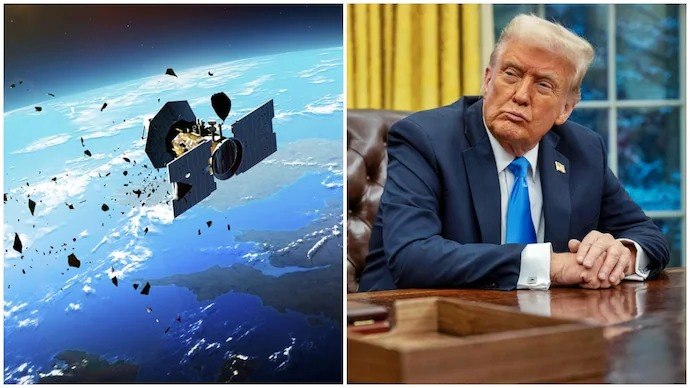
US Secretary of the Air Force Troy Meink publicly confirmed on Monday that the United States has deployed an active weapon in space, speaking at the Air, Space and Cyber Conference.
A Dangerous Precedent in the Final Frontier
The sudden disclosure marks a terrifying threshold in modern defense posture, signaling that the quiet expanse above Earth has officially been turned into an active arena for war. While military forces have relied on orbital infrastructure for decades, the explicit placement of armed combat capabilities directly into orbit sets a perilous precedent. By normalizing the weaponization of space, global powers risk converting critical shared environment into a volatile combat zone where a single conflict could plunge global communications and navigation into chaos.
Despite the monumental implications of the announcement, the Pentagon has wrapped the system in absolute secrecy. Meink stated that the orbital capability was crucial to defend American military assets and react effectively to evolving threats across the globe. However, he refused to provide basic details regarding the nature of the weapon, its precise launch date, its technical specifications, or the specific operational parameters under which it would be fired. This profound lack of transparency heightens international anxiety, leaving allies and adversaries alike to speculate on the destructive power currently circling the planet.
The Vulnerability of Orbital Infrastructure
The stakes of orbital weaponization could not be higher. Modern armed forces operate with near-total dependence on spacecraft orbiting hundreds or thousands of kilometers above the Earth’s surface. Essential functions—including GPS navigation, encrypted military communications, early missile warning networks, tactical battlefield surveillance, and strategic intelligence gathering—are entirely tied to satellite infrastructure. Neutralizing or destroying these high-altitude assets would effectively blind and paralyze ground, naval, and aerial forces before a land invasion even begins.
Recognizing this critical vulnerability, major world powers have spent years quietly developing counterspace technologies intended to degrade, jam, or physically destroy orbiting hardware. The public acknowledgment that the United States now has an operational space weapon confirms that space is no longer merely a support domain for terrestrial combat, but a primary front where warfare will be initiated and executed.
From Defense to Offense: The Space Force Mandate
The disclosure also highlights a dramatic evolution in the operational philosophy of the US Space Force, which was established in 2019. Originally framed primarily around safeguarding American satellite assets from external interference, the service branch has openly expanded its mission scope into active combat operations and domain control. A spokesperson for the US Space Force explicitly outlined that establishing space control extends beyond defensive shields to encompass direct offensive counterstrikes.
"Space control includes the use of kinetic and non-kinetic capabilities to disrupt, degrade and, if necessary, destroy an adversary’s space systems."
This aggressive posture underscores a troubling shift: offensive strikes involving physical impact weapons or high-tech energy and jamming systems are now sanctioned tools for maintaining orbital superiority. By openly contemplating the complete destruction of enemy satellites, military planners are accepting the immense collateral risks of orbital debris and widespread disruption to global civilian networks.
Treaty Loop-Holes and Accelerating Space Arms Race
The deployment exposes severe limitations in existing international law. The 1967 Outer Space Treaty, which serves as the primary governance framework for space exploration, explicitly bans the placement of weapons of mass destruction, such as nuclear warheads, in Earth’s orbit. However, the treaty remains completely silent on conventional military hardware, directed-energy assets, kinetic interceptors, and non-kinetic cyber weapons. This legal void has permitted nations to build up formidable space armaments without technically breaching international agreements.
This escalation takes place against a backdrop of intensifying geopolitical friction among Washington, Moscow, and Beijing. American defense officials have repeatedly raised alarms regarding Russian space maneuvers, including accusations that Moscow deployed a satellite equipped with potential anti-satellite attack capabilities. Similarly, the Pentagon has consistently warned that China is expanding its counterspace arsenal as part of a broader, rapid military modernization push. By responding to these perceived threats with its own deployed space weapon, the US risks triggering an unchecked orbital arms race.
The Changing Architecture of Future Warfare
The normalization of orbital weapons fundamentally alters the blueprint of future global armed conflict. Military strategists increasingly agree that the opening salvo of any potential clash between superpower nations will not erupt on land, at sea, or in the skies. Instead, combat will originate high above the atmosphere, as rival forces seek to blind opposing militaries by knocking out satellite networks in the first minutes of engagement.
As Earth’s orbit grows increasingly crowded with military hardware, the line between strategic deterrence and catastrophic escalation continues to blur. The confirmation of an active American space weapon confirms a stark new reality: space has been weaponized, and the high ground of future warfare is already armed and operational.
TL;DR
- US Air Force Secretary Troy Meink confirmed the deployment of an active weapon in space.
- The admission marks a dangerous precedent as Earth’s orbit transitions into an operational battlefield.
- Details regarding the space weapon’s design, launch date, and operational mechanics remain undisclosed.
- US Space Force confirmed space control tactics include kinetic and non-kinetic destruction of adversary satellites.
- The 1967 Outer Space Treaty bans weapons of mass destruction but allows conventional space armaments.
- US officials highlighted growing orbital threats from Russian satellite capabilities and Chinese military modernization.