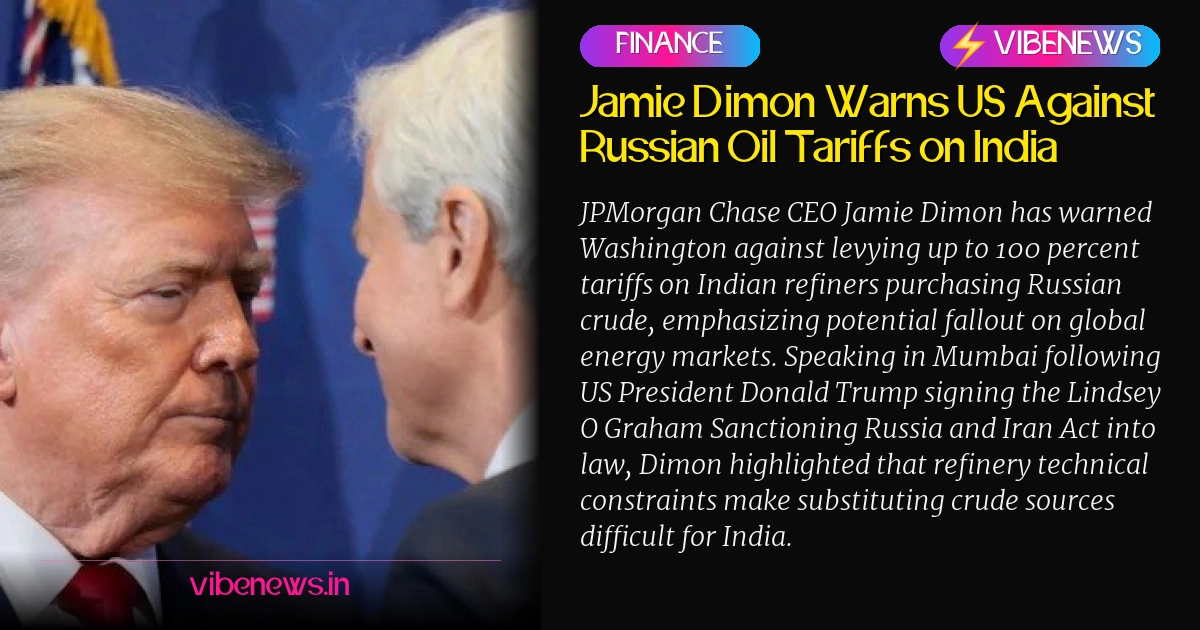
JPMorgan Chase Chief Executive Officer Jamie Dimon cautioned Washington against imposing punitive tariffs on nations buying Russian crude, warning that penalizing Indian refiners could destabilize global energy markets following new US sanctions legislation signed by President Donald Trump.
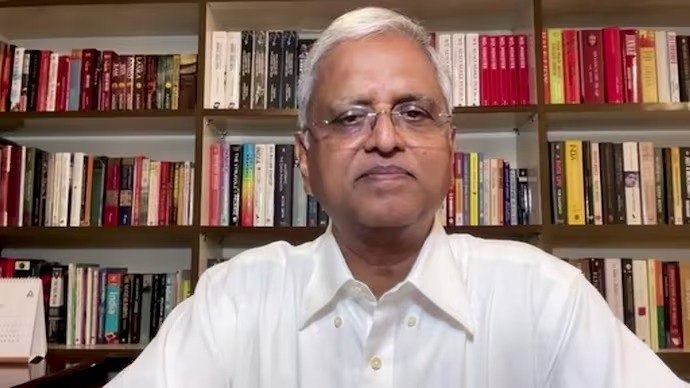
Speaking at the JPMorgan India Investor Conference in Mumbai to CNBC-TV18, the executive urged American policymakers to thoroughly evaluate how Indian energy facilities utilize Russian crude grades before enforcing trade restrictions. The warning comes after Trump signed the Lindsey O Graham Sanctioning Russia and Iran Act, which grants the US administration authority to levy tariffs reaching up to 100 percent against countries continuing energy commerce with Moscow.
Technical Realities of Global Oil Refining
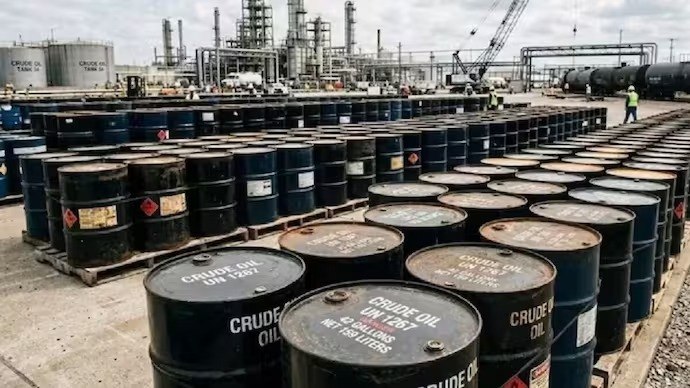
Dimon’s opposition to energy levies highlights a fundamental operational constraint: petroleum refineries are highly specialized infrastructure built to process specific chemical compositions of crude oil. Consequently, forcing Indian facilities to abruptly abandon Russian supplies could create severe operational mismatches that alternative international suppliers cannot easily resolve.
"I think hopefully America will sit down and understand all those issues and, you know, not end up punishing India and the world oil markets while doing what we need to do to combat Russia," Dimon said.
While maintaining that the US must continue offering robust assistance to Ukraine in its conflict with Russia, Dimon stressed that trade levies on energy exports are an ill-suited tool for pressuring Moscow. He noted that if Indian refiners are forced to seek non-Russian alternatives, they risk acquiring crude grades unsuited for their specific processing machinery, which could spark broader disruptions across global supply chains.
India’s Energy Security Imperative
The financial chief’s perspective aligns closely with New Delhi’s official defense of its purchasing decisions. Responding to the US legislation, Indian Ambassador to the US Vinay Mohan Kwatra articulated a "people first" framework, reiterating that national choices remain anchored in affordability, availability, and commercial viability.
India relies on foreign imports for more than 85 percent of its crude oil needs and approximately 50 percent of its natural gas requirements. Ambassador Kwatra pointed out that Indian crude acquisitions during past international supply disruptions served to stabilize broader market pricing, shielding global consumers from heightened volatility.
Import Dynamics and Bilateral Relations
Despite the ongoing diplomatic scrutiny, recent trade tracking data provided by Reuters indicates a shift in purchasing volumes. Indian imports of Russian crude dropped to approximately 2.1 million barrels per day in August—a 16.5 percent decline from July levels. Russian shipments nevertheless accounted for roughly 47 percent of India’s total crude imports of 4.44 million barrels per day for the month.
Beyond energy commerce, Dimon noted that geopolitical friction over the Ukraine conflict has heightened diplomatic complexity between Washington and New Delhi. He advocated for both nations to resume negotiations on their stalled bilateral trade agreement while providing cross-border enterprises with regulatory stability and consistent capital treatment.
TL;DR
- JPMorgan CEO Jamie Dimon urged the US to avoid imposing up to 100 percent tariffs on Indian refiners purchasing Russian crude oil.
- President Donald Trump signed the Lindsey O Graham Sanctioning Russia and Iran Act authorizing heavy tariffs on Russian energy buyers.
- Dimon warned that replacing Russian crude is complex because Indian refineries are engineered for specific oil grades.
- Indian Ambassador Vinay Mohan Kwatra defended energy imports as a national necessity, noting India imports over 85 percent of crude.
- Tanker data showed Indian imports of Russian crude fell 16.5 percent in August to 2.1 million barrels per day.