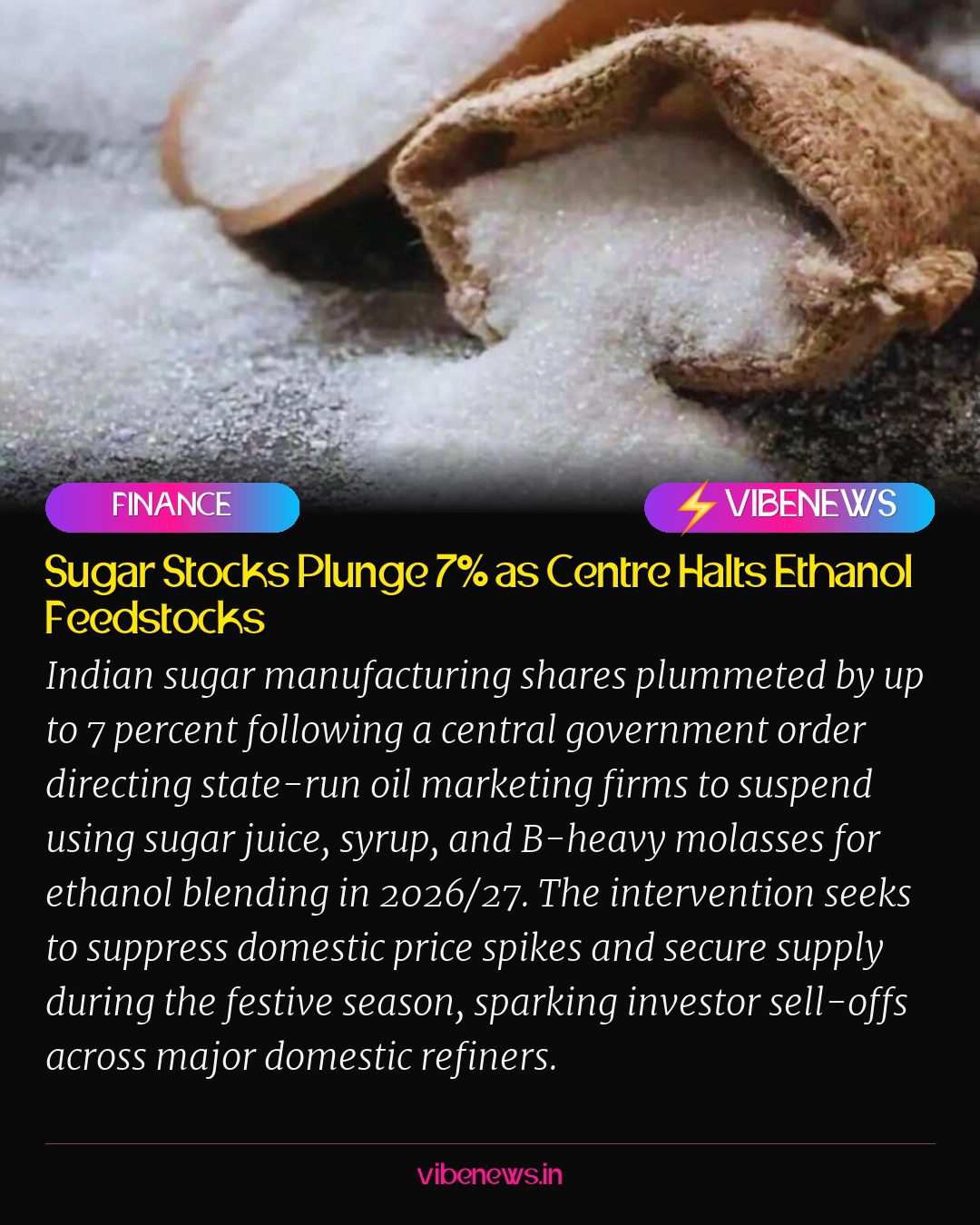

Shares of major Indian sugar manufacturers tumbled by as much as 7 percent on October 19, 2026, after the central government instructed state-run oil marketing companies to halt using sugar-based feedstocks for ethanol production during the 2026/27 supply year.
The policy directive triggered widespread selling across equity markets as institutional and retail investors reassessed revenue expectations for integrated sugar processors. Bajaj Hindusthan Sugar registered the steepest drop among peers, sliding over 7 percent during morning trading. Shree Renuka Industries dropped more than 6 percent, while Balrampur Chini Mills retreated 4 percent. Triveni Engineering and Industries fell beyond 3 percent, with EID Parry and Dhampur Sugar also recording declines exceeding 2 percent each.
Ethanol Tender Restrictions Disrupt Mill Revenue Models
The core catalyst behind the sharp market correction stems from the central administration’s revised ethanol tender conditions. The updated framework explicitly eliminates procurement sourced directly from primary sugarcane juice, concentrated sugar syrup, and B-heavy molasses—a critical sugar-dense intermediate by-product generated during industrial crushing operations.
The latest ethanol tender excludes supplies made from sugarcane juice, sugar syrup and B-heavy molasses, a by-product of sugarcane crushing that contains a high amount of sugar.
For refiners that allocated extensive capital expenditure toward dual-purpose ethanol distillation plants in recent years, this regulatory switch removes operational leeway. Mills previously preserved their operating margins by dynamically shuttling raw output between white sugar and bio-refining depending on price realisations across commodities. With diversion avenues abruptly closed, market participants foresee curtailed returns on modernised distillery assets and compressed operating cash flows.
Festive Consumption Pressures and Strict Domestic Stock Capping
The aggressive governmental intervention addresses surging retail sugar prices, which touched unprecedented highs amid fears of crop yields suffering from erratic rainfall patterns across principal cultivation belts. Analysts at Choice Broking and Motilal Oswal previously flagged rainfall deficits in agricultural zones as an emerging threat to headline cane yields.
Domestic sugar absorption historically peaks in India between August and November, when key cultural celebrations including Ganesh Chaturthi, Dussehra, and Diwali accelerate commercial bulk ordering across confectionery, sweetmeat, and biscuit manufacturing sectors. To prevent wholesale hoarding and enforce swift distribution throughout supply channels, the Food Ministry initiated stringent inventory curbs.
Dealers and trading intermediaries face a statutory 15-day limit on stock retention alongside a strict ceiling capping holdings at 1,000 quintals per entity. These administrative restrictions, enforced from October 15 through November 30, 2026, aim to sustain price stability by pushing maximum physical inventory directly into consumer-facing retail outlets.
Global Production Deficits Reinforce Supply Chain Volatility
The domestic inventory constraints align with mounting turbulence across global commodity exchanges. Brazil, the premier sugar exporter worldwide, continues to grapple with severe logistical and harvesting interruptions caused by continuous unseasonal rainfall in its Central-South cane belt. Consultancy firm Green Pool Global revised its production forecast downward by 3 percent for the 2026/27 season, while Brazilian authorities suspended bi-weekly harvest reporting, further obscuring production transparency.
Simultaneously, severe weather extremes have degraded harvest outputs in other major refining hubs:
In the European Union and the United Kingdom, severe heatwaves and prevailing El Niño conditions depressed regional harvest forecasts to 14.98 million tonnes, roughly 11 percent beneath the five-year average according to the EU Monitoring Agricultural Resources Unit.In Thailand, recognized as the world’s third-largest sugar exporter, industry forecasts dropped 15.6 percent to 9.5 million tonnes.Shift in Global Market Positioning
These coordinated weather setbacks transformed early-year expectations of an international sugar surplus into looming deficit forecasts. Speculative capital on global commodity exchanges has mirrored this underlying physical tightness.
According to data compiled by Bloomberg and the Commodity Futures Trading Commission as of September 29, net short speculative positions in raw sugar collapsed to their lowest level in more than 21 months. The reduction in short bets illustrates how large institutional traders have largely retreated from expectations of cheaper global sugar. While global market participants navigate tightening raw supplies abroad, Indian industrial refiners must now recalibrate their balance sheets around government-mandated domestic market prioritization.
TL;DR
- Government halts sugar-based feedstocks for 2026/27 ethanol production.
- Bajaj Hindusthan Sugar drops over 7% while peers slide 2% to 6%.
- Move aims to lower domestic sugar prices amid peak festive demand.
- Dealers restricted to 15-day stock holding capped at 1,000 quintals.
- Global harvest shortfalls hit Brazil, Thailand, and the European Union.