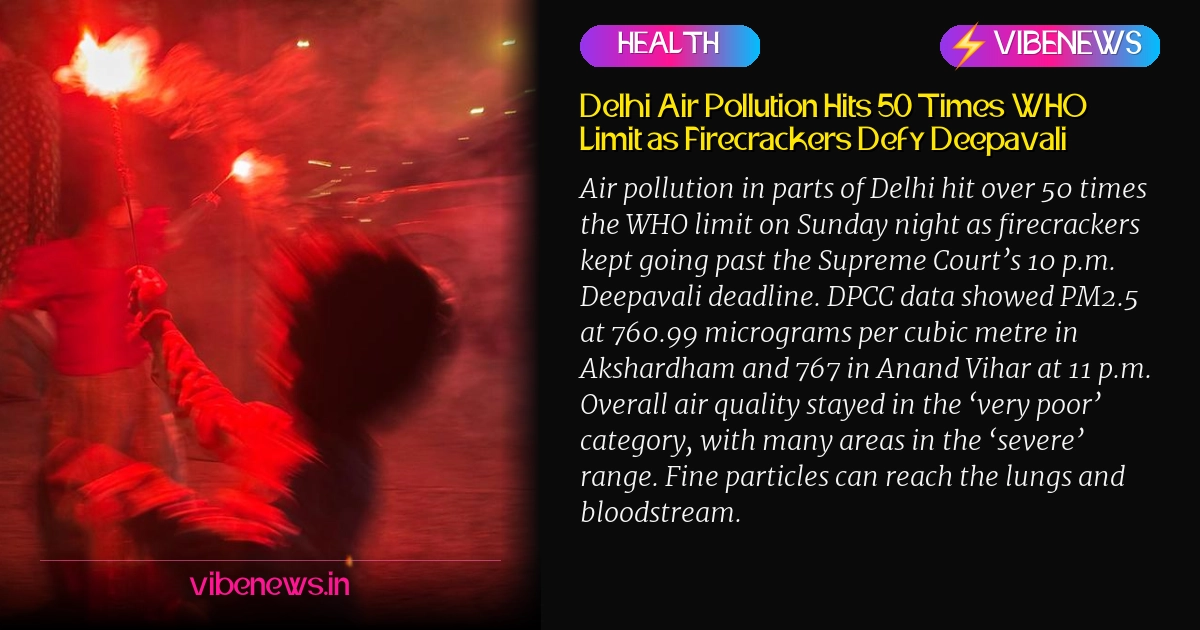
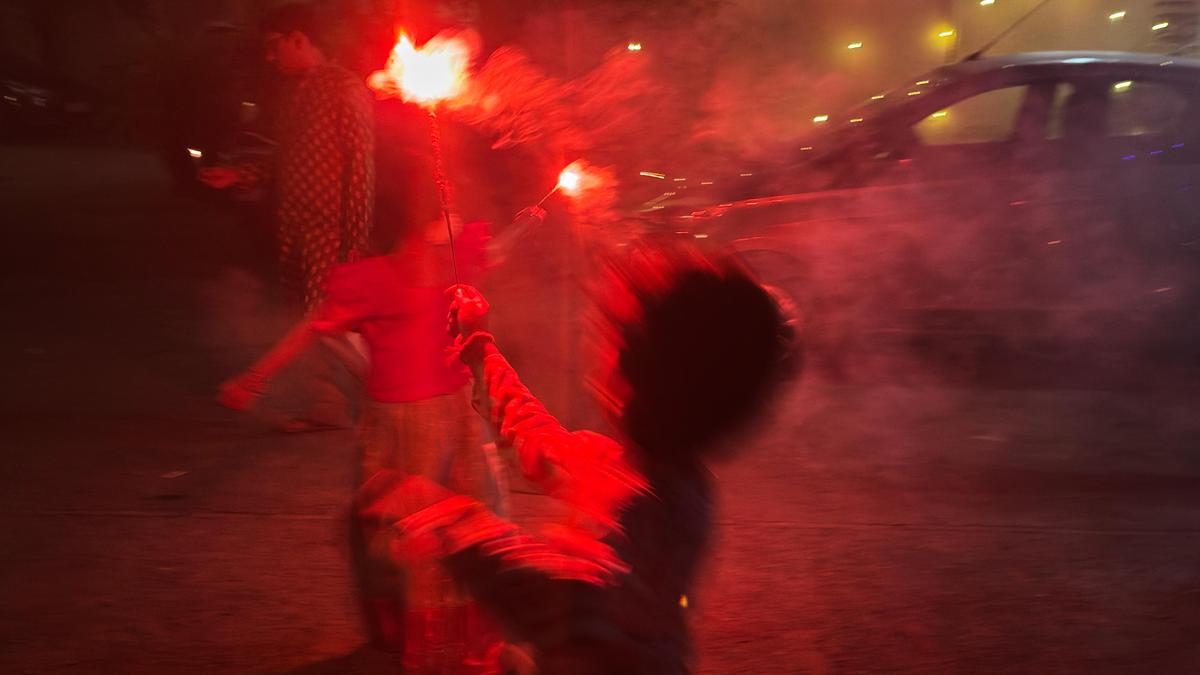
Air pollution in parts of Delhi climbed to more than 50 times the World Health Organisation’s permissible limit on Sunday night, after people kept bursting firecrackers well past the 10 p.m. deadline the Supreme Court had set for Deepavali.
Official data from the Delhi Pollution Control Committee, or DPCC, showed the fine particle reading at Akshardham reached 760.99 micrograms per cubic metre at 11 p.m. on November 8, 2026. That is about 50.73 times the WHO limit of 15 micrograms per cubic metre for a 24-hour period. Anand Vihar was worse. It recorded 767 micrograms per cubic metre at the same hour, roughly 51.13 times the limit.
Jawaharlal Nehru Stadium logged 702 micrograms per cubic metre, about 46.8 times the permissible level. Three monitoring points, three readings that all sit far outside the WHO benchmark.
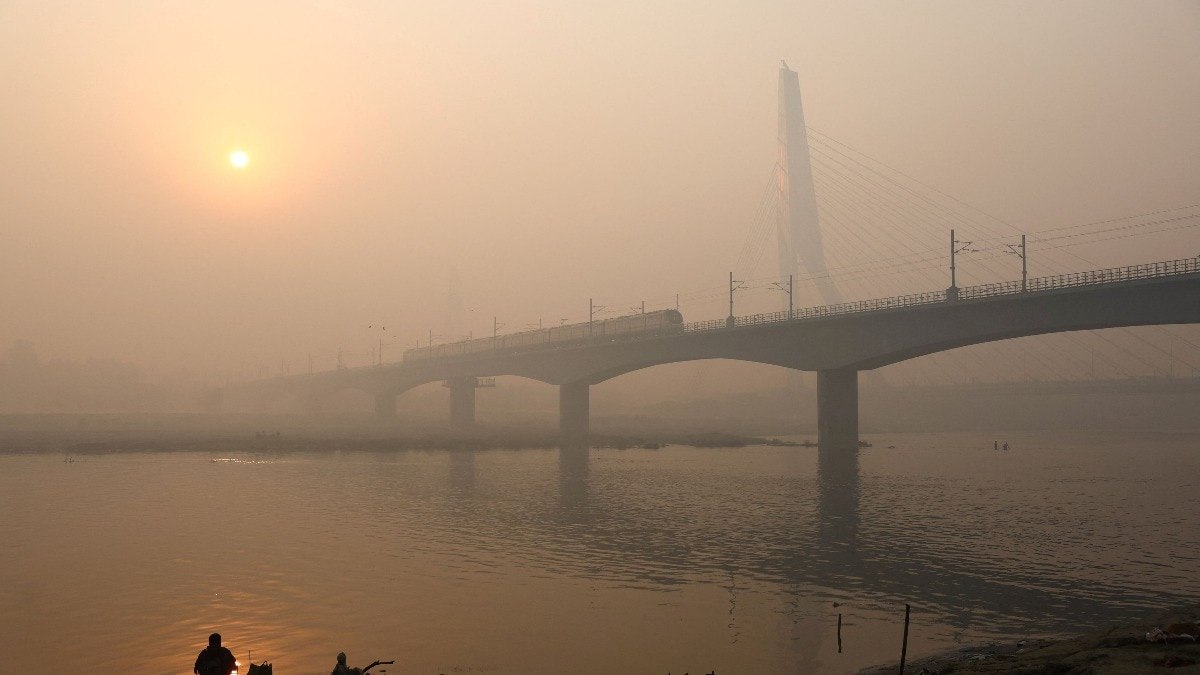
The overall air quality of the city stayed in the ‘very poor’ category, while many parts of Delhi remained under ‘severe’ conditions. Those labels describe the city’s broader air as a whole, and the monitoring stations that recorded the spikes sit in some of the most densely used parts of the capital.
What the particles do to the body. PM2.5, short for fine inhalable particulate matter, is one of the most dangerous pollutants tracked in cities. The particles are small enough to slip deep into the lungs and then the bloodstream. Once there, they are linked to a range of respiratory and other diseases.
PM2.5 (Particulate Matter 2.5) are fine inhalable particles, which can get into lungs and bloodstream and lead to a range of respiratory and other diseases.
Why the timing matters. The Supreme Court had set a 10 p.m. cutoff for Deepavali night, and it had also permitted specific time slots, green crackers and other directives for the festival in 2026. The readings were taken at 11 p.m., an hour after that cutoff. The numbers suggest that the rules did little to keep the smoke down once the celebrations were in full swing.
Reading the numbers carefully. A reading of 50 times the limit sounds dramatic, and it should. But the WHO benchmark is set for a 24-hour average, while these figures are snapshots taken at a single hour on a single night. The DPCC data does not show what the pollution levels looked like across the full day. What it does show is how sharply conditions worsened during the festival hours, when the air was already heavy with smoke.
Winter was already loading the air. Delhi-NCR and many parts of the wider Indo-Gangetic Plains see pollution spike every winter. Lower wind speeds and a drop in temperature trap pollutants close to the ground. Stubble burning during October and November adds smoke from farm fields, while vehicles and dust have been a constant presence in the city’s air. Firecrackers landed on top of that existing load, and the result was a sudden surge rather than a gradual rise.
The pattern is familiar to anyone who has lived through a Delhi winter. Each year, the festival arrives at the worst possible moment for air quality. The festival rules are written to limit the damage, but the DPCC readings from Sunday night show how quickly those limits can be overwhelmed when crowds keep bursting crackers late into the night.
For residents, the numbers translate into air that the official scale describes as very poor across the city, with severe readings in many areas. The readings are an official record of what people were breathing on the night of November 8, and they leave little room for doubt about how much smoke filled the city’s streets.
TL;DR
- Akshardham PM2.5 hit 760.99 micrograms per cubic metre at 11 p.m. on November 8, about 50.73 times the WHO 24-hour limit.
- Anand Vihar recorded 767 micrograms per cubic metre, roughly 51.13 times the permissible limit.
- Jawaharlal Nehru Stadium logged 702 micrograms per cubic metre, about 46.8 times the WHO benchmark.
- Firecrackers kept bursting well past the Supreme Court’s 10 p.m. Deepavali deadline.
- Overall Delhi air quality stayed in the ‘very poor’ category, with many areas in the ‘severe’ range.