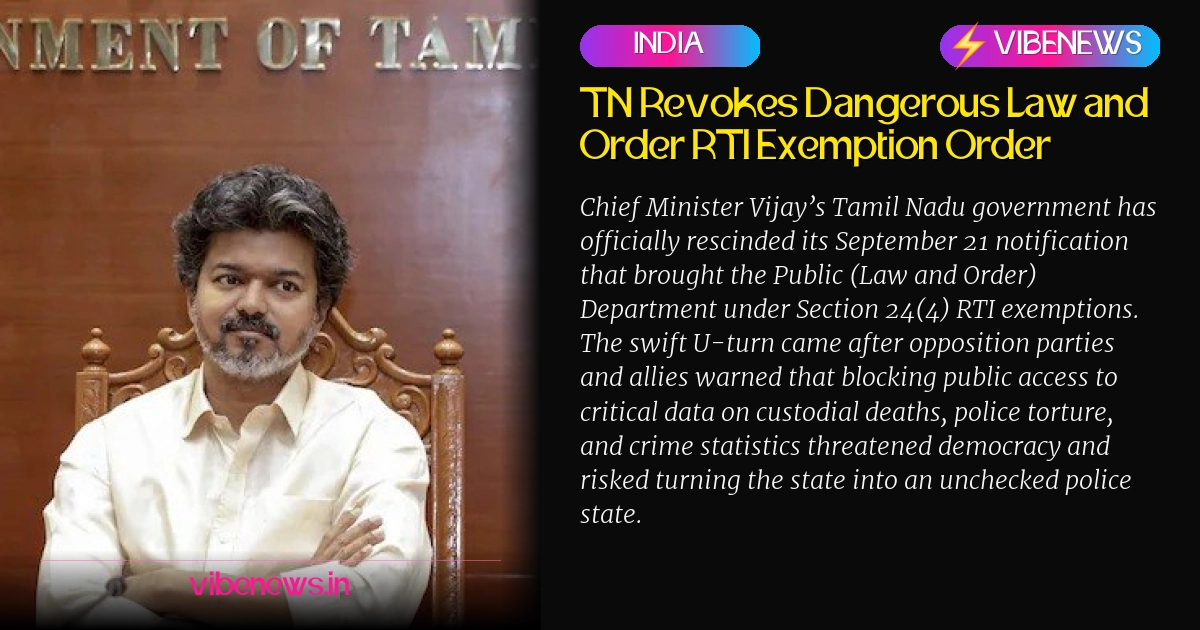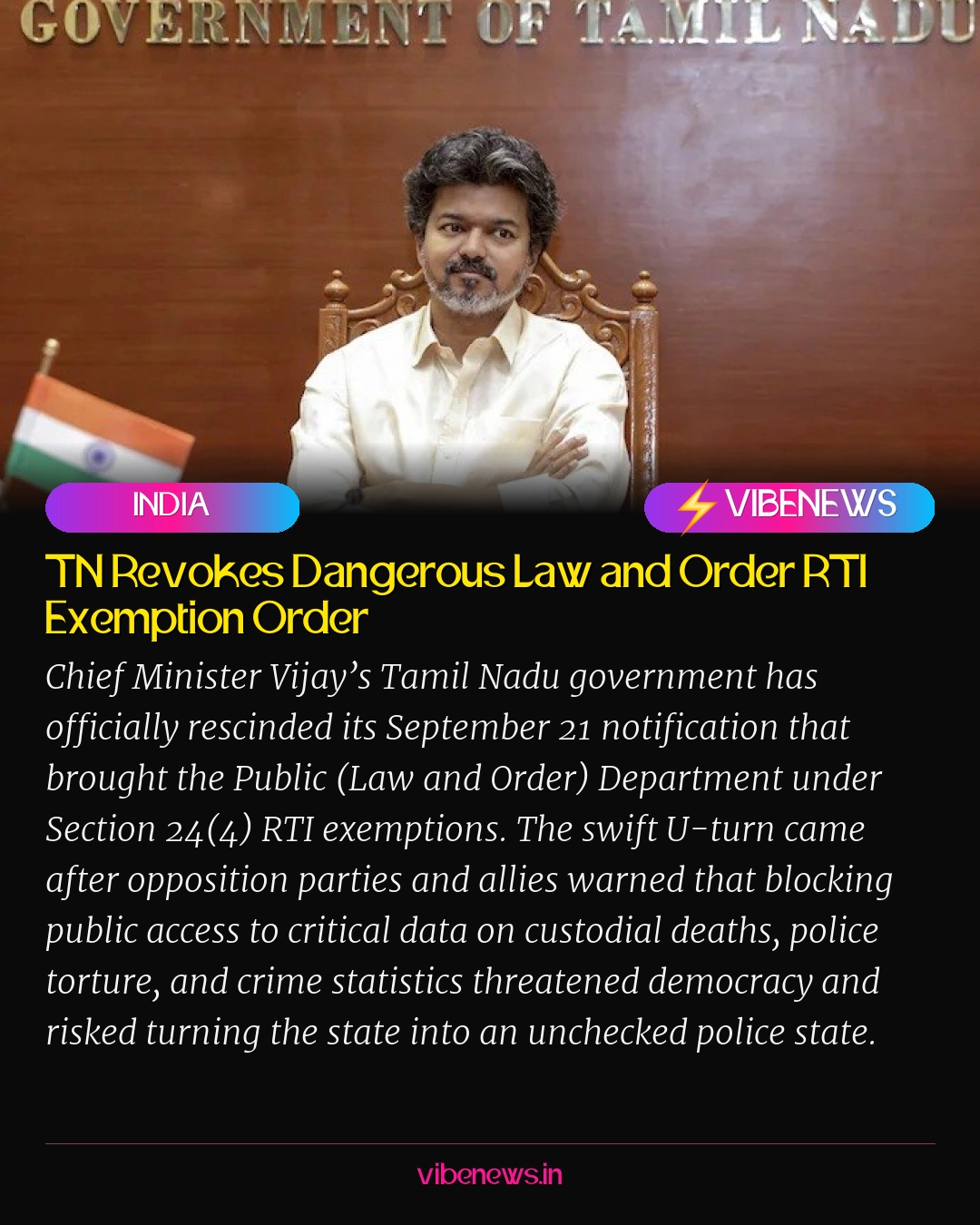

The Tamil Nadu government on Sunday revoked its controversial executive order that exempted the Public (Law and Order) Department from the Right to Information Act following widespread outrage from opposition parties and ruling allies.
Issued on September 21 under Section 24(4) of the RTI Act, the initial directive classified the state’s primary law enforcement administrative body as an intelligence and security agency. This classification effectively erected a legal wall of secrecy around critical police operations, investigative records, and official accountability measures across the state.
An Unprecedented Shield for Severe State Actions
The danger inherent in the original order lay in the exceptionally broad administrative jurisdiction of the Public (Law and Order) Department. By granting it blanket immunity under Section 24(4), the administration threatened to permanently obscure vital documentation regarding severe human rights concerns. Among the sensitive matters shielded from public view were records detailing custodial deaths, allegations of police torture, preventive detention orders, and government handling of caste and communal clashes.
Under statutory provisions, Section 24 of the RTI Act allows governments to exempt specialized intelligence and security organizations from transparency mandates, reserving disclosures only for specific allegations of corruption and human rights violations. However, extending this high-level security umbrella to routine law and order management created a dangerous legal loophole. Critics pointed out that under this system, state overreach, police misconduct, and arbitrary detentions could occur without the possibility of public auditing or institutional check.
Allegations of a Rapidly Escalating "Police State"
The decision to cloak police activities in secrecy ignited immediate resistance from lawmakers who argued that the decree posed an existential threat to civil liberties and constitutional rights. Opposition leaders highlighted ongoing police interventions in public demonstrations, noting that law enforcement personnel had recently entered college campuses to detain protesting students and suppress legitimate public agitations.
Emphasizing the severe threat to state transparency, CPI(M) Member of Parliament S Venkatesan launched a stinging critique against the executive order, cautioning that it compromised fundamental democratic guarantees.
"The police are entering college campuses and arresting students. Struggles for legitimate rights are being suppressed through violence. In this context, exempting law and order matters from the Right to Information Act is deserving of severe condemnation. This is an overt attempt to turn Tamil Nadu into a ‘police state’."
Controversy Over Crime Statistics and Public Oversight
Beyond concerns regarding police brutality, opposition voices argued that removing the Law and Order Department from RTI oversight was specifically engineered to conceal violent crime figures from public examination. The DMK accused Chief Minister Vijay’s TVK administration of misusing legal provisions to hide worsening public safety metrics.
DMK spokesperson Saravanan asserted that the legislative amendment was designed to block public inquiries into crime trends, preventing journalists and citizens from verifying law enforcement performance. Referencing statements made by Leader of the Opposition Udhayanidhi Stalin regarding 500 homicides reported since TVK assumed power, Saravanan stated that the government enacted the exemption specifically to suppress official statistics and prevent detailed public scrutiny.
Government Defense and Final Administration Retreat
Before the revocation was finalized, Education Minister Raj Mohan addressed the controversy by attempting to justify the need for information boundaries. Assuring that freedom of expression remained unthreatened, Mohan argued that a regulatory ‘Lakshman Rekha’ was essential to prevent state data from being manipulated for political gain.
However, facing mounting criticism from both political opponents and its alliance partner, the TVK-led government executed a complete reversal within hours. The Human Resources Management Department issued a fresh administrative notification confirming that the September 21 order "stood revoked," officially restoring the Public (Law and Order) Department under the purview of the Right to Information Act.
TL;DR
- Tamil Nadu revoked an executive order exempting the Public Law and Order Department from the RTI Act.
- The September 21 notification had classified the law enforcement body alongside intelligence and security agencies.
- Critics warned the secrecy order shielded police torture, custodial deaths, and campus arrests from scrutiny.
- DMK leaders alleged the amendment aimed to conceal crime statistics, including over 500 reported murders.
- The Human Resources Management Department formally issued a notification declaring the exemption stood revoked.