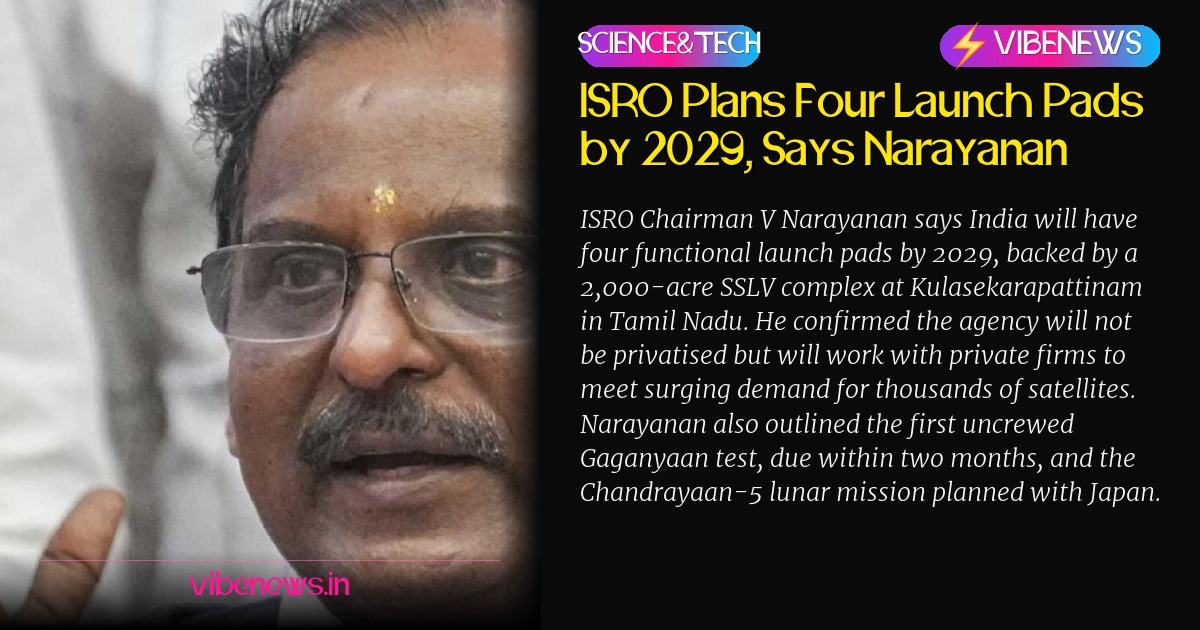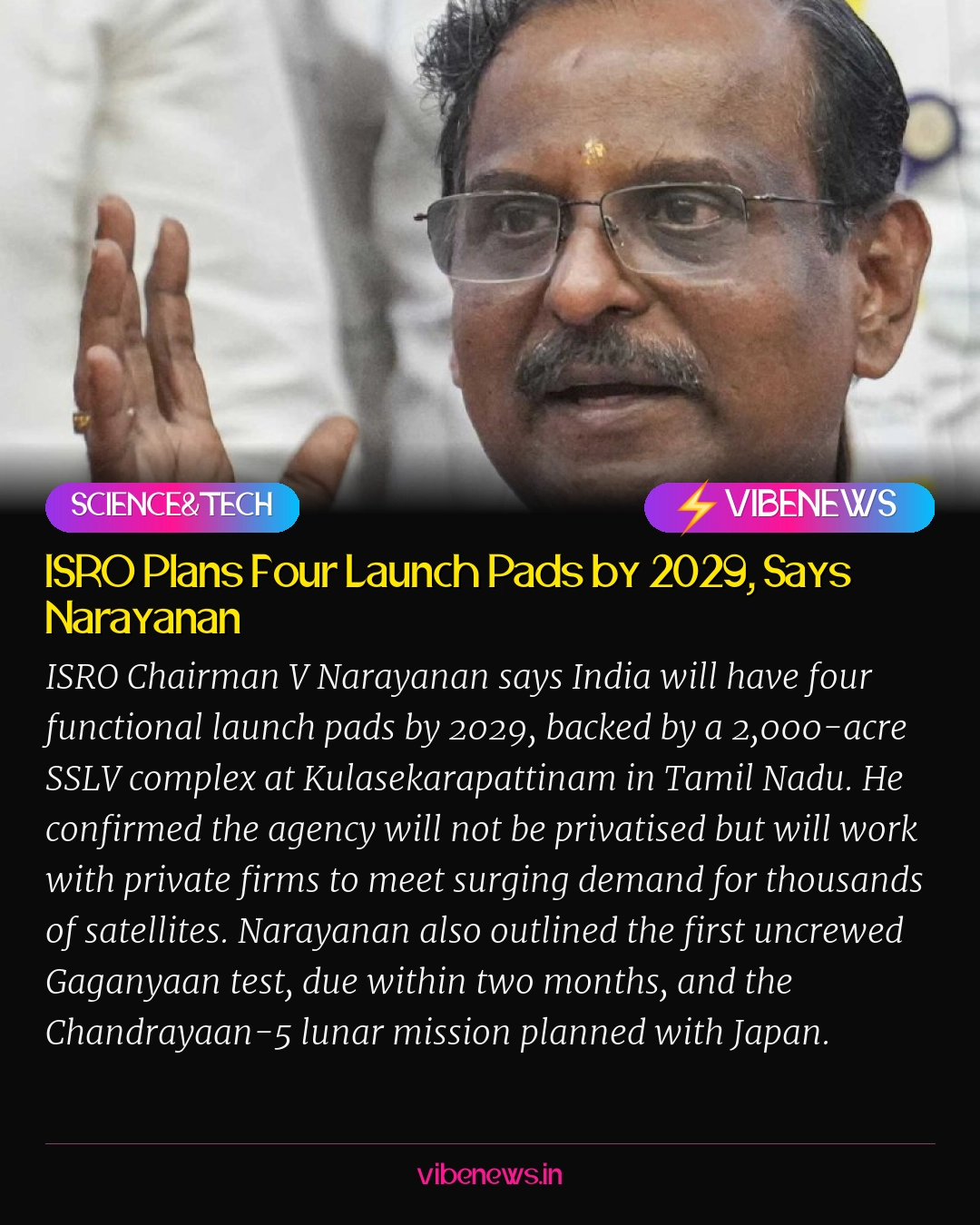
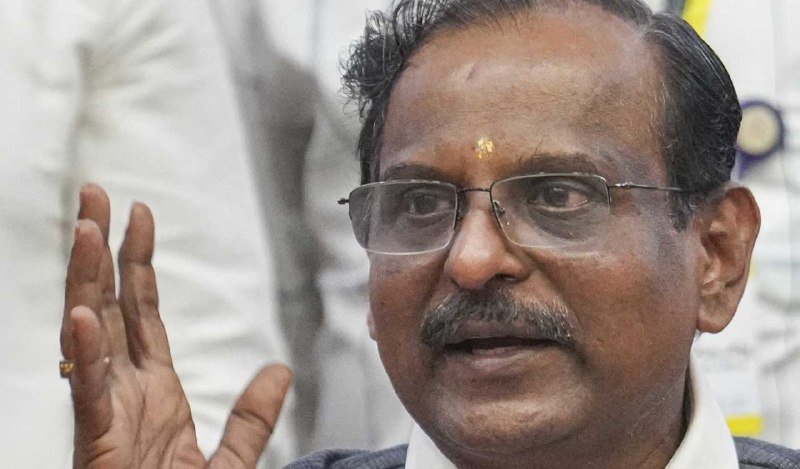
ISRO will have four functional launch pads by 2029, Chairman V Narayanan said in Chennai, laying out an aggressive expansion roadmap for India’s space agency.
Speaking at a graduation ceremony at a private university in Chennai on Saturday, Narayanan said the country will expand its space operations significantly, with private industry playing a bigger role in commercial work. The plan centres on a 2,000-acre dedicated Small Satellite Launch Vehicle (SSLV) complex at Kulasekarapattinam in Tuticorin district, Tamil Nadu, built to meet growing global demand for satellite deployment.
Private players, but no privatisation
Narayanan was quick to clarify one point. ISRO is not being privatised. The agency, he said, needs private firms because demand for satellites, both global and domestic, has surged to the point where thousands of them must be deployed. That partnership model is also meant to build an industrial base at home.
“To handle this expanding ecosystem, ISRO will handhold startups and private enterprises, transferring technological expertise to foster economic growth and generate thousands of high-tech jobs,” he said.
“To handle this expanding ecosystem, ISRO will handhold startups and private enterprises, transferring technological expertise to foster economic growth and generate thousands of high-tech jobs.”
Inside the Kulasekarapattinam spaceport
The upcoming spaceport will not be a bare launch site. Narayanan said it will feature integration buildings, launch pads, rail-track systems, and telemetry, tracking and command systems. Together, those components are what make a spaceport capable of handling a growing launch schedule rather than a handful of missions a year.
The four launch pads by 2029 are the centrepiece of that build-out. Narayanan framed them as the foundation for India’s expanded operations, supported by a rising reliance on private partners to run commercial work.
Gaganyaan moves toward its first test
The Gaganyaan programme is next in line. ISRO plans to conduct the first uncrewed Gaganyaan test within the next two months. Two more uncrewed tests will follow before any crewed flight.
Narayanan said these tests are designed to check the systems that matter most for human spaceflight. They will evaluate environmental control, safety systems, crew escape mechanisms and module interiors under varying pressure, temperature and humidity conditions.
Groundwork is already substantial. The chairman said ISRO has successfully completed approximately 8,000 ground-based experiments for the mission. Four astronaut-designates are currently undergoing specialised training.
Chandrayaan-5 looks to the Moon with Japan
Narayanan also revealed plans for Chandrayaan-5, a collaborative lunar mission with Japan’s space agency. The mission will feature a 350-kg rover designed to conduct 100 days of surface experiments on the Moon.
Taken together, the announcements show ISRO planning across several fronts at once: launch infrastructure on Indian soil, a commercial partnership model with private industry, a crewed spaceflight programme moving through its test phase, and an international lunar mission. For space enthusiasts and anyone tracking India’s rise in the global space race, the timelines are the story. Four launch pads by 2029, three uncrewed Gaganyaan tests before a crewed flight, and a 100-day rover mission on the Moon are concrete markers that can be checked against what ISRO delivers next.
TL;DR
- ISRO plans four functional launch pads by 2029, anchored by a 2,000-acre SSLV complex in Tamil Nadu.
- Chairman V Narayanan says ISRO is not being privatised, but will rely on private firms to meet surging satellite demand.
- The first uncrewed Gaganyaan test is planned within two months, followed by two more uncrewed tests before the crewed mission.
- Approximately 8,000 ground-based Gaganyaan experiments have been completed, and four astronaut-designates are in specialised training.
- Chandrayaan-5, a lunar mission with Japan, will carry a 350-kg rover for 100 days of surface experiments.