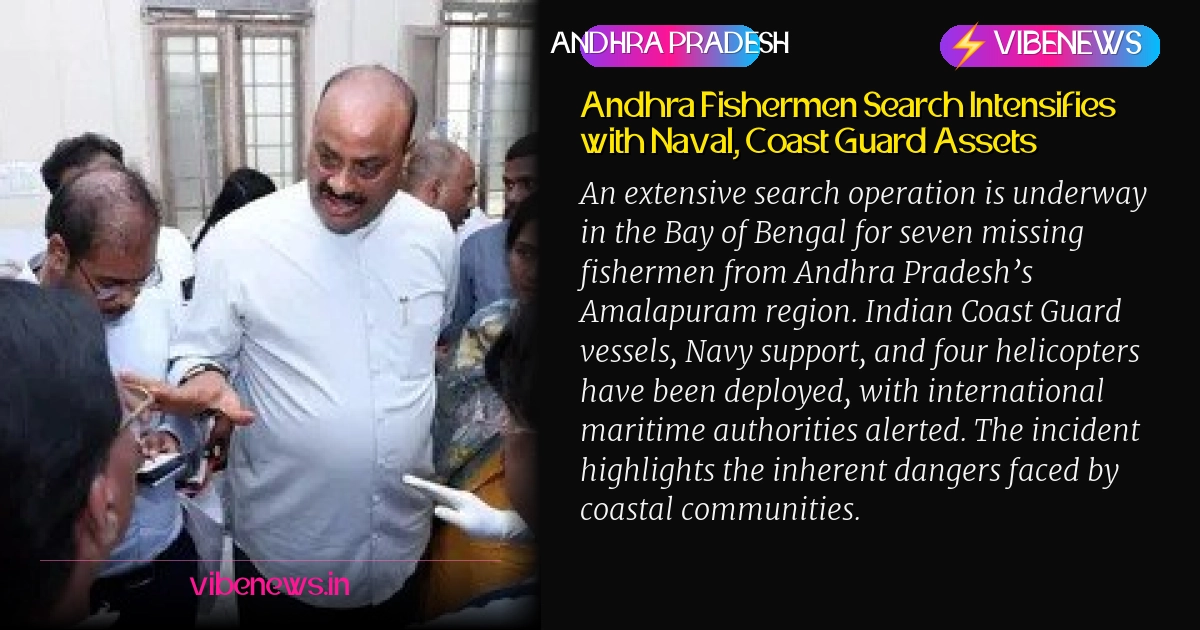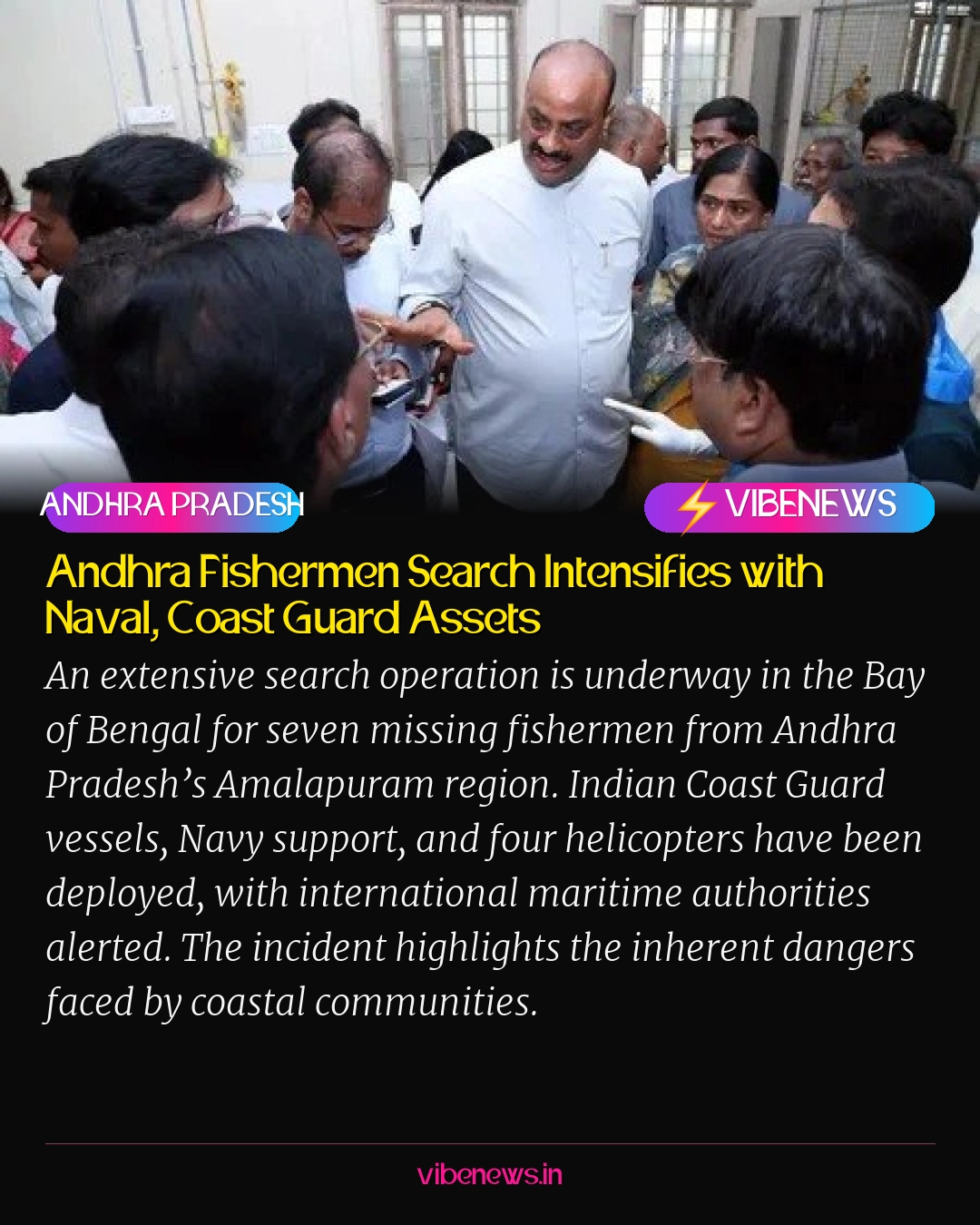

An urgent and extensive search operation is currently underway in the Bay of Bengal to locate seven fishermen from the Amalapuram region of Andhra Pradesh who have been missing for weeks. The coordinated effort involves a significant deployment of assets from the Indian Coast Guard (ICG) and the Indian Navy, with crucial support from the Central Government.
Minister for Agriculture and Fisheries, Kinjarapu Atchannaidu, confirmed the intensified search, detailing the deployment of 15 Coast Guard vessels and four helicopters. This robust response underscores the gravity of the situation and the government’s commitment to finding the missing individuals.
Heightened Alert and Coordinated Response
The Union Ministry of Defence elevated the alert level for the Indian Coast Guard following a direct intervention by Amalapuram MP Harish Balayogi. The MP met with Union Defence Minister Rajnath Singh to discuss the ongoing search efforts, prompting a swift and decisive response from central authorities.
Directives from the Deputy Director General (Operations) at ICG headquarters have mobilised both the Eastern and North-Eastern Commands in Kolkata. This broad coordination ensures that all available resources are being leveraged across a wide maritime area, reflecting the potential for the boat to have drifted significantly.
Minister Atchannaidu further disclosed that the 15 ICG vessels and four helicopters, strategically stationed in nearby waters, were deployed to expand the search grid. This multi-pronged approach aims to accelerate the operation and cover a vast expanse of the Bay of Bengal, a notoriously challenging environment for search and rescue missions.
Electronic Surveillance and International Alerts
Beyond physical deployment, electronic surveillance is being conducted simultaneously under the meticulous supervision of the Marine Rescue Coordination Center (MRCC). This technological assistance provides crucial data, helping to track potential drift patterns and identify any signals from the missing vessel.
Recognising the vastness of the Bay of Bengal and the influence of ocean currents, maritime authorities in neighbouring Myanmar and Bangladesh have also been formally alerted. This international outreach is a critical step, keeping open the possibility that the missing boat might have drifted into foreign territorial waters, necessitating cross-border cooperation.
The fishermen, hailing from the Ambedkar Konaseema district, embarked on their fishing expedition into the Bay of Bengal on August 3. They were originally scheduled to return to shore by August 12, making their disappearance a matter of growing concern as the days turn into weeks.
Investigating Possibilities and Environmental Factors
The Indian Coast Guard is actively investigating several possibilities regarding the fate of the missing boat. These include the vessel drifting into foreign waters due to strong currents or becoming stranded at sea as a result of a technical engine failure, a common hazard for fishing boats operating far from shore.
Authorities are continuously analysing information received from various maritime sources, complementing the electronic surveillance efforts by the MRCC. This comprehensive data analysis is vital for refining search patterns and allocating resources effectively in a dynamic marine environment.
The search operation meticulously considers a range of environmental factors, including prevailing ocean currents, wind direction and speed, and current weather conditions. Furthermore, the typical routes taken by fishermen in the region are being factored into the search strategy, allowing for a more targeted and efficient deployment of assets.
The search area has been extensively expanded to include Diamond Harbour, the Sundarbans, and the surrounding marine areas. This wide geographical scope reflects the challenges of locating a small vessel in a vast and often unforgiving sea, especially after an extended period.
Minister Atchannaidu reiterated that the state government is maintaining constant vigilance over the situation. It is actively coordinating with central government departments, ensuring that every available avenue and resource is being utilised in the urgent effort to bring the missing fishermen back safely to their families.
Editorial Context
The disappearance of these seven fishermen from Andhra Pradesh is more than an isolated incident; it underscores the persistent vulnerabilities faced by coastal communities whose livelihoods are inextricably linked to the sea. The Bay of Bengal, while a source of sustenance, is also a formidable and unpredictable environment, prone to sudden weather changes and powerful currents.
This event highlights the critical need for enhanced safety protocols, advanced communication systems, and robust tracking technologies for fishing vessels, particularly those venturing into deep waters. While government agencies like the ICG and Navy demonstrate commendable response capabilities, the long-term solution involves proactive measures to equip and train fishermen for emergencies.
Furthermore, the involvement of international maritime authorities from Myanmar and Bangladesh points to the necessity of seamless cross-border cooperation in search and rescue operations. Maritime boundaries often become irrelevant in the face of natural disasters or distress at sea, demanding a unified regional approach to ensure the safety of all seafarers.
For the families of the missing, each passing day brings increased anxiety and uncertainty. This incident serves as a poignant reminder of the human cost of maritime risks and the ongoing responsibility of governments to protect their citizens, particularly those engaged in hazardous occupations that form the backbone of local economies.
TL;DR
- Seven fishermen from Andhra Pradesh’s Amalapuram region have been missing since August 3, prompting an intensified search.
- The Indian Coast Guard has deployed 15 vessels and four helicopters, with support from the Indian Navy and Central Government.
- Amalapuram MP Harish Balayogi’s meeting with Union Defence Minister Rajnath Singh led to a heightened alert level for the ICG.
- Electronic surveillance by the MRCC and alerts to maritime authorities in Myanmar and Bangladesh are part of the extensive search.
- Authorities are investigating possibilities including drifting into foreign waters or engine failure, considering ocean currents and weather.
- The search area spans Diamond Harbour, the Sundarbans, and surrounding marine regions, reflecting the broad scope of the operation.