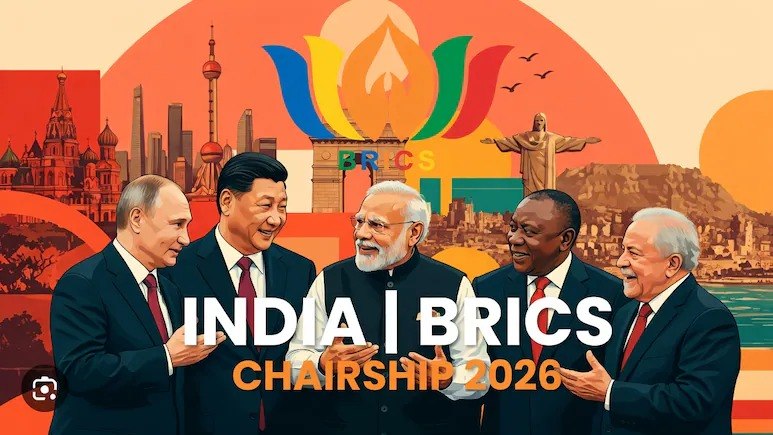
Diplomatic Leverage at Bharat Mandapam
As world leaders assemble at Bharat Mandapam for the 18th BRICS Summit this weekend, host nation India is strategically using its chairship to press for significant economic recalibration. New Delhi has placed a firm request on the table, demanding easier market access and equitable trade conditions across the bloc it helped found. Behind this diplomatic push lies a rapidly expanding yet remarkably lopsided commercial relationship among member countries.
Fresh economic data highlights that India’s trade deficit with BRICS partner nations widened dramatically to $226.1 billion in FY2025-26. While overall bilateral trade with the grouping reached approximately $417.5 billion—more than doubling the roughly $203 billion recorded five years prior in FY2020-21—the surging flow of goods has disproportionately favored foreign suppliers over domestic exporters.
Analyzing the Asymmetric Trade Reality
A calendar-year analysis published by Rubix Data Sciences further underscores this structural imbalance, placing India’s BRICS trade deficit at $224 billion for CY2025, up sharply from $117 billion in CY2021. According to research from the Delhi-based Global Trade Research Initiative (GTRI), India’s expanding reliance on Chinese industrial inputs presents a distinct structural risk, even as strong services exports and steady remittance inflows continue to cushion the nation’s broader macroeconomic standing.
A closer look at the trade metrics reveals that while Indian exports to the bloc grew by 48.8 per cent to reach $95.7 billion, imports expanded at a far steeper trajectory of 131.8 per cent, climbing to $321.8 billion. Consequently, the expanded BRICS grouping currently absorbs only about 22 per cent of India’s total global exports, while supplying over 40 per cent of its total import volume. Correcting this stark gap stands as a primary objective for Indian negotiators during the summit proceedings.
Country-Specific Dynamics: Energy, Inputs, and Trade Balances
The trade balance breakdown for FY2025-26 demonstrates that commercial realities vary wildly across the expanded 11-member alliance, which now encompasses Middle Eastern energy producers and African economies following its 2024-25 expansion. China accounts for approximately half of India’s overall deficit with the bloc, followed closely by Russia. Conversely, India maintains rare trade surpluses with partners such as Egypt and Ethiopia, proving that intra-bloc relations remain highly nuanced.
Industry experts emphasize that viewing these widening figures solely through a negative lens obscures the underlying structural narrative of regional integration.
"India’s widening trade deficit with BRICS should not be read merely as evidence of an unhealthy commercial relationship; it is better understood as a reflection of the asymmetry in India’s current economic integration with the grouping... India is becoming increasingly important as a market for BRICS suppliers without yet securing a comparable position as a supplier to the bloc," stated Sohom Banerjee, founder of advisory and research firm Quantive Advisory LLP.
Banerjee highlights that the massive deficit with Russia primarily stems from sustained purchases of discounted crude oil, which have significantly reinforced India’s energy security following global oil market disruptions. Similarly, the trade deficit with the UAE reflects heavy commodity and energy imports alongside rapidly accelerating bilateral commerce, rather than industrial vulnerability.
However, the commercial dynamic with China presents a far more complex industrial challenge. Imports from China exceed $130 billion against Indian exports of under $20 billion, heavily concentrated in machinery, electronics, components, chemicals, and essential industrial inputs integral to Indian manufacturing plants. Because these materials feed directly into domestic production, imposing broad tariffs could inadvertently penalize Indian factories and hinder domestic manufacturing ambitions.
Path Forward: Structural Integration and Market Access
While BRICS was originally established to serve as a multipolar political counterbalance to Western-dominated global institutions, the group remains commercially asymmetric. China functions as the central manufacturing core of the bloc, while other member economies occupy more peripheral positions within intra-BRICS value chains.
As the alliance moves toward deeper operational integration—including digital trade corridors, localized currency settlements, streamlined cross-border payments, and enhanced logistics connectivity—there is an underlying risk that these mechanisms could entrench India’s reliance unless matched by swift enhancements in export competitiveness. To prevent this outcome, India is advocating during summit sessions for targeted, sector-specific agreements, mutual recognition of standards, accelerated customs procedures, and the removal of non-tariff barriers in key sectors such as pharmaceuticals, engineering goods, automobiles, food processing, chemicals, and digital services.
Ultimately, the true benchmark of success for India’s chairship will not depend solely on immediate changes in trade deficit figures, but on whether New Delhi can successfully transition from being primarily a consumption market into a high-value manufacturing supplier within BRICS supply chains.
TL;DR
- World leaders gather at Bharat Mandapam for the 18th BRICS Summit hosted under India’s chairship.
- India’s trade deficit with BRICS partners expanded to $226.1 billion in FY2025-26 out of $417.5 billion total trade.
- China and Russia remain the primary contributors to India’s widening commercial imbalance within the bloc.
- Imports from BRICS expanded by 131.8 percent to $321.8 billion while exports reached $95.7 billion.
- India is advocating for mutual standards recognition and reduced non-tariff barriers in key export sectors.